Types of Specialized Investment Funds (SIF): Detailed Guide

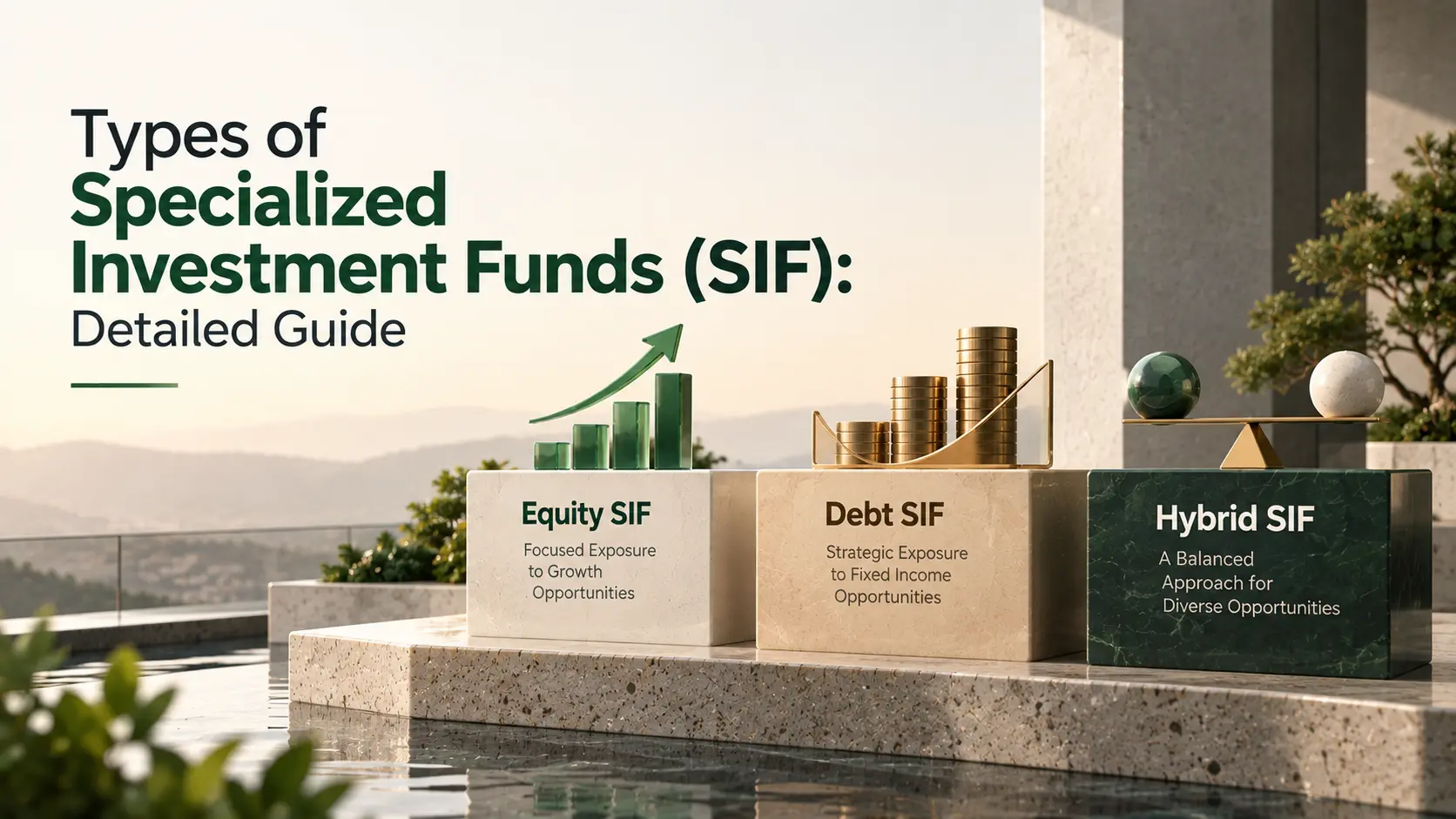
Stop treating all Specialized Investment Funds like they are the same animal. They are not.
An Equity Long Short SIF is a completely different beast from a Hybrid Active Asset Allocator SIF. They carry different risk profiles, they hunt for returns in different markets, and they are taxed completely differently. If you invest in a SIF without understanding its exact strategy type, you are flying blind.
Key Takeaways
- The main types of SIF funds in India are equity-oriented, debt-oriented, and hybrid.
- Equity SIFs are further divided into Long Short, Ex Top 100 Long Short, and Sector Rotation Long Short strategies.
- SEBI permits all SIF types to take an unhedged short exposure of up to 25 percent of their net assets.
- Debt SIFs focus on fixed income arbitrage, while Hybrid SIFs dynamically shift capital across equity, debt, commodities, and REITs.
- Taxation of SIFs depends on their underlying asset allocation, not their strategy names.
- SIF structures can be open-ended, closed-ended, or interval funds, dictating how easily you can withdraw your capital.
Table of Contents
Click to Expand
- How SEBI Classifies SIF Funds
- Equity Oriented SIFs: The Alpha Hunters
- Debt-Oriented SIFs: The Yield Extractors
- Hybrid SIFs: The Multi Asset Masters
- SIF Structure: Open-Ended vs. Interval Funds
- The Taxation Reality Across SIF Types
- The Vestbox Case Study: Matching Strategy to Investor
- Frequently Asked Questions
How SEBI Classifies SIF Funds
SEBI introduced the Specialized Investment Fund framework through a circular dated February 27, 2025, to give affluent investors access to institutional-grade strategies. You can review the framework in SEBI's February 2025 SIF Circular.
SEBI classifies SIFs into three broad categories based on the underlying asset class:
Equity-Oriented SIFs, Debt-Oriented SIFs, and Hybrid SIFs
Within these three categories, fund managers deploy distinct strategies, such as long-short positioning, sector rotation, and active asset allocation.
To understand the exact mechanics of these derivative strategies, read our guide on SIF Strategies: How long-short arbitrage derivatives work.
Equity Oriented SIFs: The Alpha Hunters
An Equity SIF aims to generate long-term capital appreciation by investing in listed stocks, but with a massive twist.
Unlike a standard mutual fund that makes money only when the market goes up, an Equity SIF can legally short sell overvalued stocks to protect the portfolio.
SEBI permits Equity SIFs to take an unhedged short exposure of up to 25 percent of their net assets. This means the fund can hold 100 percent in long equity positions, and simultaneously hold 25 percent in short derivative positions, resulting in a net long exposure of 75 percent.
There are three distinct subtypes within this category:
Equity Long Short Funds:
This is the broadest and most common strategy. The fund manager can buy high-conviction stocks across any market capitalization while shorting weak stocks in the same sector through derivatives.
SEBI mandates at least 80% allocation to equities.
Equity Ex Top 100 Long Short Funds:
This strategy completely ignores the giant large-cap stocks.
It hunts for pricing inefficiencies in the mid-cap and small-cap space, where algorithms and institutional research can find hidden alpha.
SEBI requires at least 65% of the allocation to be in stocks outside the top 100 by market capitalization.
Sector Rotation Long Short Funds:
This is a highly aggressive strategy.
The fund manager concentrates capital in up to four high-potential sectors, such as Auto, Pharma, and IT.
They can rotate capital between these sectors based on economic cycles, and even short entire sectors if they believe a specific industry is about to crash.
Debt-Oriented SIFs: The Yield Extractors
While Equity SIFs capture the spotlight, Debt SIFs are quietly becoming powerful tools for conservative HNIs.
These funds invest primarily in fixed-income instruments, such as bonds and government securities.
A Debt SIF can take short positions in the debt market using exchange-traded debt derivatives.
If a fund manager expects interest rates to rise and bond prices to fall, they can short debt derivatives to profit from the decline.
There are two subtypes here:
- Debt Long Short Funds: Invest across debt instruments of various durations, with a maximum 25 percent unhedged short exposure.
- Sectoral Debt Long Short Funds: Invest in debt instruments from at least two distinct sectors, with a maximum 75 percent limit in any single sector to avoid concentration risk.
Hybrid SIFs: The Multi Asset Masters
Hybrid SIFs are the most flexible and complex structures in the SIF universe.
They are not restricted to just equity or debt.
They can dynamically allocate capital across equity, debt, REITs, InvITs, and even commodity derivatives, choosing whichever offers the best risk-adjusted opportunities.
There are two subtypes in this category:
Active Asset Allocator Long Short Funds
This is the ultimate institutional strategy.
The fund manager has no fixed minimum allocation to any single asset class.
If equities look risky, they can move 100 percent of the portfolio into debt or commodities.
The only constraint is a maximum 25 percent unhedged short exposure across equity and debt combined.
Hybrid Long Short Funds
Unlike the Active Asset Allocator, this strategy mandates a meaningful allocation to both core asset classes at all times.
SEBI requires at least 25% in equity and 25% in debt.
The manager uses derivatives to hedge around these core holdings.
SIF Structure: Open-Ended vs. Interval Funds
Beyond strategy, SIFs are also classified by how easily you can withdraw your money.
This is a critical factor for HNIs who need liquidity for their businesses.
| Structure | Liquidity | Best For |
|---|---|---|
| Open Ended | Daily redemption available | Investors who need immediate liquidity |
| Close Ended | Fixed maturity of 3 to 5 years | Investors who can lock in capital for long term bets |
| Interval Funds | Redemption only during specific windows | Strategies that require time to unwind complex derivatives |
Most complex Hybrid Long Short strategies are structured as Interval Funds, allowing the manager to execute multi-month derivative plays without the fear of sudden redemptions.
The Taxation Reality Across SIF Types
The taxman does not care about the clever name of your SIF strategy.
The underlying asset allocation dictates SIF taxation, just as it does for standard mutual funds.
To understand the deep math behind this, read our guide on SIF Taxation.
Equity SIFs:
If the fund maintains over 65 percent in domestic equities, you pay 20 percent Short-Term Capital Gains and 12.5 percent Long-Term Capital Gains above the Rs 1.25 lakh exemption limit.
Debt and Hybrid SIFs:
If the fund holds less than 65 percent in equities, all gains are added to your income and taxed at your personal income tax slab rate, regardless of how long you hold it.
The Vestbox Case Study: Matching Strategy to Investor
Let us look at a real-world scenario to see why choosing the wrong SIF type destroys portfolios.
The Client: A 50-year-old business owner with a moderate risk appetite, looking to park Rs 25 Lakhs in a SIF for steady returns.
The Problem: He was advised to invest in an Equity Ex Top 100 Long Short Fund.
Because this strategy focuses entirely on mid- and small-cap stocks, it carried a Level 5 Risk Band.
Based on Vestbox data, when the mid-cap sector faced a sudden 15 percent correction, his concentrated Ex Top 100 SIF amplified the losses, resulting in an estimated drawdown of roughly 22 percent.
He lost Rs 5.5 Lakhs in two months.
The Solution: We intervened and redirected his remaining capital into an Active Asset Allocator SIF.
This strategy dynamically shifted 60 percent of the corpus into fixed income and commodities when equity volatility spiked.
Based on Vestbox data, his estimated post-tax return normalized to a steady 8.5 percent annually, with near-zero drawdown.
He saved his capital simply by matching the right SIF type to his specific risk profile.
To apply this framework to your own wealth, read our guide on How to choose the right SIF.
To see the top-performing funds in each category, explore our list of the Best SIF Funds in India.
Disclaimer: The above scenario is an illustrative study based on expected market behavior and estimated Vestbox data. The figures are approximate and meant strictly for educational purposes to demonstrate portfolio architecture. Actual market returns and fund performance will vary based on real-time conditions.
Frequently Asked Questions
What are the different types of SIFs in India?
The main types of SIFs in India are Equity-Oriented, Debt-Oriented, and Hybrid funds. These are further classified by strategy, including Long-Short, Ex-Top 100, Sector Rotation, and Active Asset Allocation.
What is an Equity SIF?
An Equity SIF primarily invests in equity and equity-related instruments. It uses unhedged derivatives to short overvalued stocks, generating alpha and protecting the portfolio during market crashes.
What is a Debt SIF?
A Debt SIF invests primarily in fixed income instruments and bonds. Its key feature is the ability to take short positions in the debt market using exchange-traded debt derivatives to profit from rising interest rates.
What is a Hybrid SIF?
A Hybrid SIF invests across multiple asset classes simultaneously, including equity, debt, REITs, InvITs, and commodity derivatives. It dynamically shifts capital based on market conditions.
What is a Sector Rotation SIF?
A Sector Rotation SIF concentrates capital in up to four high-potential sectors. The manager rotates capital between these sectors based on economic cycles and can short entire sectors using derivatives.
Are SIFs riskier than mutual funds?
Yes, SIFs generally carry higher risk than standard mutual funds because they use complex derivatives, short selling, and concentrated strategies. However, the risk level varies significantly by SIF type.
Can SIFs use derivatives?
Yes. All SIF types share one defining feature: they can use derivatives, including futures and options, not just for hedging but for active alpha generation. SEBI permits an unhedged short exposure of up to 25 percent of net assets.
Want the full overview of SIFs, regulations, and benefits? Explore the complete guide: What are Specialized Investment Funds (SIFs)? How do SIFs work?.
Ready to explore?
SEBI-regulated long-short and hedging strategies designed to capture opportunities in all market conditions.
Disclaimer
Mutual fund investments are subject to market risks. Read all scheme-related documents carefully. Please consult a certified financial advisor before making any investment decisions.
Trust & Compliance
This article has been created following our strict Editorial Policy. We believe in complete transparency regarding how we operate; you can read our Disclosures. For legal liabilities and risk factors, please review our Disclaimer.
Share & Save Article
Other Posts
What is ESOP? A Complete Guide to Employee Stock Ownership Plans
Aug 6, 2026
ESOP Taxation in India: A Complete Guide to Perquisite & Capital Gains Tax
Aug 7, 2026
ESOP vs Equity Shares vs RSU: Understanding Employee Equity
Aug 11, 2026
ESOP vs ESPP: Which Employee Equity Plan is Better?
Aug 11, 2026
