ESOP vs Equity Shares vs RSU: Understanding Employee Equity

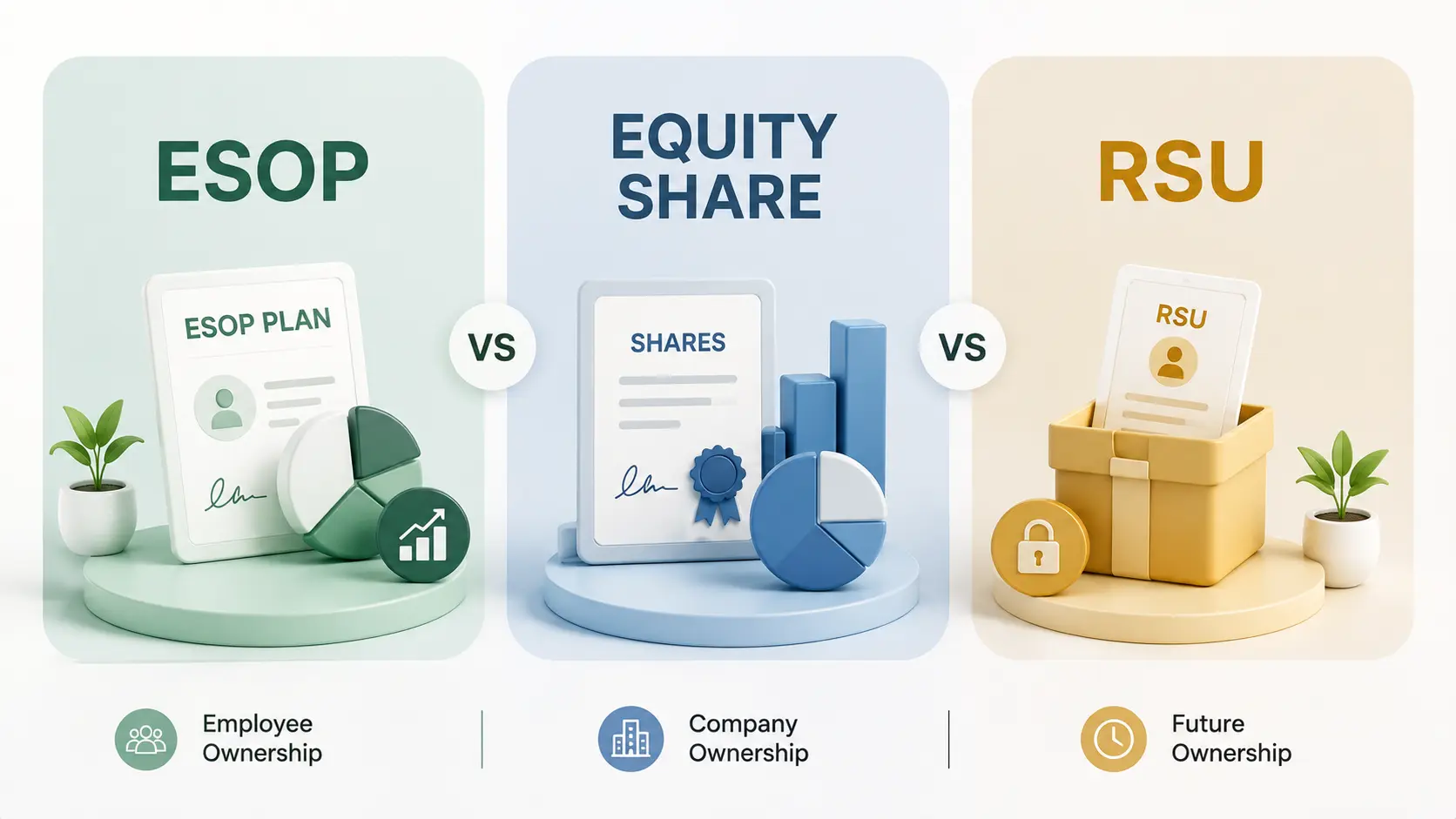
Table of Contents
Click to Expand
- What is an ESOP?
- What is an Equity Share?
- What is an RSU?
- The Master Comparison: ESOP vs Equity vs RSU
- Taxation Differences: The Critical Distinction
- Liquidity and Risk Exposure
- Case Study: The Tech Executive's Offer
- What Happens When You Finally Sell?
- How Vestbox Helps & Why Choose Vestbox
- Conclusion / Final Thoughts
- Frequently Asked Questions
Key Takeaways:
- ESOPs: The right to buy shares at a discounted, locked-in price in the future.
- Equity Shares: Direct, immediate ownership purchased at market price.
- RSUs: A promise to receive actual shares for free after hitting a work milestone.
- Taxation: Equity and RSUs trigger tax based on market price. ESOPs trigger tax based on the discount received.
- Risk: ESOPs and unlisted RSUs carry massive illiquidity and concentration risk.
You get a job offer from a fast-growing tech company. The compensation section looks incredible. But instead of just a salary, they throw confusing terms at you: "We offer equity shares, ESOPs, and RSUs."
Most employees sign the document. They assume all three mean the same thing. They don't.
Mixing up these three instruments can cost you lakhs in taxes and lock your wealth in an illiquid stock for years. Here is the exact structural difference between the three.
What is an ESOP?
ESOP stands for Employee Stock Ownership Plan.
It gives you the right to buy company shares at a heavily discounted price in the future. You do not own the stock today. You only own the option to buy it later.
If the company's valuation skyrockets, you get to buy the stock at the old, lower price. To see the exact timeline for how these options unlock, read our complete guide on What is ESOP.
What is an Equity Share?
An equity share represents direct, fractional ownership in a company.
When you buy equity shares on the stock market (such as the NSE or BSE), you pay the current market price. You own the stock immediately. You can sell it five minutes later if you want.
There are no vesting schedules, no cliffs, and no employer restrictions. It is pure, liquid ownership.
What is an RSU?
RSU stands for Restricted Stock Unit.
An RSU is a promise from your employer to give you actual shares for free, but only after you meet certain conditions. Usually, the condition is staying at the company for a specific number of years.
There is no exercise price. You do not have to pay to buy them. Once the restriction period (vesting) ends, the shares are legally yours.
The Master Comparison: ESOP vs Equity vs RSU
The core difference lies in how you get the shares, what you pay, and when you pay tax on them.
| Parameter | ESOPs | Equity Shares | RSUs |
|---|---|---|---|
| What you get | Right to buy in the future | Immediate ownership | Actual shares after a lock-in |
| Cost to Employee | Heavily Discounted Price | Full Market Price | Free (No cost) |
| Vesting Schedule | Yes (Cliff + Graded vesting) | None | Yes (Usually graded over time) |
| Tax Trigger | When you exercise (buy) | When you sell | When the shares vest (Restriction ends) |
| Primary Risk | Illiquidity and high taxation | Market volatility | Market volatility if stock drops before vesting |
Taxation Differences: The Critical Distinction
Taxation is where employees lose the most money if they don't understand the rules.
● ESOPs: Taxation is a two-stage trap. You pay income tax (Perquisite Tax) on the difference between the Fair Market Value and your discounted exercise price when you buy them. Then you pay Capital Gains Tax when you sell them.
● Equity Shares: You only pay Capital Gains Tax when you sell the shares on the open market.
● RSUs: The moment your RSUs vest, the shares are considered income. You are taxed on the fair market value of the shares at your income tax slab rate. If you hold the actual shares after vesting, you pay Capital Gains Tax only on the growth from the vesting date to the sale date.
The math for ESOPs is brutal. To see the exact formulas, FMV calculations, and the start-up deferral rules, read our deep dive into ESOP Taxation in India.
Liquidity and Risk Exposure
Understanding the paperwork is step one. Understanding the risk is step two.
Listed vs. Unlisted: If you get equity shares, ESOPs, or RSUs in a listed company (like Infosys or TCS), you can usually sell them on the open market once vested. The risk is standard market volatility.
If you get them in an unlisted startup, you are holding illiquid paper. You cannot sell them until an IPO or a secondary sale happens.
Concentration Risk: All three carry concentration risk. If 80% of your net worth is tied up in your employer's stock, whether through ESOPs or RSUs, you are taking a massive gamble. If the company fails, you lose your salary and your net worth simultaneously.
Case Study: The Tech Executive's Offer
Imagine a senior developer gets two job offers.
Offer A (Listed Company): ₹40 Lakhs salary + ₹10 Lakhs in RSUs. The RSUs vest over 4 years. At the end of year 4, the shares are deposited into her Demat account. She pays tax on the market value at vesting, but she can sell them the next day to fund her lifestyle or reinvest.
Offer B (Unlisted Startup): ₹30 Lakhs salary + ESOPs valued at ₹50 Lakhs. The ESOPs look better on paper. But she must wait 4 years to vest. She then has to pay a massive perquisite tax out of her own pocket to exercise them. Then she has to wait for an IPO to receive the funds.
Offer B has higher theoretical upside. But Offer A provides real, liquid wealth in a predictable timeframe. Understanding how ESOPs create wealth requires looking beyond the paper valuation to the actual cash-flow reality.
What Happens When You Finally Sell?
Let's say you navigated the taxes, the vesting periods, and your company finally goes public. You sell your ESOPs or RSUs.
You suddenly have ₹5 Crores in your bank account. This is the most dangerous moment for an employee. Most people leave it in a savings account or dump it into real estate. They replace single-stock risk with asset-class stagnation.
If you are dealing with a multi-crore liquidity event from employee equity, you need institutional management. Standard mutual funds are structurally inefficient for the kind of focused, high-conviction portfolios required at this level.
How Vestbox Helps & Why Choose Vestbox
We help you manage the wealth you build through employee equity, from exercise to exit.
Why choose Vestbox:
● Pre-Exercise Liquidity Check: Before initiating a massive tax event by exercising ESOPs, conduct a structural portfolio review. We will show you if your current investments are leaking tax efficiency and help you identify liquid funds to pay the tax bill.
● Post-Liquidity Diversification: When your RSU or ESOP cash hits your account, we help you replace that single-stock risk. Through Portfolio Management Services in India, we build a focused, actively managed equity portfolio across different sectors. We monitor and rebalance it so your wealth continues to compound safely.
You spent years working for your equity. Don't let poor planning waste the payout.
Ready to institutionalize your wealth? Explore Portfolio Management Services in India and see how professional managers protect your capital.
Conclusion / Final Thoughts
Equity shares, ESOPs, and RSUs are not interchangeable terms.
Equity gives you immediate, liquid ownership. RSUs give you free shares after a waiting period. ESOPs give you the right to buy shares at a discount, but they carry the heaviest tax and cash-flow burdens.
Read your offer letter carefully. Understand exactly which instrument you are getting. And more importantly, understand exactly when the tax man is going to come knocking.
Explore ESOP Services on Vestbox
Frequently Asked Questions
Is RSU better than ESOP?
For most employees, yes. RSUs are simpler. You don't have to pay with personal funds to buy the shares, and there is no complicated perquisite tax calculation. You pay tax on the market value when they vest.
Do I own the shares if I have ESOPs?
No. You only own the right to buy them. You become a shareholder when you actually pay the exercise price and the shares are allotted to you.
Can I sell my ESOPs or RSUs immediately after vesting?
Only if the company is publicly listed; otherwise, if it is an unlisted startup, you cannot sell them until an IPO occurs or the company facilitates a private secondary sale.
Why do companies offer ESOPs instead of just giving RSUs?
Startups prefer ESOPs because they do not want to give away actual equity for free. ESOPs allow the company to retain employees through a vesting schedule without immediately diluting the founder's ownership as aggressively.
Do RSUs have an exercise price like ESOPs?
No. RSUs are granted for free. You do not have to pay an exercise price to convert your RSUs into actual shares.
Disclaimer
Mutual fund investments are subject to market risks. Read all scheme-related documents carefully. Please consult a certified financial advisor before making any investment decisions.
Trust & Compliance
This article has been created following our strict Editorial Policy. We believe in complete transparency regarding how we operate; you can read our Disclosures. For legal liabilities and risk factors, please review our Disclaimer.
Share & Save Article
Other Posts
What is ESOP? A Complete Guide to Employee Stock Ownership Plans
Aug 6, 2026
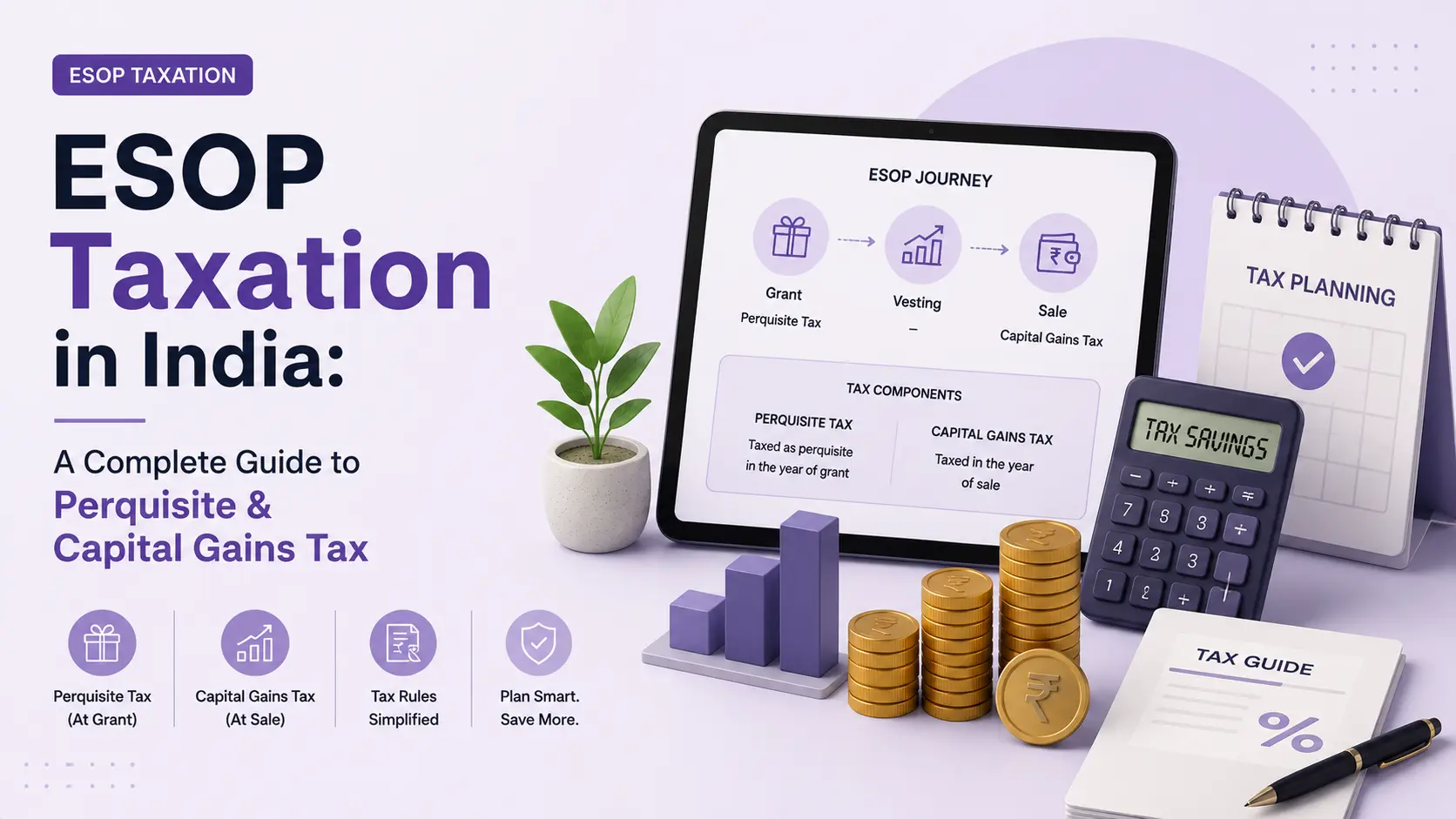
ESOP Taxation in India: A Complete Guide to Perquisite & Capital Gains Tax
Aug 7, 2026
ESOP vs ESPP: Which Employee Equity Plan is Better?
Aug 11, 2026
ESOP Buyback in India: The Ultimate Liquidity Guide
Aug 11, 2026
