What is ESOP? A Complete Guide to Employee Stock Ownership Plans

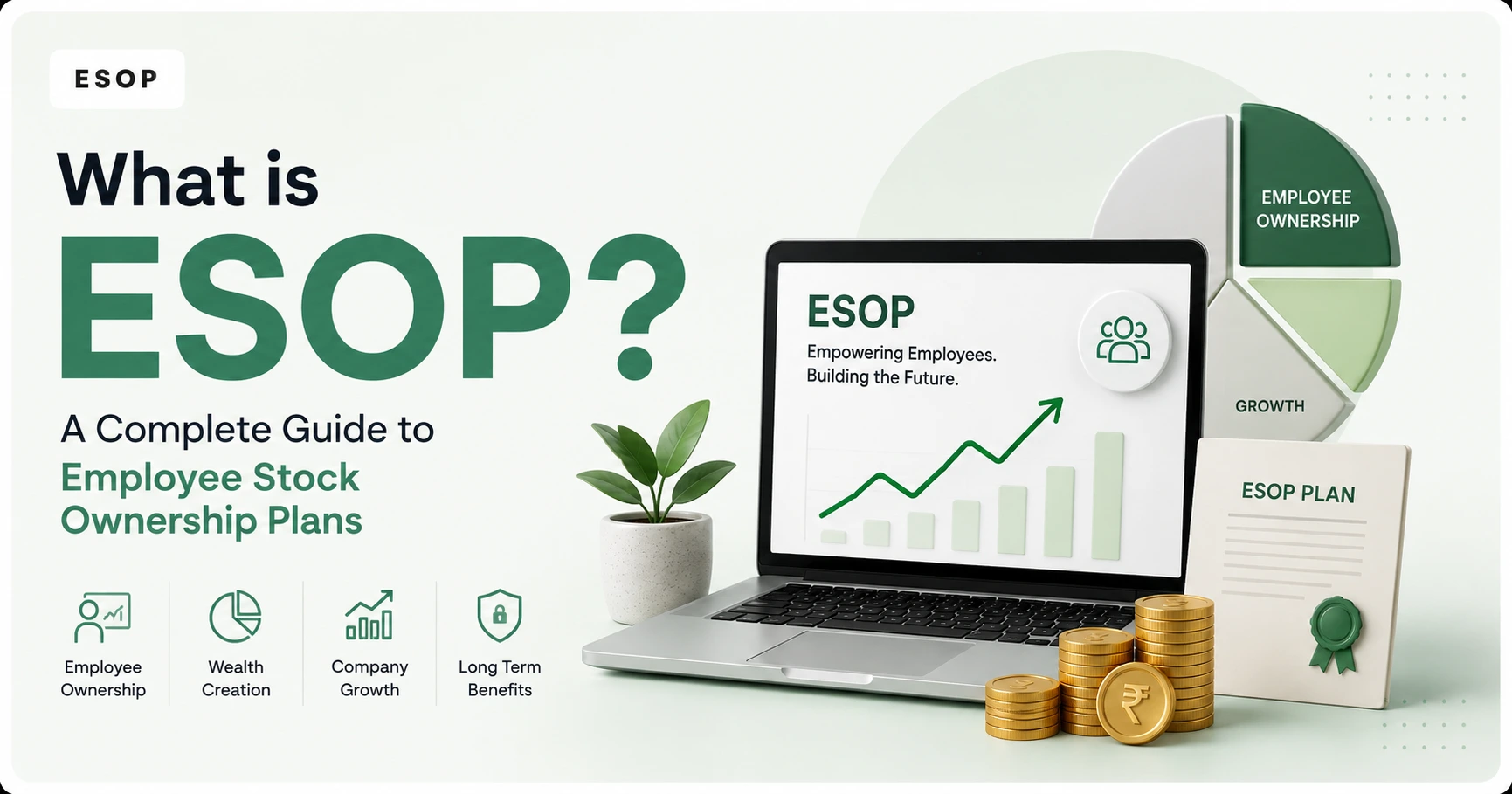
Table of Contents
Click to Expand
- What is the Meaning of ESOP?
- How Does ESOP Work? The Vesting Timeline
- ESOP Valuation Example
- Taxation of ESOPs in India
- The Cash Flow Trap: Funding Your Exercise
- What Happens to ESOPs When You Leave the Company?
- What Happens When the Company is Listed?
- SEBI Rules and Guidelines for ESOPS
- Benefits of ESOPS
- The Hidden Risk of ESOPS
- Other Forms of Employee Equity
- Conclusion / Final Thoughts
- Frequently Asked Questions
Key Takeaways:
- Meaning: ESOP stands for Employee Stock Ownership Plan. It gives employees the right to buy company shares at a discounted price in the future.
- Vesting: You do not get shares on day one. You must wait out a "cliff" and a "vesting schedule" to earn the right to buy them.
- Taxation: ESOPs are taxed twice in India. First as "perquisite" income when you buy them. Second as capital gains when you sell them.
- Risk: ESOPs create massive concentrated wealth, but they are highly illiquid until the company goes public.
What is the Meaning of ESOP?
ESOP stands for Employee Stock Ownership Plan.
Under this plan, a company offers its employees the right to buy its shares at a locked-in, heavily discounted price in the future.
It is critical to understand that an ESOP is not a direct share grant. You do not own the stock immediately. You only own the option to buy it later. If the company grows and the share price skyrockets, you get to buy the stock at the old, lower price. The difference is your profit.
How Does ESOP Work? The Vesting Timeline
Employers do not hand over equity on your first day. The process is strictly timed to retain employees. Here is the standard timeline used by Indian start-ups and corporations:
-
The Grant Date:
The company offers you a specific number of options. For example, 5,000 options at an exercise price of ₹50 per share. -
The Cliff Period:
You must wait a minimum time before any shares vest. In India, this is almost always 12 months. If you quit at month 11, you lose everything. -
The Vesting Schedule:
After the cliff, your shares unlock gradually; usually, 25% of your total grant vests per year over 4 years.- End of Year 1: 1,250 shares vested.
- End of Year 2: 2,500 shares vested.
- End of Year 3: 3,750 shares vested.
- End of Year 4: 5,000 shares vested.
-
The Exercise Period:
Once vested, you have a specific window to purchase the shares. This varies by company, ranging from 90 days after you leave to five years while still employed. -
The Sale:
You buy the shares at the ₹50 exercise price. You then sell them on the open market (during an IPO or a secondary sale) to realize your cash profit.
ESOP Valuation Example
Startups usually communicate ESOP value in Lakhs rather than percentages. Here is how that math works.
- Company Valuation: ₹100 Crore
- Total Shares Issued: 1 Crore
- Price Per Share: ₹100 (Valuation Shares)
- You are granted 5,000 shares.
- Your Initial ESOP Value: 5,000 × ₹100 = ₹5,00,000
If the company raises funding a year later and the valuation doubles, the price per share becomes ₹200. Your ESOP value is now ₹10,00,000. Your wealth grows as the company grows.
Taxation of ESOPs in India
This is where employees lose the most money. ESOP taxation in India happens in two distinct stages.
Stage 1: Tax on Exercise (Perquisite Tax)
When you exercise your options, the difference between the Fair Market Value (FMV) of the share and your exercise price is taxed as a perquisite. This is added to your salary and taxed at your income tax slab rate.
ESOP Tax Calculation Example (Stage 1):
| Parameter | Details |
|---|---|
| Exercise Date | January 1, 2024 |
| Fair Market Value (FMV) | ₹150 per share |
| Your Exercise Price | ₹50 per share |
| Taxable Value (FMV - Exercise) | ₹100 per share |
| Number of Shares Exercised | 1,000 |
| Total Taxable Perquisite | ₹1,00,000 |
| Tax Payable (Assuming 30% Slab) | ₹30,000 |
Note for Start-ups: The government provides tax relief for eligible start-ups. Employees of recognized start-ups can defer paying this perquisite tax until the earlier of: 5 years from the grant date, the date of selling the shares, or the date of leaving the company.
Stage 2: Tax on Sale (Capital Gains Tax)
When you eventually sell the shares, the difference between the Sale Price and the FMV on the date of exercise is subject to Capital Gains Tax.
ESOP Tax Calculation Example (Stage 2):
| Scenario | Details |
|---|---|
| FMV on Exercise Date | ₹150 per share |
| Case 1: Indian company sold after 6 months (Short-Term) | Sale Price ₹160. Gain = ₹10/share. Taxed at 20% STCG |
| Case 2: Foreign company sold after 6 months (Short-Term) | Sale Price ₹160. Gain = ₹10/share. Taxed as per Income Slab |
| Case 3: Sold after 2 years (Long-Term) | Sale Price ₹200. Gain = ₹50/share. Taxed at 12.5% LTCG (exceeding 1.25 Lakh). |
Rule for Unlisted Companies: If the company is unlisted, the shares are considered short-term if sold within 24 months, and long-term if sold after 24 months.
Suggestion: ESOPs are taxed at every stage like vesting, exercise, and sale. Explore the full ESOP Taxation page to stay ahead.
Don't miss this: The right strategy can legally reduce your capital gains tax. Learn how in our complete capital gains guide.
The Cash Flow Trap: Funding Your Exercise
The math looks great on paper. But there is a hidden operational trap.
In many cases, you must pay the exercise price and the perquisite tax out of your own pocket before you are allowed to sell the shares. If your ESOP profit is 1 Crore, you might need to find 30 Lakhs in liquid cash to trigger the transaction.
If you do not have the cash, you cannot exercise. This is why serious investors never treat ESOPs in isolation. They have to plan their liquid savings to ensure they can actually afford to buy the equity they have earned.
What Happens to ESOPs When You Leave the Company?
Your ESOP fate depends entirely on your vesting status.
- Unvested ESOPs: If you resign before the cliff period ends or before shares vest, you lose them. They go back to the company's pool.
- Vested ESOPs: You usually have a limited window (often 30 to 90 days) to exercise your vested options after resigning. If you do not pay the exercise price and buy them in that window, you lose them.
What Happens When the Company is Listed?
Illiquidity is the biggest challenge for unlisted companies. You cannot easily sell your shares because there is no public market for them. Valuations are determined by merchant bankers based on funding rounds.
Once the company goes public Initial Public Offering (IPO), everything changes. You can sell your shares on the open stock exchange. The FMV is determined by company valuation, and the shares are subject to standard equity taxation rules.
SEBI Rules and Guidelines for ESOPS
ESOPs in India are strictly regulated to protect employees. The framework is governed by the Securities and Exchange Board of India (Share Based Employee Benefits) Regulations, 2021.
Key rules include:
- Minimum Lock-in: Employees cannot exercise options within 1 year of the grant.
- Pricing Floor: The exercise price can not be less than the share's face value.
- Company Cap: A company cannot issue ESOPs exceeding 15% of its total paid-up capital without specific shareholder approval.
Benefits of ESOPS
For the Employee:
- Leverage: You get the upside of share price appreciation without putting down massive capital upfront.
- Discounted Entry: You buy the stock at a lower price than outside investors or later VC investors.
For the Employer:
- Retention: The vesting schedule acts as golden handcuffs. Employees cannot leave without leaving massive potential wealth on the table.
- Cash Conservation: Start-ups use ESOPs to attract top talent when they cannot afford high cash salaries.
The Hidden Risk of ESOPS
ESOPs create immense paper wealth, but they carry a massive structural flaw: Concentration Risk.
If you are a senior employee, your salary might be ₹50 Lakhs a year, but you might have ₹3 Crores worth of vested ESOPs. 80% of your net worth is tied to a single, illiquid stock. If the start-up fails, your net worth drops to zero. If you try to manage this risk yourself, emotional attachment to your employer usually prevents you from making rational decisions.
Other Forms of Employee Equity
ESOPs are the most common, but not the only way companies offer equity:
- Restricted Stock Units (RSUs): You are promised actual shares, not an option to buy them. You usually get them as you hit work milestones. No exercise price is required.
- Sweat Equity Shares: Often given to founders or early directors, these are issued at a discount or for non-cash consideration.
Conclusion / Final Thoughts
An ESOP is a powerful wealth creation tool. But it is not a guaranteed lottery ticket.
The mechanics are strict. The taxation is brutal if you do not plan for the perquisite tax hit. Illiquidity requires immense patience. Treat your ESOPs as a highly concentrated, high-risk asset that requires careful financial planning, not a bonus you can spend tomorrow.
Explore ESOP Services on Vestbox
Frequently Asked Questions
What is the simple meaning of ESOP?
ESOP stands for Employee Stock Ownership Plan. It is a company benefit that gives employees the right to buy the company's shares at a locked-in, discounted price in the future.
What is a 1-year cliff in ESOP?
A cliff is a waiting period. A 1-year cliff means you must complete exactly one year of service before any of your ESOPs vest. If you leave at 11 months, you get zero shares.
Do I have to pay tax when my ESOPs vest?
No. In India, you do not pay tax when the shares vest. You only pay tax when you actually "exercise" (buy) the shares. The difference between the Fair Market Value and your exercise price is taxed as income.
Can I sell my ESOPs immediately after exercising?
Only if the company is publicly listed. If it is an unlisted start-up, you cannot sell them easily until an IPO happens or the company facilitates a secondary sale.
What is the difference between ESOP and RSU?
An ESOP gives you the right to buy shares at a fixed discounted price later. An RSU gives you actual shares for free once you hit a work milestone. With ESOP, you pay to play. With RSU, it is a direct grant.
What happens to my ESOPs if I quit my job?
Your unvested ESOPs are forfeited immediately. Your vested ESOPs usually have a small exercise window (like 30 to 90 days). If you don't buy them in that window, you lose them.
Disclaimer
Mutual fund investments are subject to market risks. Read all scheme-related documents carefully. Please consult a certified financial advisor before making any investment decisions.
Trust & Compliance
This article has been created following our strict Editorial Policy. We believe in complete transparency regarding how we operate; you can read our Disclosures. For legal liabilities and risk factors, please review our Disclaimer.
Share & Save Article
Other Posts
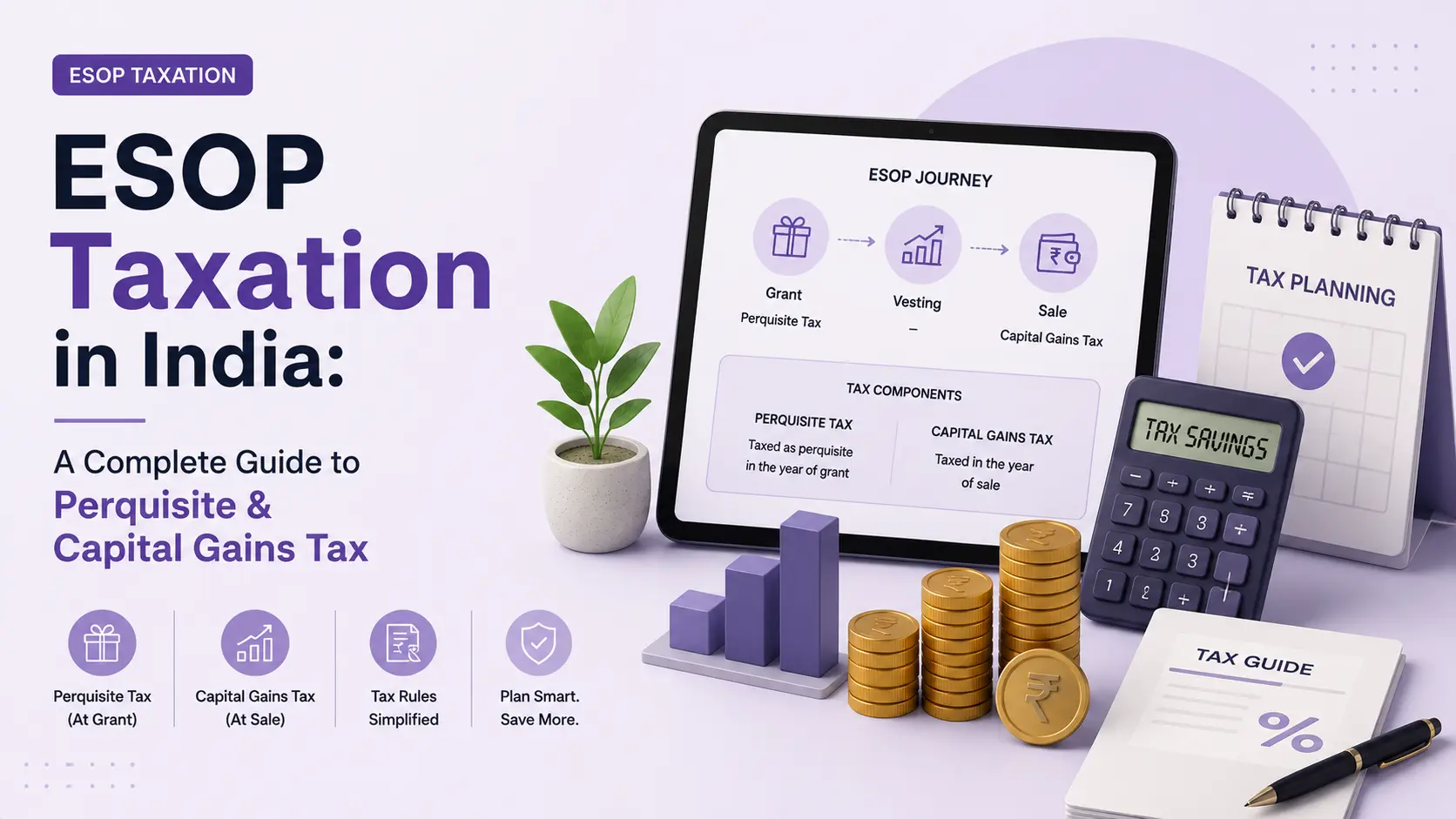
ESOP Taxation in India: A Complete Guide to Perquisite & Capital Gains Tax
Aug 7, 2026
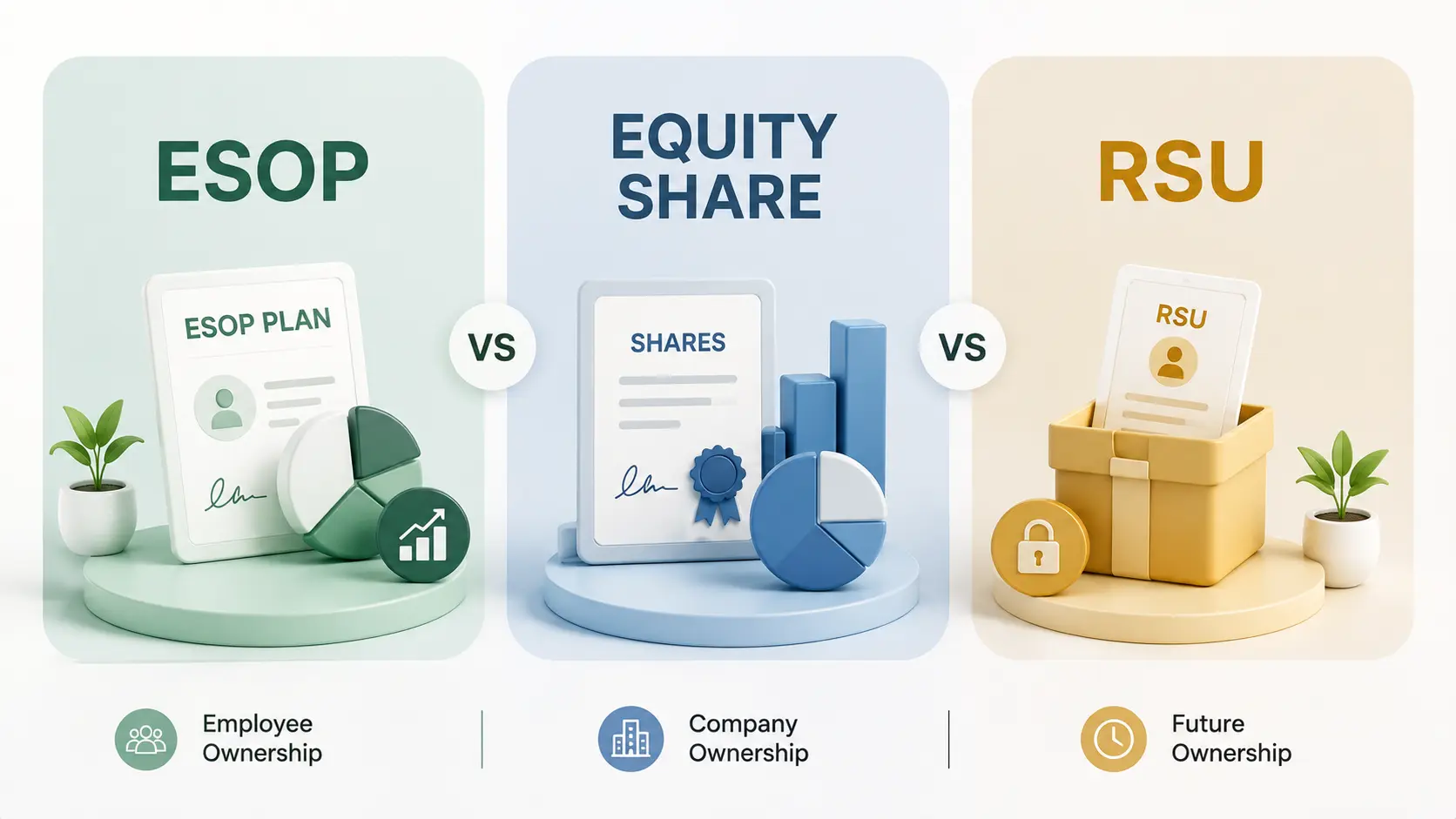
ESOP vs Equity Shares vs RSU: Understanding Employee Equity
Aug 11, 2026
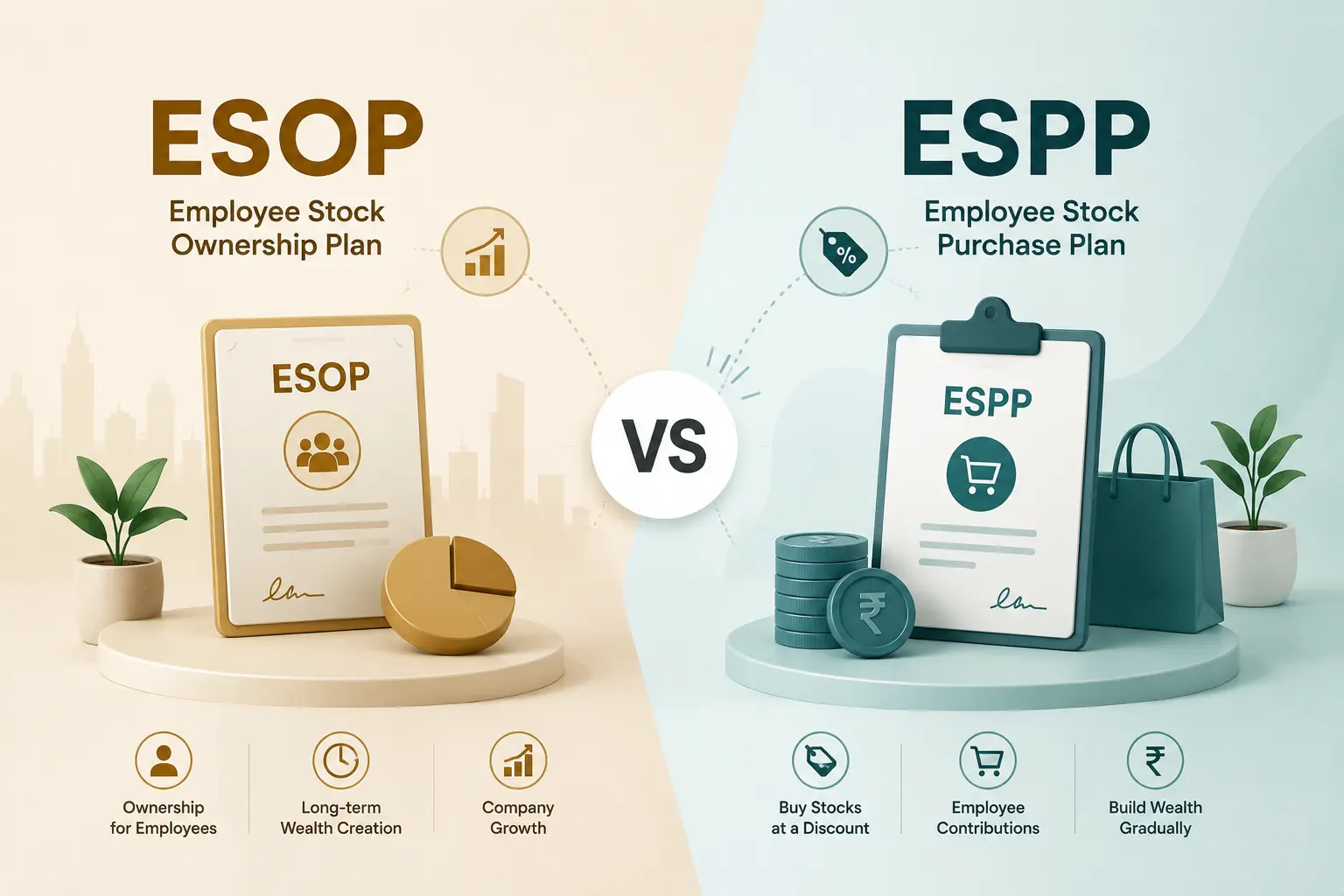
ESOP vs ESPP: Which Employee Equity Plan is Better?
Aug 11, 2026
ESOP Buyback in India: The Ultimate Liquidity Guide
Aug 11, 2026
