ESOP Taxation in India: A Complete Guide to Perquisite & Capital Gains Tax

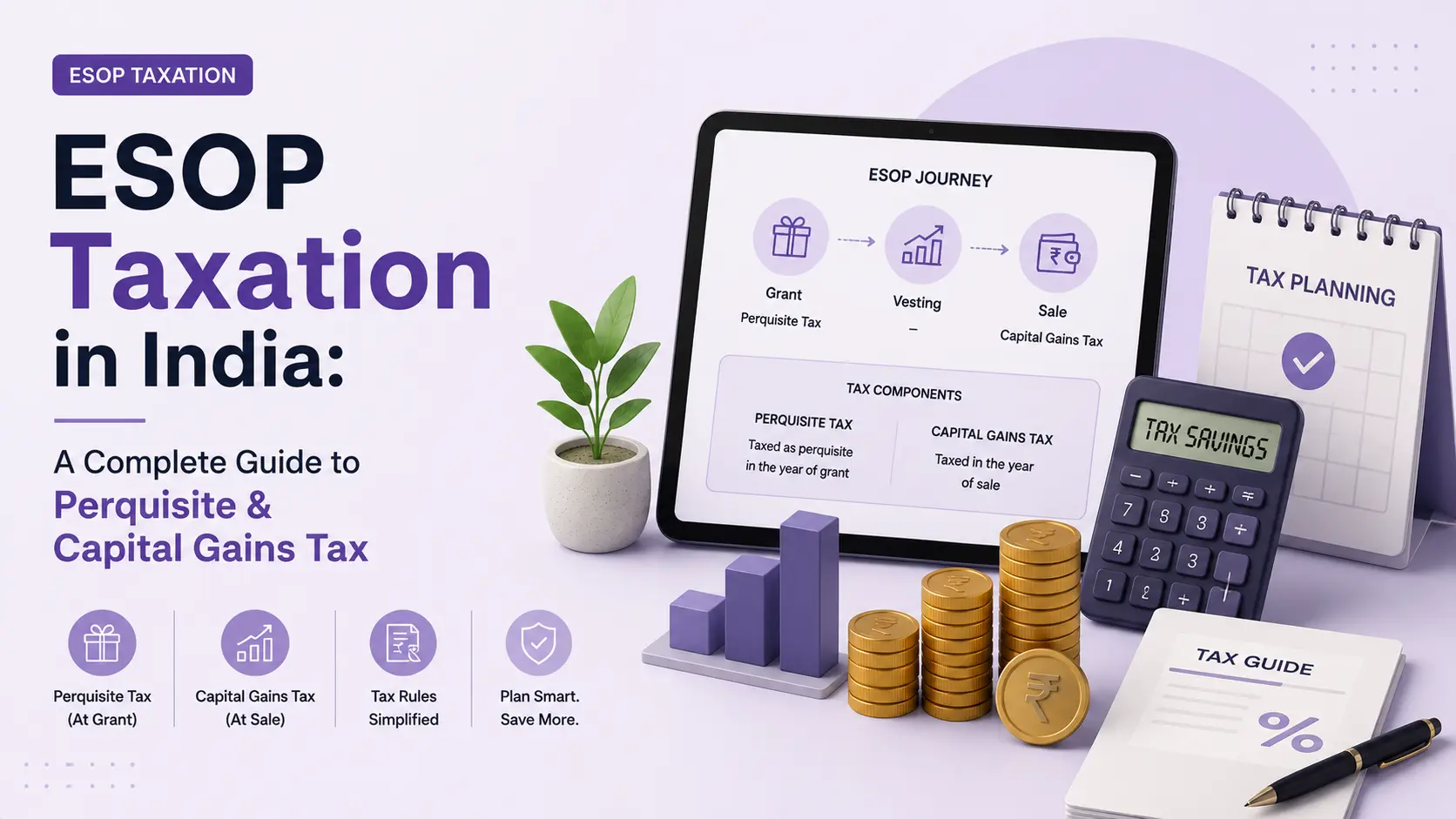
Table of Contents
Click to Expand
- The Biggest Shock of an ESOP Event
- The Two Stages of ESOP Taxation
- Stage 1 Deep Dive: Perquisite Tax Calculation
- The Start-up Tax Exemption (Rule 11UA Relief)
- The TDS Shock on Deferred ESOPs
- Stage 2 Deep Dive: Capital Gains Tax Calculation
- Case Study: The Cash Flow Squeeze
- How to Legally Optimize Your ESOP Tax Outflow
- The Post-Tax Wealth Management Strategy
- How Vestbox Helps & Why Choose Vestbox
- Conclusion / Final Thoughts
- Frequently Asked Questions
Key Takeaways:
- Dual Taxation: ESOPs are taxed twice. First as income (Perquisite Tax) when you buy the shares. Second as Capital Gains when you sell them.
- The FMV Trap: The tax you pay on exercise is based on the Fair Market Value (FMV), not the exercise price. A high FMV means a massive tax bill.
- Start-up Relief: Eligible start-ups can defer the first tax payment for up to 5 years, but TDS is still deducted immediately.
- Listed vs. Unlisted: The capital gains tax rules vary significantly depending on whether the company is listed on a stock exchange.
The Biggest Shock of an ESOP Event
You finally exercise your options. You feel like a millionaire.
Then the HR department hands you your tax breakdown. The reality hits you. The government takes a massive chunk of your equity before you ever see a rupee of cash.
ESOP taxation in India is brutal if you don't plan for it. The rules are strict, the math is complex, and the difference between listed and unlisted companies can cost you lakhs in unnecessary taxes.
If you need a refresher on the basic structure of vesting and exercising before diving into the math, read our complete guide on What is ESOP.
The Two Stages of ESOP Taxation
You do not pay tax when your ESOPs vest. You only pay tax when specific triggers happen.
There are two distinct tax events in the ESOP lifecycle:
Stage 1: The Exercise Event (Perquisite Tax)
When you sign the papers and buy the shares from the company at your discounted price, you trigger a tax event. The discount you received is treated as a "perquisite" (a fringe benefit from your employer). This is added to your salary and taxed at your income tax slab rate.
Stage 2: The Sale Event (Capital Gains Tax)
When you eventually sell those shares on the open market or through a secondary sale, you trigger a second tax event. The profit you make from the sale price is taxed as Capital Gains.
Stage 1 Deep Dive: Perquisite Tax Calculation
The core formula for Stage 1 is simple:
Taxable Value = Fair Market Value (FMV) on Exercise Date - Exercise Price Paid
The trap lies in how the Fair Market Value is calculated. The Income Tax Department does not allow you or your company to estimate the price.
How is Fair Market Value (FMV) Calculated?
The FMV depends on whether the company is listed or unlisted.
- For Listed Companies: The FMV is simple. It is the average of the opening price, highest, lowest, and closing prices of the company's shares on the date of exercise.
- For Unlisted Companies: This is complex. Under the Income Tax Rules (Rule 11UA), the FMV must be determined by a Merchant Banker using one of two methods:
- NAV Method: Based on the company's Net Asset Value.
- DCF Method: Discounted Cash Flow method, which projects future cash flows and discounts them to present value.
Note: For unlisted companies, the FMV cannot exceed the price at which the company issued shares to new investors in the last 12 months.
Perquisite Tax Example (Unlisted Startup):
| Parameter | Details |
|---|---|
| Exercise Date | January 1, 2024 |
| FMV (Determined by Merchant Banker) | ₹500 per share |
| Your Exercise Price | ₹50 per share |
| Taxable Perquisite Value | ₹450 per share |
| Number of Shares Exercised | 10,000 |
| Total Taxable Perquisite | ₹45,00,000 |
| Tax Payable (Assuming 30% Slab) | ₹13,50,000 |
You owe ₹13.5 Lakhs in tax before you can even sell the shares.
The Start-up Tax Exemption (Rule 11UA Relief)
Recognizing that start-up employees were drowning in taxes before they could sell their shares, the government introduced a major relief.
If you work for an eligible start-up (registered with DPIIT), you can defer paying this ₹13.5 Lakh perquisite tax.
You do not pay the tax in the year you exercise the shares. You pay it on the earliest of these three dates:
- 5 years from the ESOP grant.
- The date you actually sell the ESOPs.
- The date you resign or leave the company.
This is a massive cash flow advantage. It allows you to exercise your options without draining your savings account to pay the taxman upfront. The framework is governed by the Income Tax Act, under Section 17(2)(viia) and Rule 11UA.
The TDS Shock on Deferred ESOPs
There is a massive misunderstanding about the start-up tax deferral.
Deferring the tax does not mean you defer the TDS (Tax Deducted at Source). Even if you legally delay paying the actual tax for 5 years, your company is required by the Income Tax Department to deduct TDS on the perquisite value in the financial year you exercise the options.
This TDS is usually deducted at around 20% to 30%.
What this means for you: You will have to arrange the cash to pay this TDS to the company immediately upon exercise. You will not lose this money; you can adjust it against your final tax liability when the 5-year deferral period ends. But you still need liquid savings to survive the initial TDS hit.
Stage 2 Deep Dive: Capital Gains Tax Calculation
Once you have exercised the shares (and paid or deferred the perquisite tax), you own the stock. When you sell it, you pay Capital Gains Tax.
The formula for Stage 2:
Capital Gain = Sale Price - FMV on the Date of Exercise
Crucial note: You do not subtract your original exercise price here. You only subtract the FMV from Step 1.
Capital Gains on Indian Listed Companies
If the company is listed on the NSE/BSE, standard equity rules apply:
- Short-Term Capital Gains (STCG): If you sell within 12 months of exercising. Taxed at 20%.
- Long-Term Capital Gains (LTCG): If you sell after 12 months. Taxed at 12.5% on the amount exceeding 1.25 Lakh.
Capital Gains on Foreign Listed Companies
- Short-Term Capital Gains (STCG): If you sell within 24 months of exercising. Taxed at your income tax slab rate..
- Long-Term Capital Gains (LTCG): If you sell after 24 months. Taxed at a flat 12.5% (without indexation benefit, based on recent budget updates).
Capital Gains on Unlisted Companies
If the company is unlisted, the holding period and rates change completely:
- Short-Term Capital Gains (STCG): If you sell within 24 months of exercising. Taxed at your income tax slab rate.
- Long-Term Capital Gains (LTCG): If you sell after 24 months. Taxed at a flat 20% (without indexation benefit, based on recent budget updates).
Capital Gains Tax Example (Unlisted Startup Sale):
Continuing the previous example. You exercised at an FMV of ₹500. Two years later, the company did a secondary sale at ₹800.
| Parameter | Details |
|---|---|
| Sale Price | ₹800 per share |
| FMV on Exercise Date | ₹500 per share |
| Capital Gain Per Share | ₹300 per share |
| Number of Shares Sold | 10,000 |
| Total Capital Gain | ₹30,00,000 |
| Tax Payable (20% LTCG Unlisted) | ₹6,00,000 |
Wondering how much you'll pay? Enter your numbers in our Capital Gains Calculator.
Case Study: The Cash Flow Squeeze
Look at the total tax burden of a single ESOP transaction from the examples above:
- Stage 1 Perquisite Tax: ₹13,50,000
- Stage 2 Capital Gains Tax: ₹6,00,000
- Total Tax Paid: ₹19,50,000
The government takes nearly ₹20 Lakhs from a theoretical profit of ₹75 Lakhs (Sale price of ₹800 less exercise price of ₹50, times 10,000 shares).
This is why employees panic. If you don't have liquid savings to handle the Stage 1 tax bill, you might be forced to take a personal loan to exercise your options. This completely defeats the purpose of wealth creation.
How to Legally Optimize Your ESOP Tax Outflow
You cannot avoid the tax, but you can manage the timing to reduce the pain.
- Maximize the Start-up Deferral: If you qualify, always defer the Stage 1 tax. Do not pay it out of pocket if you don't have to.
- Stagger Your Exercise: Do not exercise 50,000 shares in one financial year. If your company allows a long exercise window, exercise 10,000 shares a year. This spreads your perquisite tax over 5 years, keeping you in a lower tax slab.
- Plan the Sale Timing: If you hold unlisted shares for 24 months, your capital gains tax drops from your slab rate (which could be 30%) to a flat 20%. Holding for a few more months can save you lakhs.
The Post-Tax Wealth Management Strategy
Clearing the tax hurdle is only step one. What you do with the remaining cash determines your actual wealth.
Many executives dump their post-tax ESOP cash into fixed deposits or real estate. This replaces single-stock risk with asset-class stagnation.
If you are dealing with multi-crore ESOP payouts, you need institutional-grade management. Standard mutual funds are structurally inefficient for the kind of concentrated, high-conviction portfolios required at this level. You can read about the HNI glass ceiling with mutual funds to see why.
How Vestbox Helps & Why Choose Vestbox
Don't let poor tax planning eat your ESOP wealth.
Why choose Vestbox:
- Pre-Exercise Liquidity Check: Before you trigger a massive tax event, run a structural portfolio review. We will determine whether your existing investments are losing tax efficiency and help you identify liquid funds to pay the TDS and perquisite liability.
- Post-Liquidity Diversification: When the cash finally hits your account, we help you replace that single-stock risk. Through Portfolio Management Services in India, we build a focused, actively managed equity portfolio. We monitor and rebalance it so your wealth continues to compound safely. To see how this operational framework works, read our guide on how PMS works through construction and monitoring.
- Secondary Sale Guidance: If you are trying to sell unlisted shares to fund your tax liability, understanding the secondary market is critical. Read our guide to selling unlisted ESOPs in India before you initiate a tender offer.
Conclusion / Final Thoughts
ESOP taxation in India is a two-stage mathematical trap. The perquisite tax hits you when you buy. The capital gains tax hits you when you sell.
If you ignore the math, the government will take a disproportionate chunk of your equity. If you plan your exercise schedule, utilize start-up deferrals, and actively manage the post-tax cash, you can turn a paper promise into real, protected wealth.
Explore ESOP Services on Vestbox
Frequently Asked Questions
Can I claim the start-up ESOP tax deferral if I leave the company?
No. If you resign, the deferral period ends immediately. You must pay the deferred perquisite tax in the financial year that you leave the company, regardless of whether you have sold the shares.
Is ESOP perquisite tax added to my salary for slab calculation?
Yes. The taxable value (FMV minus Exercise Price) is added to your total income for the year. If your salary is already high, exercising a massive ESOP grant can push you into the 30% tax bracket.
Do I get indexation benefits on unlisted ESOP capital gains?
No. As per recent amendments to the Income-tax Act, the indexation benefit for unlisted shares has been removed. Long-term capital gains are taxed at a flat 20%.
What happens if I sell my unlisted ESOPs before 24 months?
It is treated as Short-Term Capital Gains (STCG). The profit is added to your total income and taxed at your standard income tax slab rate, which could be as high as 30%.
Who calculates the Fair Market Value (FMV) for unlisted ESOPs?
It cannot be calculated internally by the company. It must be determined by a SEBI-registered Merchant Banker using the NAV or DCF methods prescribed under Rule 11UA of the Income Tax Rules.
Disclaimer
Mutual fund investments are subject to market risks. Read all scheme-related documents carefully. Please consult a certified financial advisor before making any investment decisions.
Trust & Compliance
This article has been created following our strict Editorial Policy. We believe in complete transparency regarding how we operate; you can read our Disclosures. For legal liabilities and risk factors, please review our Disclaimer.