ESOP vs ESPP: Which Employee Equity Plan is Better?

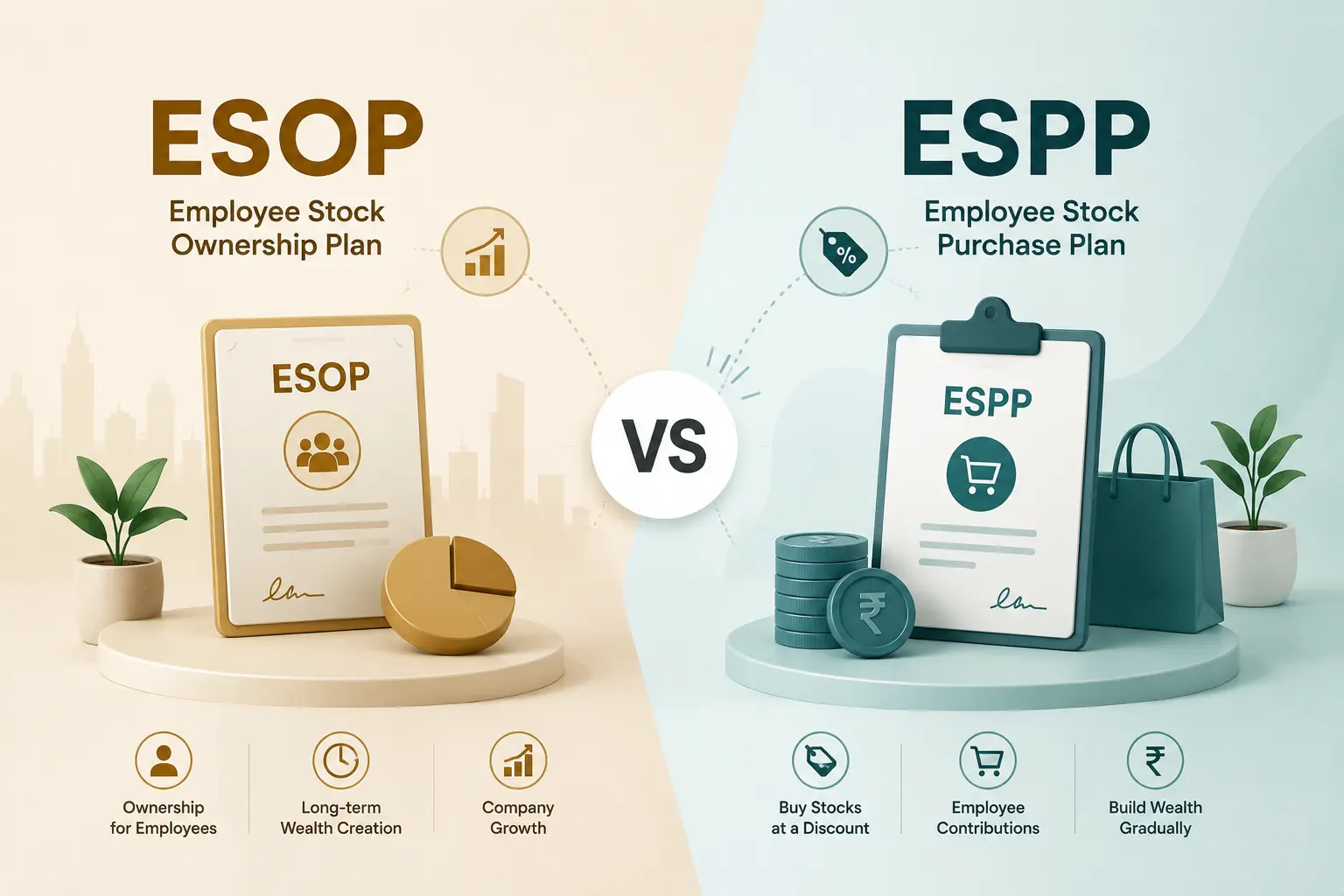
Table of Contents
Click to Expand
- What is an ESOP?
- What is an ESPP?
- The Master Comparison: ESOP vs ESPP
- Taxation Differences: The Indian Employee Trap
- Case Study: The Amazon SDE vs. The Startup VP
- The Hidden Danger of ESPPs: Dollar-Cost Averaging into One Stock
- What Happens When You Sell?
- How Vestbox Helps & Why Choose Vestbox
- Conclusion / Final Thoughts
- Frequently Asked Questions
Key Takeaways:
- ESOP: Gives you the right to buy company shares at a fixed, discounted price in the future. Common in Indian start-ups.
- ESPP: Allows you to buy company shares directly from your salary at a market discount. Common in US tech giants with Indian offices.
- The Core Difference: ESOP is a future option. ESPP is an ongoing payroll deduction plan.
- Taxation: Both trigger income tax on the discount received, but the timing of the tax event is different.
- The Trap: Both carry massive concentration risk. Continually purchasing your employer's stock repeatedly can destroy your net worth if the company falters.
You work for a massive US tech giant in India. Your compensation letter mentions an "ESPP." Your friend works for an Indian startup and has "ESOPs."
You both assume you have the same basic benefit. You don't.
Mixing up ESOPs and ESPPs is a common mistake. They use completely different mechanics to give you equity. One requires waiting years for a liquidity event. The other deducts money from your monthly salary to buy shares immediately.
If you choose the wrong one without understanding the tax implications, you can lose lakhs in the long run.
What is an ESOP?
An Employee Stock Ownership Plan (ESOP) gives you the right to buy company shares at a locked-in, discounted price in the future.
You do not own the stock today. You must wait out a cliff period and a vesting schedule. Once vested, you pay the exercise price to buy the shares. You usually cannot sell them until the company goes public or facilitates a private secondary sale.
This is the standard compensation tool for Indian start-ups. To see the timeline for options to vest, read our complete guide on What is ESOP.
What is an ESPP?
An Employee Stock Purchase Plan (ESPP) is very different. It is a program that allows you to buy company shares directly out of your paycheck, usually at a discount to the market price.
US-based tech companies like Amazon, Microsoft, and Google offer ESPPs to their Indian employees.
Here is how it usually works:
- You elect to contribute a percentage of your base salary (typically up to 10% or 15%) to the plan.
- Every six months, the company uses that money to buy shares for you at a discount.
- The standard discount is 15% off the lower of the stock price at the beginning or the end of the 6-month purchase period.
- You can usually sell the shares immediately in the open market and pocket the discount as cash.
The Master Comparison: ESOP vs ESPP
The structural differences dictate how you manage your cash flow and your taxes.
| Parameter | ESOP | ESPP |
|---|---|---|
| What you get | Right to buy shares in the future | Actual shares purchased regularly from salary |
| Price Mechanism | Fixed strike price (granted years ago) | Floating market price minus a discount (usually 15%) |
| How you pay | You pay the exercise price out of pocket | Automatically deducted from your monthly paycheck |
| Vesting Schedule | Strict cliff (usually 1 year) and graded vesting | Usually no vesting cliff. You own the shares the day you buy them. |
| Liquidity | Highly illiquid until an IPO or secondary sale | Highly liquid if the company is listed on a US exchange |
| Tax Trigger (India) | When you exercise the options | When the shares are purchased at a discount |
Taxation Differences: The Indian Employee Trap
If you are an Indian employee of a US MNC, you must understand how the Indian Income Tax Department views these plans.
ESOP Taxation in India:
As we broke down in detail, ESOPs face a dual-tax trap. You pay income tax (Perquisite Tax) on the difference between the Fair Market Value (FMV) and your exercise price when you buy the shares. Then you pay Capital Gains Tax when you eventually sell them. Use our ESOP Tax Calculator to estimate this initial liability, and read the full tax rules in our ESOP Taxation in India guide.
ESPP Taxation in India:
ESPP taxation is much simpler, yet it still catches people off guard.
When the company uses your salary to buy shares at a 15% discount, the Indian tax department views that 15% discount as a fringe benefit (perquisite).
Even if you sell the shares on the same day to lock in your cash profit, you still have to pay income tax on that 15% discount at your standard slab rate for that financial year.
Case Study: The Amazon SDE vs. The Startup VP
Let's look at how the cash flow differs between the two structures.
Scenario A (ESPP - Amazon SDE): An engineer at Amazon India earns ₹50 Lakhs a year. They put 15% of their salary into the ESPP. Every six months, Amazon buys discounted US shares for them. The engineer immediately sells the shares to capture the 15% discount. They pay Indian income tax on that discount. Their salary is high, but the cash flow is monthly, and the money is liquid.
Scenario B (ESOP - Indian Startup VP): A VP at an Indian startup gets ESOPs. They wait 4 years for the cliff. The company grows 10x. They finally exercise their options. They suddenly owe ₹30 Lakhs in perquisite tax out of their own pocket, even though they cannot sell the unlisted shares yet. They are cash-poor and illiquid.
ESPPs provide steady, liquid cash flow. ESOPs provide massive, delayed, illiquid wealth. Understanding how ESOPs create wealth requires knowing which structure fits your current lifestyle.
The Hidden Danger of ESPPs: Dollar-Cost Averaging into One Stock
ESPPs sound like a guaranteed money-making machine. You get a 15% discount every six months. Why wouldn't you max it out?
Because it creates a massive concentration risk.
By automatically buying your employer's stock every month for years, you are dollar-cost averaging your entire savings into a single asset. If the tech sector crashes, or your specific company misses earnings, your salary and your investment portfolio drop at the same time.
To understand the mathematical danger of putting too much of your net worth into a single stock, read our guide on Portfolio Risk and calculation.
What Happens When You Sell?
Let's say you have spent 5 years maxing out your ESPP at a US tech giant. You have accumulated $200,000 worth of stock. You sell it and repatriate the money to India.
You now have ₹1.6 Crores in your bank account.
The biggest mistake tech employees make is leaving this cash in a savings account or dumping it into a single real estate property. You just spent years taking concentrated risk on one stock. You need to institutionalize that wealth.
Standard mutual funds are too rigid for the kind of focused, high-conviction portfolios required at this level.
How Vestbox Helps & Why Choose Vestbox
We help tech professionals and startup founders manage the wealth generated by equity compensation.
Why choose Vestbox:
● Tax Optimization: Before you trigger a massive tax event by exercising ESOPs or selling ESPP shares, run a structural portfolio review. We will show you how to optimize your existing portfolio to manage the tax liability without draining your cash reserves.
● De-Risking Your Portfolio: If 80% of your net worth is tied to your employer's stock, you are in danger. Through Portfolio Management Services in India, we build a focused, actively managed equity portfolio across 20-30 different sectors. We monitor and rebalance it so you are never exposed to a single company's failure. To see how this active management works, read our guide on how PMS works through construction and monitoring.
● Managing US Equity: If you are dealing with ESPP proceeds from US tech firms, we help you manage currency risk and repatriation strategies to deploy that capital effectively in the Indian market.
Stop gambling your salary on your employer's stock.
Ready to diversify your tech wealth? Explore Portfolio Management Services in India and see how professional managers protect your capital.
Conclusion / Final Thoughts
ESOPs and ESPPs are fundamentally different tools.
ESOPs are a long-term gamble on a startup's success, requiring you to wait years for a massive, illiquid payout. ESPPs are a short-term cash-flow hack, allowing you to skim a guaranteed discount off a listed stock every six months.
Understand which plan you have. Understand how the Indian tax department taxes the discount. And most importantly, do not let the convenience of an ESPP trick you into putting your entire net worth into one company's stock.
Explore ESOP Services on Vestbox
Frequently Asked Questions
Is ESPP better than ESOP?
It depends on your goal. ESPPs provide immediate, liquid cash flow and are virtually risk-free if you sell the shares immediately. ESOPs are highly risky and illiquid, but they offer the mathematical leverage to generate multi-crore wealth if the company succeeds.
Do I have to pay tax on ESPP if I sell the shares on the same day?
Yes, in India. Even if you sell the shares the same day you bought them, the 15% discount you received is treated as a perquisite and taxed at your income tax slab rate for that year.
Can I lose money on an ESPP?
Yes. If the stock price drops below the discounted purchase price before you can sell it, you will lose money on the transaction. This is rare for 6-month purchase periods, but it happens.
Can Indian employees of US companies participate in ESPP?
Yes. US tech giants like Amazon, Microsoft, and Adobe actively offer ESPPs to their Indian workforce. The shares are usually listed on NASDAQ or NYSE, and Indian employees can participate via their global brokerage accounts.
Why do companies offer a 15% discount on ESPP?
It is a tax-free benefit for the employee (in the US) and a powerful retention tool for the company. It essentially functions as a stealth bonus that encourages employees to become shareholders and stay loyal to the firm.
Disclaimer
Mutual fund investments are subject to market risks. Read all scheme-related documents carefully. Please consult a certified financial advisor before making any investment decisions.
Trust & Compliance
This article has been created following our strict Editorial Policy. We believe in complete transparency regarding how we operate; you can read our Disclosures. For legal liabilities and risk factors, please review our Disclaimer.
Share & Save Article
Other Posts
What is ESOP? A Complete Guide to Employee Stock Ownership Plans
Aug 6, 2026
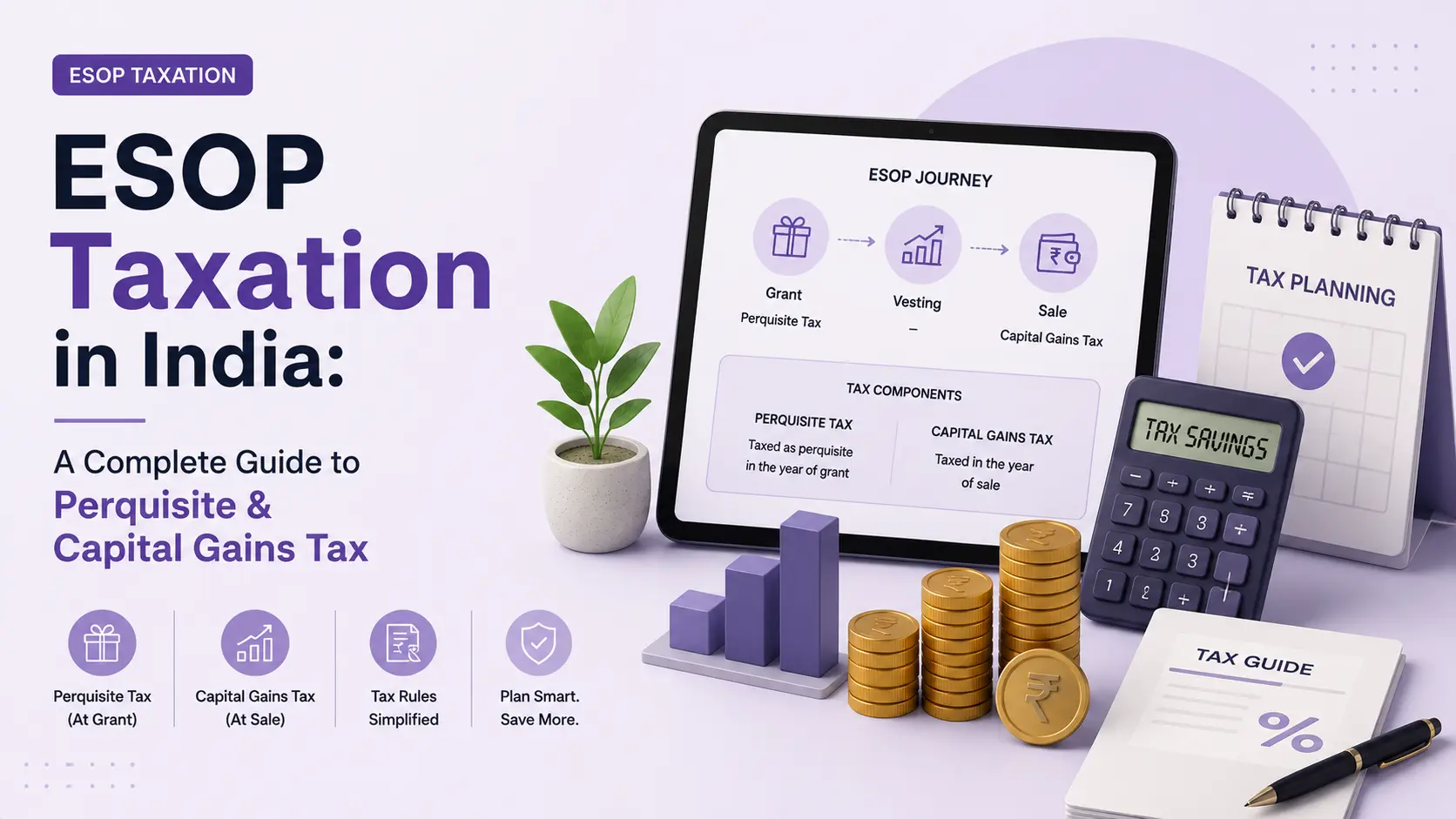
ESOP Taxation in India: A Complete Guide to Perquisite & Capital Gains Tax
Aug 7, 2026
ESOP vs Equity Shares vs RSU: Understanding Employee Equity
Aug 11, 2026
ESOP Buyback in India: The Ultimate Liquidity Guide
Aug 11, 2026
