What is PMS? A Complete Guide to Portfolio Management Services in India

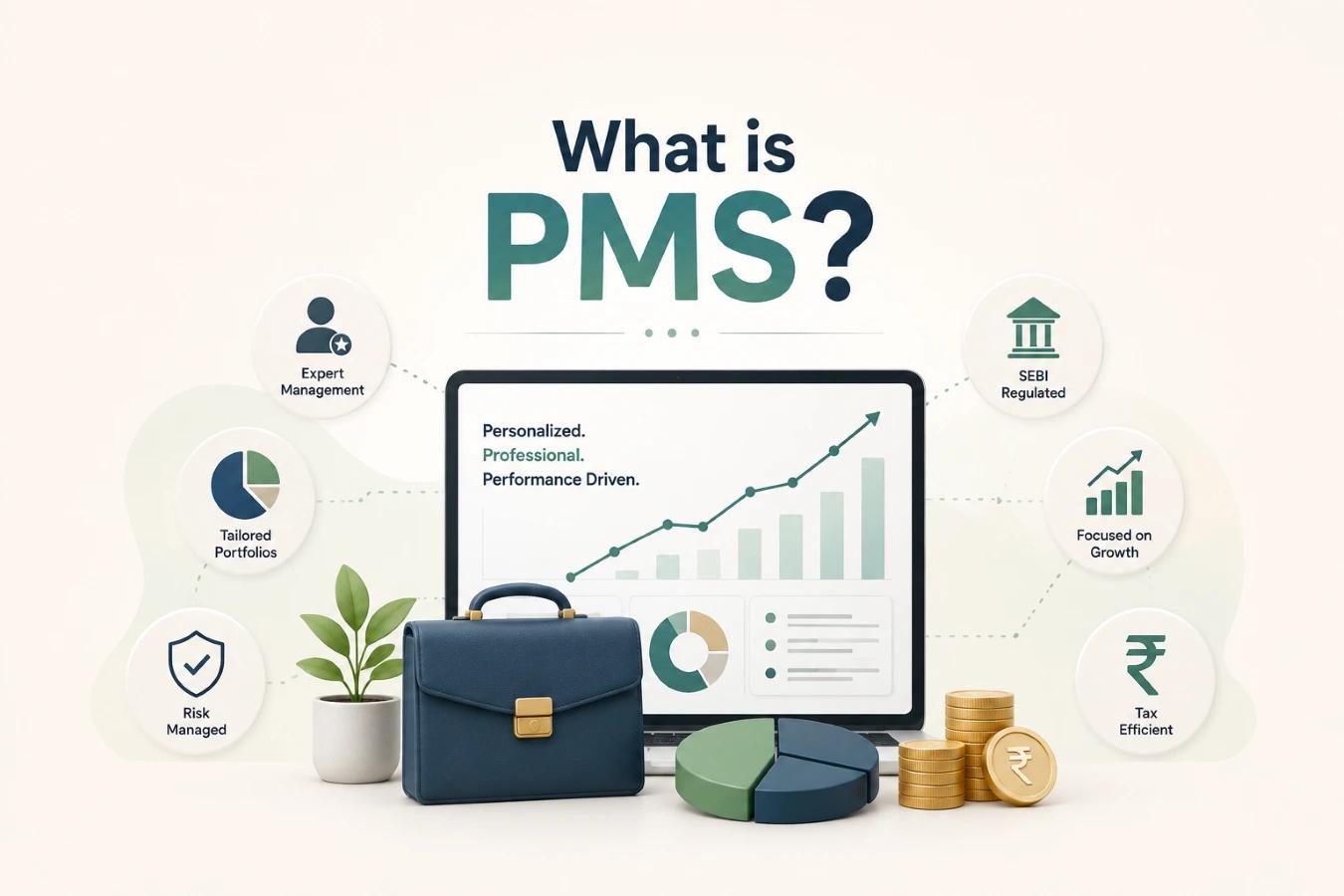
Table of Contents
Click to Expand
- Introduction
- What is Portfolio Management Services (PMS)?
- Types of Portfolio Management
- Objective of Portfolio Management
- How Do PMS Work? (The Process of PMS)
- Elements of PMS
- SEBI Rules and Guidelines for PMS
- Features of PMS
- Benefits of PMS Investment
- Taxation and Charges of PMS
- Why Should You Invest in PMS Services?
- How is PMS Different from Mutual Funds?
- Who Does PMS Suit?
- How Vestbox Helps & Why Choose Vestbox
- Conclusion / Final Thoughts
- Frequently Asked Questions
Most investor portfolios aren't built. They are thrown together.
You buy a large-cap fund. Then you add a mid-cap fund after a tip. Eventually, you buy a thematic fund during a rally. Over time, you end up with a messy collection of overlapping stocks. Your sector bets are totally unintended. Your portfolio has drifted far from your original risk appetite.
We see this exact problem constantly. It is the main reason Portfolio Management Services (PMS) was introduced.
For high-net-worth individuals in India, PMS changes how capital is deployed. Let’s break down exactly what PMS is. We will look at the legal rules, the costs, and how to know if it fits your wealth goals.
What is Portfolio Management Services (PMS)?
Portfolio Management Services (PMS) is a specialised, SEBI-regulated investment setup built for affluent investors. You hand your capital to a dedicated fund manager. They curate a custom basket of securities, like equities or debt, based exactly on your financial goals and risk appetite.
It differs completely from pooled vehicles. With PMS, you hold the underlying stocks directly in your own Demat account. The entry barrier is set at ₹50 lakh by SEBI. The core purpose isn't to promise fixed returns. It is to strategically navigate market cycles and maximise risk-adjusted alpha through active management.
Note: If you are looking for software to track stocks, you want a Portfolio Management System. This guide covers the SEBI-regulated investment service.
Types of Portfolio Management
PMS in India is split by how much power you give the fund manager:
- Discretionary PMS: You pick the overarching strategy. The manager holds full authority to buy and sell on your behalf. This allows for agile, real-time adjustments.
- Non-Discretionary PMS: The manager acts purely as an advisor. They research and suggest trades, but you must approve every single transaction. It requires your constant involvement.
Learn the difference between Discretionary vs Non-Discretionary PMS
Objective of Portfolio Management
What is the actual goal here? It isn't just to blindly beat a benchmark index. The real objective of portfolio management is to grow your wealth while keeping downside risk tightly controlled. A good manager builds a resilient portfolio. They aim for consistent, risk-adjusted returns (alpha) by selecting high-conviction stocks and managing risk.
How Do PMS Work? (The Process of PMS)
The mechanics are straightforward. But it feels very different than logging into a standard mutual fund app. Here is the actual onboarding journey:
- Risk Mapping and Onboarding: It starts with a deep dive into your finances, what returns you actually need, and when you need the money.
- Mandate Finalization: You don't just "invest in PMS." You choose a specific path like Value, Growth, or Quant that fits your exact profile.
- Capital Deployment: You move your minimum capital (₹50 Lakhs) into a newly created, dedicated Demat account.
- Active Execution: The manager builds a concentrated portfolio. As the market shifts, they buy or sell without needing to call you for permission.
- Transparent Reporting: You get daily updates. Plus, you can log in to your Demat account anytime to see each stock you own, along with the buy price and current value.
Elements of PMS
A PMS setup relies on four separate parts working together:
- The Capital Provider: You. Your risk tolerance sets the hard boundaries for the portfolio.
- The Portfolio Manager: The SEBI-registered expert who does the heavy lifting, researching stocks and executing trades.
- The Investment Mandate: Think of this as the rulebook. It dictates exactly what the manager can and cannot buy.
- The Independent Custodian: A third-party entity that holds your shares. This ensures the manager can never access or run off with your money.
SEBI Rules and Guidelines for PMS
SEBI keeps a tight grip on PMS through the Portfolio Managers Regulations. Here are the non-negotiable rules:
- Mandatory Registration: You cannot offer PMS without a valid SEBI registration. Period.
- Minimum Investment Threshold: SEBI forces a hard floor of ₹50 Lakhs. This keeps retail noise out so managers can focus on high-touch strategies.
- Independent Custody: Your money and shares cannot be held by the fund manager. A completely separate, independent custodian must hold them to eliminate counterparty risk.
Features of PMS
What makes PMS physically different from a mutual fund?
- Direct Asset Ownership: The stocks sit in your personal Demat account, not in a pooled trust.
- Concentrated Basket: Instead of 100 stocks, PMS usually holds just 20 to 35 high-conviction picks. No bloating.
- Tailored Strategy Alignment: You can select a mandate that reflects your particular views on market sectors or capitalization.
- Operational Agility: The manager can dump a bad stock instantly. They aren't stuck waiting to handle daily retail redemptions like mutual fund managers are.
Benefits of PMS Investment
The advantages go far beyond just picking good stocks. They offer real structural benefits:
- Superior Tax Efficiency: Because you hold individual stocks, Long-Term Capital Gains (LTCG) tax applies only to the individual securities held for over 12 months. Mutual funds use scheme-level averaging, which often creates a higher tax bill. To see the math behind this, Understand how PMS generates alpha through concentrated portfolios.
- Zero Cash Drag: Mutual funds often hold 5-10% cash to handle daily redemption queues. PMS stays fully deployed. Your money is always in the market.
- Direct Corporate Actions: If a company issues a bonus, dividend, or right, it goes straight into your account. It immediately compounds your wealth.
Taxation and Charges of PMS
You need to know exactly what this costs before you sign up.
Charges
Expect a two-part fee structure:
- Management Fee: A fixed annual charge (typically 1% to 2% of your total AUM) to cover operations and research.
- Performance Fee: A cut of profits (typically 10% to 20%) generated above a specific benchmark. This ensures the manager only wins if you win.
Taxation
Equity PMS works just like buying stocks directly. Hold for under 12 months? You pay 20% STCG. Hold for over 12 months? You pay 12.5% LTCG (above ₹1.25 lakh). Debt PMS is taxed at your standard income slab rate.
Why Should You Invest in PMS Services?
The need for PMS becomes obvious when you look at the hidden flaws in assembled portfolios.
Imagine you have ₹1 Crore to invest. You spread it across five top-rated mutual funds. You think you are diversified. But when you look at the actual holdings, you find a nasty surprise. 60% of your capital is anchored to the same 15 large-cap stocks. You are paying layered fees for redundant exposure.
PMS fixes this. A ₹1 Crore PMS allocation builds a precise, 25-stock portfolio with zero internal overlap. Your capital is actively engineered for a specific outcome. It strips away the bloat.
How is PMS Different from Mutual Funds?
The real difference comes down to scale and flexibility. When a mutual fund gets too big, it is forced to hold 60 to 100+ stocks to manage daily liquidity. This massive over-diversification usually leads to average, index-hugging returns.
This creates a hard HNI glass ceiling with mutual funds. PMS doesn't have this problem. It stays small, focused, and agile.
| Parameter | Mutual Funds | Portfolio Management Services (PMS) |
|---|---|---|
| Minimum Investment | Low (₹500 - ₹5,000) | High (₹50 Lakhs) |
| Ownership Structure | Units of a pooled trust | Individual securities in Demat |
| Customisation | Standardised mandate | Highly customised mandates |
| Portfolio Density | Diluted (50-100+ stocks) | Concentrated (20-35 stocks) |
| Taxation Mechanism | Scheme-level averaging | Stock-level direct LTCG/STCG |
Who Does PMS Suit?
PMS is built for one specific group: High Net Worth Individuals (HNIs). If you have crossed the ₹50 Lakh mark and mutual funds feel too rigid, PMS is the logical next step. It gives you direct ownership and professional risk management.
On the flip side, trying to manage this much money yourself usually ends badly. Emotional trading creeps in. The hidden risks of a self-managed portfolio usually show up as overlapping sector bets. And that risk hits hardest during a market crash.
How Vestbox Helps & Why Choose Vestbox
Most PMS distributors act like salesmen. They want to push their own in-house funds. Vestbox operates differently. We are a conflict-free distribution platform.
Why choose Vestbox for Portfolio Management Services:
- Unbiased Strategy Curation: We don't manufacture our own PMS. We give you objective access to top-tier, SEBI-registered managers across Value, Midcap, and Quant strategies. Your needs drive the choice, not our quotas.
- Diagnostic-First Approach: Don't deploy ₹50 Lakhs on impulse. Before picking a mandate, run a structural portfolio review. We will show you exactly where your current money is leaking through overlaps and risk drift.
- Institutional Transparency: We prioritise clarity over salesmanship. By checking the 5 signs you need a portfolio review, you can objectively decide if a PMS structure is actually right for you.
When you want to stop assembling and start engineering, Vestbox gives you the tools and access to make it happen.
Conclusion / Final Thoughts
PMS is not just another line item on your investment statement. It is a complete structural upgrade. You get direct ownership, better tax efficiency, and a manager who actually has the flexibility to protect your downside.
For serious wealth, the goal moves beyond "participating in the market" to become "engineering specific outcomes" over a full market cycle.
Ready to explore curated options?
Explore Portfolio Management Services in India through the Vestbox platform. Evaluate the strategies, fee structures, and risk parameters to find your fit.
Unsure where to start?
Get a complimentary, data-driven Portfolio Review to identify hidden risks and overlapping funds with Vestbox.
Frequently Asked Questions
What is the minimum investment required for PMS in India?
SEBI sets a hard floor of ₹50 Lakhs. You cannot start a PMS mandate with less than this amount.
Is PMS better than Mutual Funds?
"Better" is the wrong word. It is a different tool. If you have ₹10,000, mutual funds are ideal. If you have ₹50 Lakhs+ and want direct stock ownership with concentrated bets, PMS is the superior structural fit.
Who can invest in PMS?
Any Indian resident individual, HUF, trust, or corporate entity can invest, provided they meet the strict ₹50 Lakh minimum threshold.
Is PMS a better option for high-net-worth investors?
Yes. Once your capital grows large, mutual funds start getting structurally bloated. PMS gives HNIs the custom strategies and stock-level tax efficiency that large mutual funds cannot offer.
What happens if my PMS portfolio manager changes?
Your stocks stay exactly where they are. You don't lose your portfolio. The PMS firm will assign a new manager, usually someone from the same team using the same mandate. You always have the right to review the transition and exit if you aren't comfortable.
Can NRIs invest in Portfolio Management Services (PMS) in India?
Yes, they can. NRIs can invest on a repatriable (NRE) or non-repatriable (NRO) basis. They need to meet the standard of ₹50 Lakh minimum and comply with the RBI's Foreign Exchange Management Act (FEMA) guidelines.
What is the timeline for changing holdings in PMS?
It happens fast. Since the manager has discretionary power, they can buy or sell a stock the same day they see an opportunity. The actual shares hit your Demat account following the standard stock market settlement cycle (usually T+1 day).
Can I withdraw my money from PMS at any time?
Not immediately. Most PMS strategies lock your money up for 6 to 12 months. This lets the manager actually execute the strategy without liquidity shocks. Post-lock-in, you can request an exit and get your payout in a few business days.
Is PMS safe in India?
Yes, from a regulatory standpoint. SEBI rules force an independent custodian to hold your shares. The manager cannot touch your assets. But remember, the market risk of the stocks inside the portfolio is still very real.
Disclaimer
Mutual fund investments are subject to market risks. Read all scheme-related documents carefully. Please consult a certified financial advisor before making any investment decisions.
Trust & Compliance
This article has been created following our strict Editorial Policy. We believe in complete transparency regarding how we operate; you can read our Disclosures. For legal liabilities and risk factors, please review our Disclaimer.
Share & Save Article
Other Posts
How to Check Income Tax Refund Status Online: A Complete Guide
Jul 18, 2026
Why is Income Tax Refund Delayed? A Complete Guide to Processing Times
Jul 18, 2026
What is Portfolio at Risk? A Complete Guide to Meaning, Formula, Calculation, & Benefits.
Jun 5, 2026

What is SIP & How Does It Actually Work?
May 27, 2026
