High Returns, Low Profits? 5 Signs You Need a Portfolio Review

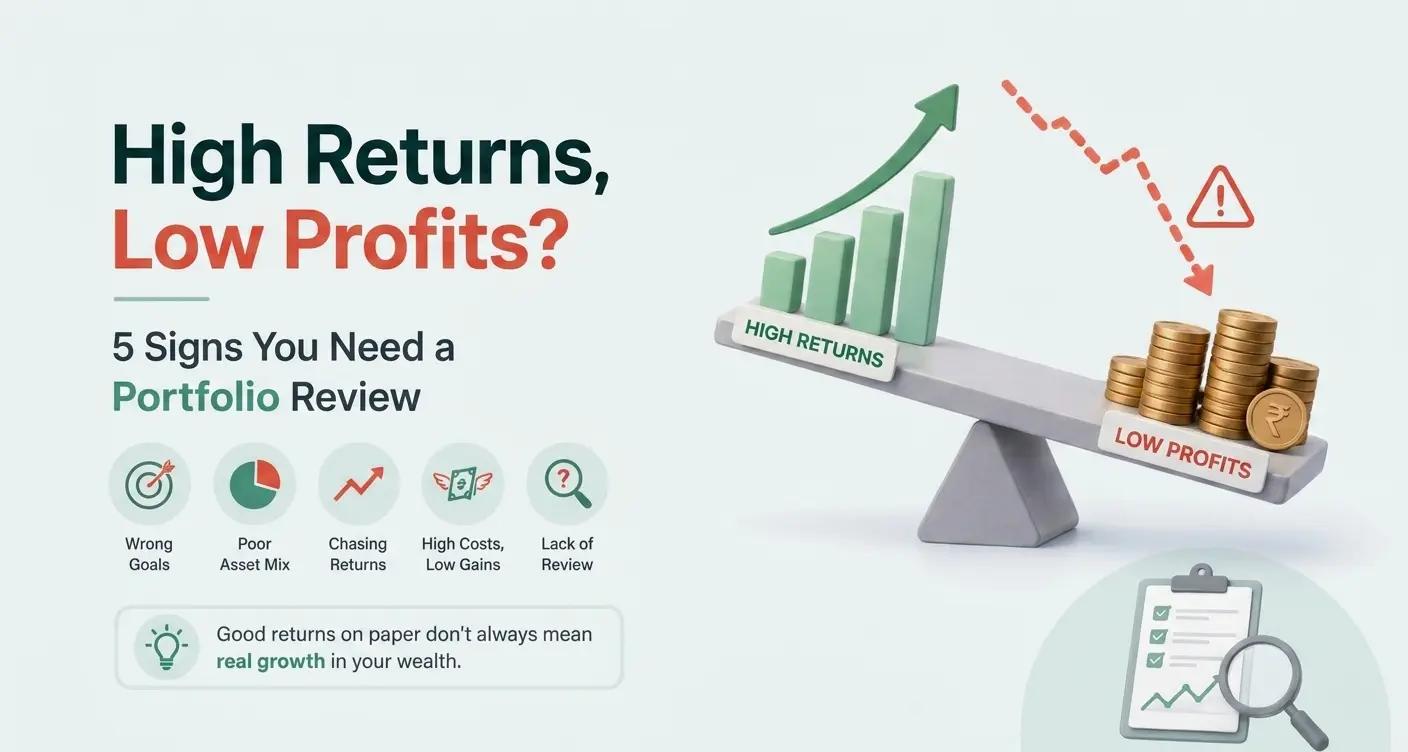
Table of Contents:
Click to Expand
Open your portfolio tracking app right now. If the overall return number is green, you probably feel a sense of relief. You assume the system is working, your wealth is compounding, and you can go back to your day job.
But aggregate returns are a mirage. They hide a terrifying reality.
Most Indian investors do not have a portfolio; they have a chaotic collection of financial products bought on impulse, on tips, and based on incomplete advice. Under that green aggregate number, your portfolio is likely bleeding real returns due to structural inefficiencies.
If you suspect your investments are underperforming, you need to get a professional portfolio review before another quarter of compounding is lost forever.
The "Set It and Forget It" Fantasy
The financial industry sold retail investors a beautiful lie: "Buy assets, set it, and forget it."
For a basic passive index fund, this works. But as your wealth grows, life gets complicated. You change jobs, your tax bracket jumps, you receive company ESOPs, you dabble in direct stocks, and you buy random mutual funds recommended by different people at different times.
"Set it and forget it" quickly becomes "Set it and neglect it." Without an institutional-grade audit, your portfolio slowly mutates into a highly inefficient risk and tax liability.
Sign 1: The Overlapping Mirror
This is the most common wealth leak in India, and it happens across your entire investment ecosystem, not just in mutual funds.
Let’s say you hold a large-cap mutual fund, a flexi-cap fund, and direct shares of Reliance, HDFC Bank, and Infosys because you believe in those companies. You think you are highly diversified.
Under SEBI categorization of mutual funds, large-cap and flexi-cap funds are legally mandated to hold a massive portion of their assets in the top 100 companies. Because these are the only companies large enough to absorb institutional money, every major fund must hold Reliance, HDFC, and Infosys.
The Leak: You are holding HDFC Bank directly, plus owning it again in Fund A, and again in Fund B. You haven't diversified; you’ve just concentrated your risk in 10 underlying mega-caps while paying three different sets of fees. When a sector correction hits these giants, your entire portfolio tanks simultaneously because your "diversified" assets are actually mirror images of each other.
Sign 2: The Tax-Blind Switching Penalty
Human beings are emotional. When a specific stock or fund underperforms for six months, the instinct is to sell it and switch to the current chart-topper.
The Leak: Every time you switch an equity mutual fund or sell a direct stock before 12 months, you trigger a Short-Term Capital Gains (STCG) tax of 20% on any profits. Even if you hold it longer, you trigger a Long-Term Capital Gains (LTCG) tax of 12.5% on gains exceeding ₹1.25 Lakhs.
Most retail investors switch investments 3 to 4 times over 5 years without calculating the tax bill. By the time they calculate their actual post-tax returns, they have drastically underperformed a standard bank Fixed Deposit. You are transferring your wealth to the government simply because of impatience.
Sign 3: The Direct Equity "Dead Zone"
Every HNI has a "Dead Zone" in their Demat account. These are 5 to 10 direct stocks bought on a broker's tip or a friend's hot tip three years ago. They are currently sitting at a 40% to 60% loss.
The Leak: You refuse to sell them because selling means "booking the loss" and admitting you were wrong. This is the sunk-cost fallacy.
While you hold onto these zombie stocks hoping they "come back to your buying price," that locked capital is missing out on the compounding power of quality assets. Worse, you cannot use those losses to offset your capital gains tax because you haven't actually sold them. A professional review ruthlessly identifies these dead zones and executes tax-loss harvesting to turn those mistakes into actual tax savings.
Sign 4: The Goal-Asset Mismatch
This is a silent structural leak. You are saving for your daughter's college education in 3 years, but you have allocated that money to a mid-cap mutual fund or direct small-cap stocks. These assets can drop 35% in a single year. If the market crashes a year before you need to pay the college fees, your child's future is compromised.
Conversely, you are saving for retirement 20 years away, but 60% of your money is sitting in low-yield debt funds because you are "scared of the stock market."
The Leak: Mismatching your time horizon with your asset volatility guarantees that you either take too much risk for short-term needs or too little risk for long-term wealth creation.
Sign 5: Ignoring the Multiple Pay
Look at your entire wealth landscape. You might be paying a mutual fund Expense Ratio, paying an annual fee to a financial advisor, and paying brokerage charges on your direct equity account.
The Leak: If the underlying assets in all three of these buckets are heavily overlapping (as explained in Sign 1), you are essentially paying three different people to manage the same risk. You are triple-paying for "diversification" that doesn't actually exist.
Why a DIY Audit is Financially Dangerous
You cannot audit your own portfolio. You have emotional attachments to the stocks you picked. You suffer from confirmation bias.
Calculating exact overlap across direct stocks and 10 different mutual fund fact sheets, calculating the exact capital gains tax liability if you were to consolidate those holdings, and mapping the remaining capital to your specific risk profile requires institutional-grade computational power. Doing it on a basic Excel sheet will lead to math errors, which can lead to wrong financial decisions.
The Vestbox Diagnostic: Stop the Bleeding
At Vestbox, when an investor comes to us for a portfolio review, we don't just look at aggregate returns. We run a structural X-ray of every single asset, including direct stocks, mutual funds, ESOPs, and fixed income.
Real-World Vestbox Data: In a recent audit of a ₹2.5 Crore portfolio, we discovered the client held 11 mutual funds alongside a direct stock portfolio. Our overlap engine revealed that 65% of his total equity exposure was just a shadow replication of the Nifty 50. Worse, he had unknowingly triggered nearly ₹4 Lakhs in STCG taxes over the previous two years due to blind switching between funds with identical mandates.
We suggested consolidating the redundant funds, mapped the direct equity dead zone for immediate tax-loss harvesting, and transitioned a portion of the capital into a structured, customized PMS mandate to eliminate the overlap.
Your portfolio is not a museum for your past financial mistakes. It is an engine meant to fund your future. If you suspect your engine is leaking, get a diagnostic before the damage becomes irreversible.
And if that diagnostic reveals that standard retail products cannot accommodate the complexity of your wealth, it might be time to explore how the ultra-rich structure their money. To understand the differences between pooled retail products and bespoke wealth structures, understand the difference between SIF vs PMS vs AIF vs Mutual Funds.
Explore our complete guide:
Disclaimer
Mutual fund investments are subject to market risks. Read all scheme-related documents carefully. Please consult a certified financial advisor before making any investment decisions.
Trust & Compliance
This article has been created following our strict Editorial Policy. We believe in complete transparency regarding how we operate; you can read our Disclosures. For legal liabilities and risk factors, please review our Disclaimer.
Share & Save Article
Other Posts
The Paradox of Legacy: Why Generational Wealth Demands Institutional Architecture
May 1, 2026
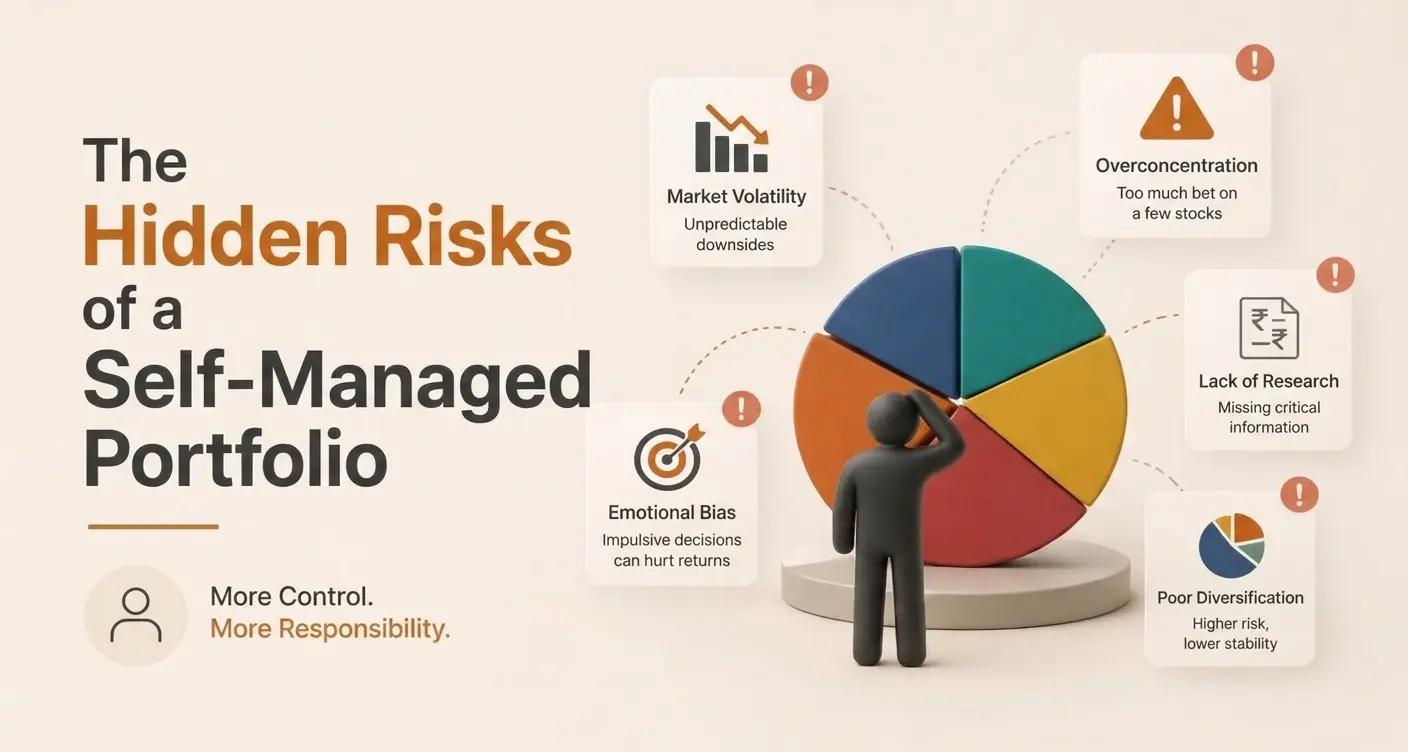
The Hidden Risks of a Self-Managed Portfolio
May 1, 2026

Why Traditional Wealth Structures Fail At The 75 Crore Mark
May 1, 2026

The Founders Trap: Why Micromanaging Wealth Destroys It
May 1, 2026
