Discretionary PMS vs Non-Discretionary PMS: A Complete Guide to Execution

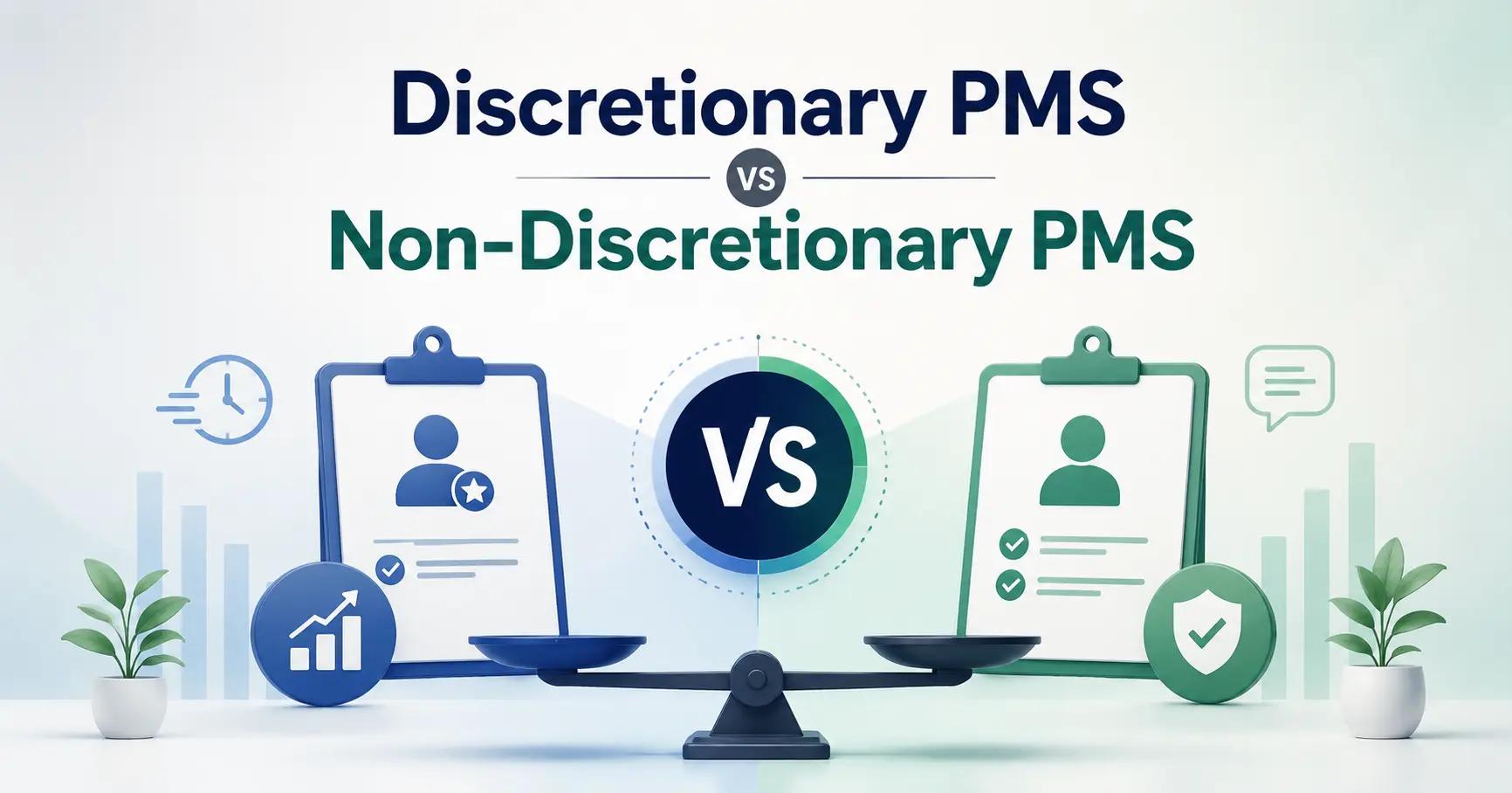
Table of Contents
Click to Expand
- Introduction
- What is Discretionary vs Non-Discretionary PMS?
- Objective of Discretionary and Non-Discretionary PMS
- How Do They Work? (The Process of PMS Execution)
- Elements of PMS Execution Styles
- SEBI Rules and Guidelines for PMS Execution
- Features of Discretionary vs Non-Discretionary PMS
- Benefits of PMS Investment Based on Execution Style
- Taxation and Charges of Discretionary & Non-Discretionary PMS
- Case Study: The Market Correction Scenario
- Why Should You Choose One Over the Other?
- How is This Different from Mutual Funds?
- Who Does Each PMS Style Suit?
- How Vestbox Helps & Why Choose Vestbox
- Conclusion / Final Thoughts
- Frequently Asked Questions
Introduction
Imagine the market drops 5% in a single hour. Your PMS manager decides it is time to exit three mid-cap stocks to protect your capital.
Who presses the sell button?
Do you want to be the one scrambling to approve the trades between meetings? Or do you want a manager who already executed the trade the second the market broke?
This is not a minor operational detail. It is the single most important decision you will make after choosing your investment strategy. It is the divide between Discretionary and Non-Discretionary PMS.
Pick the wrong execution style, and a brilliant investment thesis turns into a missed opportunity.
Before you hand over your capital, you need to honestly assess your schedule and your mental state during stressful situations.
What is Discretionary vs Non-Discretionary PMS?
When you invest in PMS, you are hiring a professional to manage your capital. The dispute arises over how much power you hand them.
- Discretionary PMS: You give the manager a signed Power of Attorney (PoA). They have the legal right to buy and sell stocks in your Demat account without asking you for permission every single time.
- Non-Discretionary PMS: The manager acts purely as an advisor. They research the stocks and tell you what to buy. But you must manually authorize every transaction.
Objective of Discretionary and Non-Discretionary PMS
The objective here isn't about picking better stocks. It is about operational mechanics.
The objective of Discretionary PMS is speed. Markets move in milliseconds. If a geopolitical event happens, the manager needs to hedge the portfolio immediately. They cannot wait for you to return their call.
The objective of Non-Discretionary PMS is absolute control. You want the brainpower of a professional fund manager, but you refuse to let anyone else press the buy or sell button in your account.
How Do They Work? (The Process of PMS Execution)
The onboarding is identical. You go through risk profiling. You select a mandate such as Value or Midcap. You transfer the ₹50 Lakhs.
The process splits the second a trade idea is generated:
Discretionary Process:
- The manager spots an opportunity.
- They execute the trade instantly in your Demat account.
- You receive a confirmation email at the end of the day.
Non-Discretionary Process:
- The manager spots an opportunity.
- They send you an alert or call you with the thesis.
- You review the idea. You manually approve it.
- The manager executes the trade.
Elements of PMS Execution Styles
The structural pillars of PMS remain the same, but the legal framework shifts:
- The Investor: In discretionary, you are the capital provider. In non-discretionary, you are the final decision-maker.
- The Portfolio Manager: In a discretionary role, they are the executor. In non-discretionary, they are a paid consultant.
- The Power of Attorney (PoA): This is the defining element. Discretionary mandates require a registered PoA with your Depository Participant (DP). Non-discretionary mandates usually do not.
- The Custodian: Remains the same. An independent third party holds your shares safely in both setups.
SEBI Rules and Guidelines for PMS Execution
SEBI is extremely strict about keeping these two structures separate. The regulatory framework is enforced under the Securities and Exchange Board of India (Portfolio Managers) Regulations.
Here are the non-negotiable rules:
- Strict Segregation: A portfolio manager cannot mix discretionary and non-discretionary money in the same account. If you give ₹50 Lakhs for discretionary and ₹50 Lakhs for non-discretionary, they must open two entirely separate Demat accounts.
- No Cross Trades: The manager cannot use discretionary client money to bail out a non-discretionary client's trade, or vice versa.
Features of Discretionary vs Non-Discretionary PMS
The features define your daily experience as an investor.
Discretionary Features:
- Total Agility: The manager can pivot the entire portfolio in a single day if the market crashes.
- Zero Daily Involvement: You do not need to check your phone during market hours.
Non-Discretionary Features:
- Final Say: No stock enters your portfolio unless you explicitly say yes.
- Tax Lot Control: Because you manually approve each buy, you can strategically time purchases to manage your exact holding dates for tax purposes.
Benefits of PMS Investment Based on Execution Style
The structural benefits depend entirely on how you interact with your money.
Discretionary Benefits:
- Capturing Alpha: In high-conviction strategies, a 2-day execution delay can destroy the alpha. Discretionary PMS ensures you capture the exact entry price the manager wants.
To understand why this speed matters, first explore and understand how PMS generates alpha through concentrated portfolios.
- Eliminates Emotional Bias: You cannot panic-sell during a correction because you don't have the execution power. The manager sticks to the mandate.
Non-Discretionary Benefits:
- Complete Transparency: You learn the "why" behind every single trade. It is highly educational.
- No Unwanted Surprises: You will never log in and find a stock you didn't personally approve.
Taxation and Charges of PMS
The tax structure for equity PMS remains identical regardless of execution style. You pay 20% STCG (under 12 months) and 12.5% LTCG (over 12 months, above ₹1.25 lakh).
The fee structures usually differ:
- Discretionary Fees: Because the manager is doing the heavy lifting of execution and timing, they almost always charge a standard Management Fee (1-2%) PLUS a Performance Fee (10-20% of profits).
- Non-Discretionary Fees: Because you are doing the execution work and taking the timing risk, managers often charge a lower fee. Some might only charge a flat advisory fee and waive the performance fee entirely.
Case Study: The Market Correction Scenario
Let’s look at how these two styles perform during a real-world event.
Imagine a sudden 10% market crash due to global news. Your PMS manager decides the portfolio is too risky and wants to exit 5 mid-cap stocks to buy defensive large-cap stocks.
The Discretionary Outcome:
The manager executes the trades at 10:30 AM. They capture the exact prices they wanted. The portfolio is protected by noon.
The Non-Discretionary Outcome:
The manager calls you at 10:30 AM. You are in a meeting. They email you. You see the email at 2:00 PM. By the time you manually approve the trades, the market has fallen another 3%. You lose money purely because of execution delay.
Why Should You Choose One Over the Other?
The decision comes down to your own psychology and schedule.
If you are a busy executive or a doctor who cannot look at a screen during market hours, Non-Discretionary PMS is a trap. You will become the bottleneck in your own portfolio.
If you are a highly experienced investor who wants institutional-grade research but insists on keeping control of the trigger, Non-Discretionary is the only ethical choice.
How is This Different from Mutual Funds?
Mutual funds are technically discretionary. You give them your money, and the fund manager buys and sells without asking you.
But mutual funds suffer from massive structural bloat. As funds grow, they are forced to hold 60-100+ stocks. This creates a hard HNI glass ceiling with mutual funds. PMS avoids this bloat while giving you the option to choose how that focused portfolio is executed.
| Parameter | Mutual Funds | Discretionary PMS | Non-Discretionary PMS |
|---|---|---|---|
| Execution Power | Fund Manager | Fund Manager | Investor |
| Speed | Fast | Instant | Slow (Depends on you) |
| Portfolio Size | 50-100+ stocks | 20-35 stocks | 20-35 stocks |
| Investor Involvement | Zero | Zero | High (Daily approvals) |
Who Does Each PMS Style Suit?
Discretionary PMS Suits:
High-net-worth individuals who have crossed the ₹50 Lakh threshold but lack the time or emotional discipline to manage daily market swings. It suits investors who want to outsource the entire operational burden.
Non-Discretionary PMS Suits:
Investors who want to learn. It also suits those with complex tax structures who need to manually control exactly when they buy or sell to optimize their capital gains.
On the flip side, if you are currently managing your own stocks and making these execution mistakes yourself, you aren't alone. The hidden risks of a self-managed portfolio usually show up precisely when you lack a professional framework.
How Vestbox Helps & Why Choose Vestbox
Most distributors want to shove you into a discretionary mandate because it is easier for them. Vestbox operates differently.
We help you determine whether you actually need a PMS before you choose an execution style.
Why choose Vestbox:
- Diagnostic-First Approach: Don't choose an execution style on a hunch. Before deploying ₹50 Lakhs, run a structural portfolio review. We will show you whether overlaps and risk drift are breaking your current mutual funds.
- Clarity on Execution: We explain the exact mechanics of both styles. If you are a busy professional, we guide you toward discretionary. If you want control, we curate non-discretionary options.
We do not manufacture our own funds. We provide unbiased access to top-tier managers.
Ready to explore curated mandates? Explore Portfolio Management Services in India through the Vestbox platform. Review the strategies, check the execution styles, and find the exact fit for your wealth goals.
Conclusion / Final Thoughts
Discretionary vs Non-Discretionary PMS is not a debate about which strategy makes more money. It is a debate about operational mechanics.
Discretionary PMS gives you speed and removes your emotional flaws. Non-Discretionary PMS gives you absolute control and tax precision.
Choose the wrong one, and you will either bottleneck your own returns or lose sleep over a lack of control. Choose the right one, and your portfolio runs exactly as it was engineered to.
Explore our complete guide: What is PMS? A Complete Guide to Portfolio Management Services in India. What is a Portfolio Review? A Complete Guide to Fixing Your Investments
Frequently Asked Questions
Which is better, discretionary or non-discretionary PMS?
"Better" depends on your schedule. If you cannot check your phone during market hours, discretionary is the only logical choice. If you want to approve every single trade, non-discretionary is better.
Can I switch from non-discretionary to discretionary PMS later?
Yes. You usually have to give written notice to the portfolio manager. They will transition your account once the legal paperwork for the Power of Attorney is updated.
Do I need to give a Power of Attorney (PoA) for discretionary PMS?
Yes. A registered PoA is legally required for the manager's trading terminal to execute trades directly in your Demat account.
Who pays the brokerage charges in non-discretionary PMS?
You do. Since you are manually approving the trades, the brokerage fees are debited directly from your trading account, just like regular stock investing.
Is non-discretionary PMS cheaper than discretionary?
Usually, yes. Because you are taking on the execution work and timing risk, managers often waive or reduce the performance fee for non-discretionary mandates.
Can a portfolio manager mix my discretionary and non-discretionary money?
No. SEBI strictly prohibits this. They must open two completely separate Demat accounts to prevent cross-subsidization or confusion.
How do I know if my current mutual funds need to be replaced by PMS?
If your mutual funds hold 80+ stocks and your returns match the index, you are paying fees for no alpha. Run a diagnostic to check for bloat and overlap before switching.
Disclaimer
Mutual fund investments are subject to market risks. Read all scheme-related documents carefully. Please consult a certified financial advisor before making any investment decisions.
Trust & Compliance
This article has been created following our strict Editorial Policy. We believe in complete transparency regarding how we operate; you can read our Disclosures. For legal liabilities and risk factors, please review our Disclaimer.
Share & Save Article
Other Posts
How to Check Income Tax Refund Status Online: A Complete Guide
Jul 18, 2026
Why is Income Tax Refund Delayed? A Complete Guide to Processing Times
Jul 18, 2026
What is Portfolio at Risk? A Complete Guide to Meaning, Formula, Calculation, & Benefits.
Jun 5, 2026

What is SIP & How Does It Actually Work?
May 27, 2026
