Why is Income Tax Refund Delayed? A Complete Guide to Processing Times

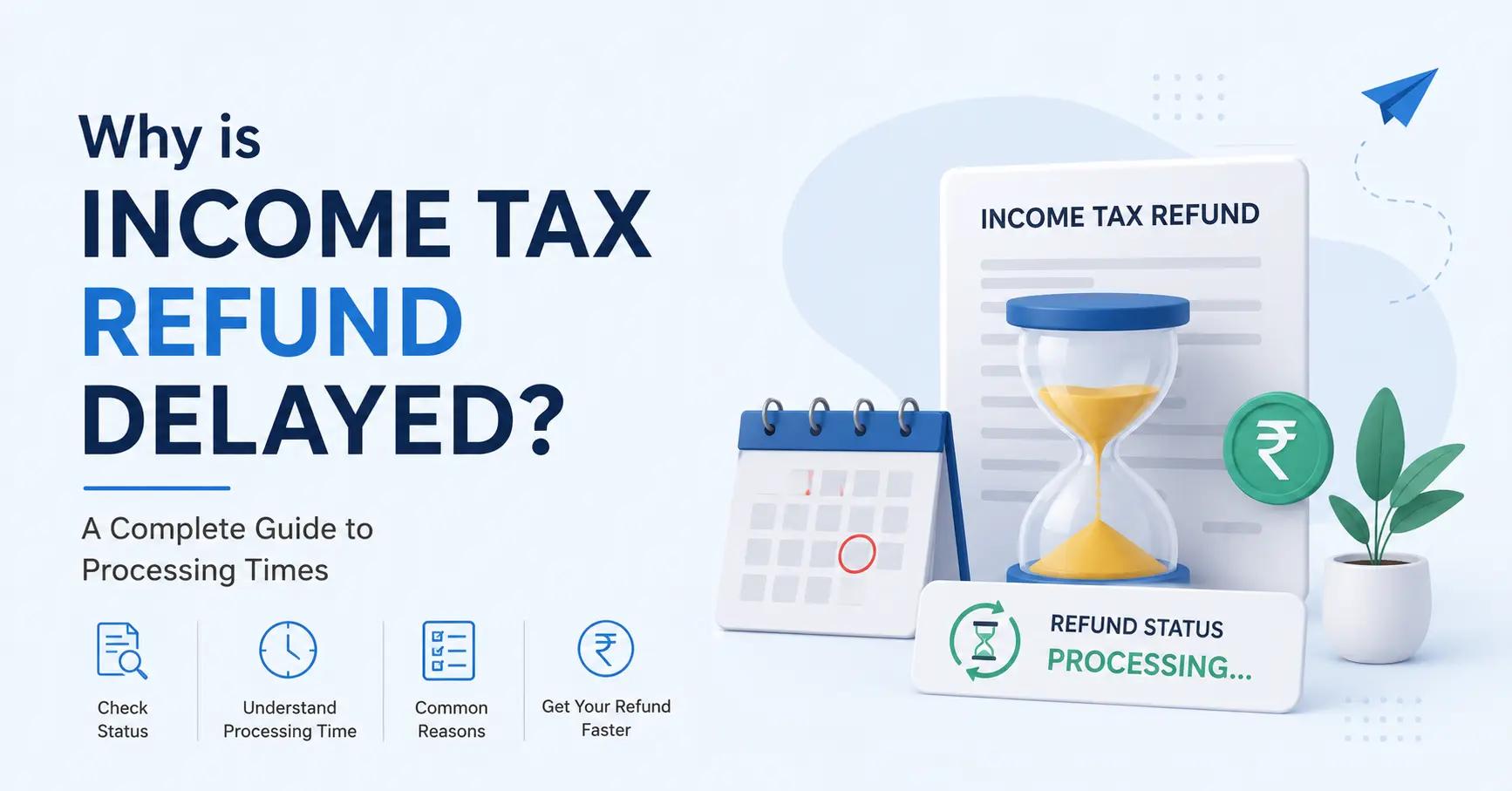
Table of Contents
Click to Expand
- What is the Standard Processing Time for ITR Refunds?
- The Real Reasons Why Your Tax Refund is Delayed
- How to Check Your Income Tax Refund Status
- What to Do If Your Refund is Delayed Beyond 90 Days
- Elements of the Tax Refund Processing System
- Features of the New Tax Processing System
- Case Study: The IT Mismatch Trap
- Why Active Management Beats Passive Waiting
- Conclusion / Final Thoughts
- Frequently Asked Questions
You filed your ITR on time. You checked the acknowledgement. You expect the money in your bank account within weeks.
It has been two months. Your bank account is still empty.
The anxiety is completely normal. Every year, millions of taxpayers stare at their bank apps wondering why the government is holding their money. The system is not broken. It is just backlogged.
This guide breaks down the reasons your income tax refund is delayed, the standard processing times, and the exact steps to find it.
What is the Standard Processing Time for ITR Refunds?
There is no single "refund release date." The timeline depends entirely on how you filed your return.
E-Verified Returns (Fastest)
If you used Aadhaar OTP or Net Banking to e-verify your ITR, the refund processing starts immediately. The standard timeline is 30 to 45 days from the date of e-verification.
Non-E-Verified Returns (Slowest)
If you did not e-verify, your return goes into a manual queue. A human officer must physically open your file and verify it. This takes significantly longer, usually 3 to 6 months.
If you are past the 45-day mark and did not e-verify, do not panic yet. You are likely in the manual queue.
The Real Reasons Why Your Tax Refund is Delayed
Understanding the backend mechanism helps. The Income Tax Department processes millions of returns through a clearinghouse system. Delays occur when your return is flagged or stuck at a specific stage.
1. Large Volume of E-Verified Returns
Over 80 percent of taxpayers in 2024 chose the e-verification system to speed up refunds.
The system works well, but the volume of instant verifications is still creating a processing bottleneck at the clearing house level.
2. Manual Verification Scrutiny
If you did not e-verify, your return is sent to the assessing officer. Even a slight mismatch between the PAN details and ITR data will lead the officer to issue a notice. The refund is pending until we hear back from you and iron out the discrepancy.
3. Mismatched Bank Account or PAN Details
This is the most common reason for a refund to get stuck. If the bank account number you provided has an incorrect IFSC code, or the name on the bank account does not match your PAN card exactly, the system cannot initiate the refund transfer.
4. Outstanding Tax Demand
Did you owe tax in the previous year and didn't pay it? The IT department can legally hold your refund for the current year to offset your past-due arrears. They won't release the money until the old dispute is settled.
How to Check Your Income Tax Refund Status
Don't just wait. You can actively track where your refund is sitting in the system.
- Go to the official Income Tax e-Filing Portal.
- Click on View Filed Returns.
- Submit your PAN and Assessment Year.
- Scroll down to the Refunds section. It will show the exact quantum of your refund and the current processing stage (Processed, Sent to Bank, Refund Failed, etc.).
What to Do If Your Refund is Delayed Beyond 90 Days
If you are well past the standard timeframe, sitting tight is the wrong strategy. You need to force the department's hand.
Raise a Grievance
Go to the Income Tax portal and navigate to Services > Grievances. Submit a grievance stating your ITR was processed months ago, but the refund has not been credited. This forces a customer service representative to look at your file manually.
Contact Your Assessing Officer
Every return is assigned a specific jurisdictional assessing officer. If you know your jurisdiction code, tracking down the officer directly often yields faster results than submitting generic web forms.
Elements of the Tax Refund Processing System
To understand the delay, you have to understand the infrastructure.
The Income Tax Department does not transfer money directly to your bank from their own servers. They use a clearinghouse system. The IT department generates a refund cheque and sends it to the clearinghouse. The clearinghouse then routes it to your specific bank branch.
If there is a data mismatch at any point in this chain, the entire process halts until it is manually fixed.
Features of the New Tax Processing System
The shift to complete digital processing has fundamentally changed refund timelines.
In the past, physical paper returns caused 6- to 12-month delays. Today, the e-filing system features real-time tracking. If you e-verify, the system generates an electronic refund warrant. This digital mandate eliminates the physical clearing delays that previously affected the department.
Case Study: The IT Mismatch Trap
Imagine two taxpayers. Both filed on July 31st. Both are owed a ₹25,000 refund.
Taxpayer A (E-Verified)
His bank details matched his PAN perfectly. His refund was processed and sent to the clearinghouse in 14 days. Money hit his account on day 30.
Taxpayer B (Non-E-Verified)
He didn't e-verify. His assessing officer noticed his middle name on the PAN card didn't match the bank account name. A notice was issued. Taxpayer B ignored the notice. The refund is frozen. It will take 5 months to resolve the name mismatch and release the funds.
This is why e-verification is critical. It bypasses the human bottleneck.
Why Active Management Beats Passive Waiting
Waiting for a tax refund is dead capital. If your money is sitting in the government's clearinghouse for 4 months, you are losing out on potential interest or investment returns.
Instead of just waiting for the government to process your return, you should be actively optimizing your tax outgo. If your tax liability is too high because of overlapping mutual funds or unmanaged capital gains, you are leaving money on the table.
Before you file next year, run a structural portfolio review. We can identify exactly where your portfolio is leaking tax efficiency and fix it. For HNIs looking to actively manage their capital gains and tax liability, explore Portfolio Management Services in India.
Conclusion / Final Thoughts
A delayed tax refund is frustrating, but almost always resolvable.
If you e-verified your return and your bank details are correct, it is just a matter of time. If you didn't e-verify, or if there is a data mismatch, you must take proactive steps to resolve the blockage.
Stop staring at your bank app. Log in to the portal, identify the exact hold-up, and raise a grievance to have your money released.
Use our free Capital Gain Calculator to estimate your Short-Term (STCG) and Long-Term (LTCG) capital gains tax on equity investments in India.
Learn about: ITR Full Form: What is Income Tax Return? Types & How to File Online.
Frequently Asked Questions
Is my income tax refund stuck if the status shows "Processed"?
Not necessarily. "Processed" means the IT department has finished calculating your refund. It has been handed over to the clearinghouse. The delay is now happening at the bank or clearinghouse level.
Can an income tax refund be delayed after 90 days?
Yes, especially for non-e-verified returns. If there is an outstanding tax demand against your PAN, the department will legally hold your refund until the old demand is cleared.
What happens if I provided the wrong bank account number?
The refund will fail. The money will bounce back to the IT department. You will need to submit a rectification request to update the correct bank details so a new refund voucher can be generated.
Who processes the actual income tax refund?
The Income Tax Department's system generates the refund. However, the actual transfer to your bank is executed by authorized clearinghouses (like NSDL or UTIITSL) under the strict guidelines of the Reserve Bank of India.
Disclaimer
Mutual fund investments are subject to market risks. Read all scheme-related documents carefully. Please consult a certified financial advisor before making any investment decisions.
Trust & Compliance
This article has been created following our strict Editorial Policy. We believe in complete transparency regarding how we operate; you can read our Disclosures. For legal liabilities and risk factors, please review our Disclaimer.
Share & Save Article
Other Posts
How to Check Income Tax Refund Status Online: A Complete Guide
Jul 18, 2026

What is Portfolio at Risk? A Complete Guide to Meaning, Formula, Calculation, & Benefits.
Jun 5, 2026

What is SIP & How Does It Actually Work?
May 27, 2026

What is an AMC in Mutual Funds? Understanding Asset Management Companies
May 27, 2026
