How PMS Generates Alpha: The Power of Concentrated Portfolios

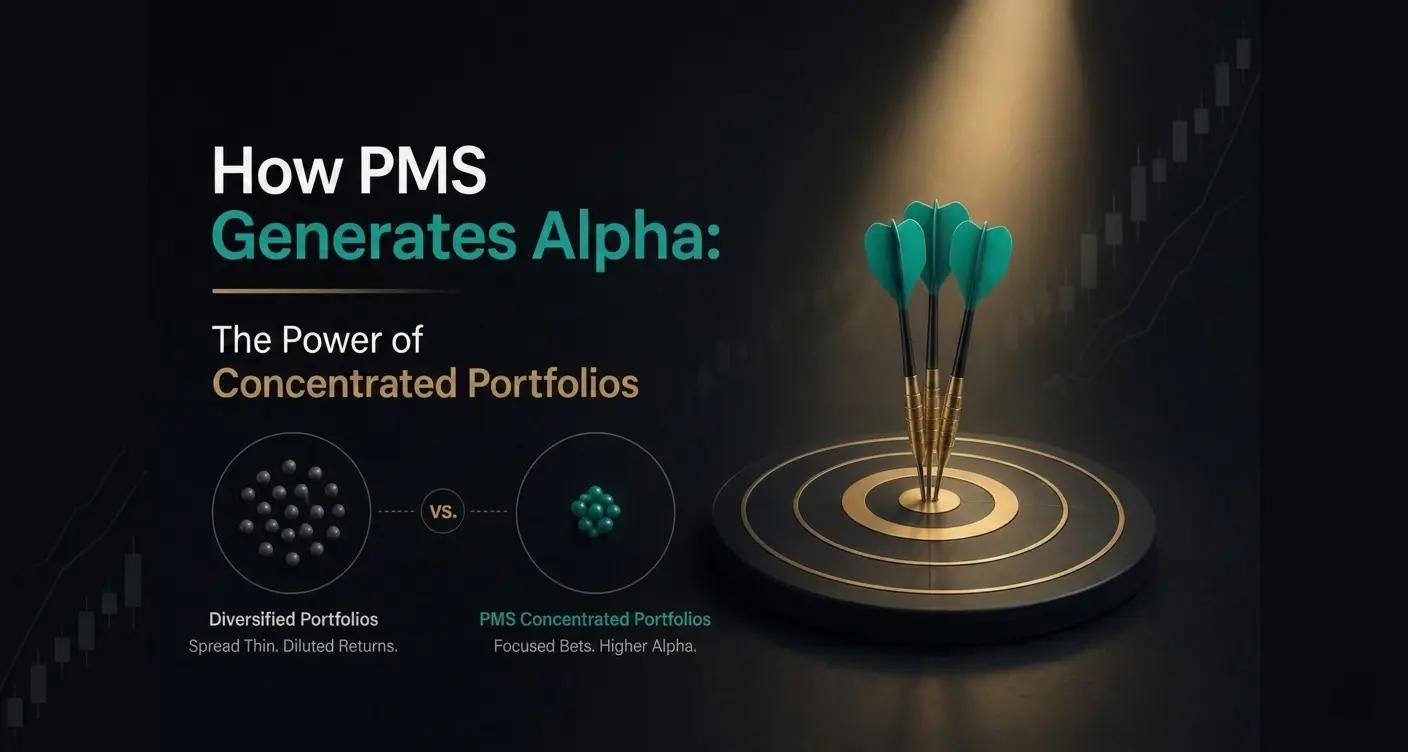
Table of Contents:
Click to Expand
- The Financial Theater of "High Returns"
- The Mutual Fund Dilution Effect
- The Concentrated Alpha Engine (The 20-Stock Sweet Spot)
- Margin of Safety: Buying ₹100 Assets for ₹60
- The Cash Optionality Advantage
- The Vestbox Case Study: The Cash Call That Saved a Crore
- The Brutal Reality: Amplified Downside Risk
Walk into any elite wealth management firm and utter the word "Alpha." Advisors will lean across the table, lower their voices, and throw around terms like "quantitative models," "factor investing," and "macro-hedging."
It is impressive-sounding financial theater.
But when you strip away the vocabulary, Alpha is a brutally simple concept. It is the exact measure of how much return you generate above what the market blindly gives you for doing nothing. If the Nifty delivers 12% and your portfolio delivers 18%, the extra 6% is Alpha.
The challenge? The pooled structure of standard mutual funds places mathematical limits on how much concentrated Alpha they can generate. If you want to understand how institutional money actually outperforms the broader market, you need to view Vestbox PMS investment strategies and look under the hood.
The Financial Theater of "High Returns"
The biggest trap for high-net-worth individuals is confusing a bull market with personal genius.
When the market surges by 20% and your mutual fund portfolio surges by 22%, you feel like a financial wizard. You start believing your fund manager is an "Alpha generator."
In a raging bull market, almost any equity allocation can beat the index by taking slightly more risk. True Alpha is mathematically defined as generating market-beating returns on a risk-adjusted basis over a full market cycle, including the inevitable crashes. Standard mutual funds struggle to do this consistently, not because the managers lack skill, but because their structure prevents them from doing so. To understand why, you have to look at how they are legally forced to construct their portfolios.
The Mutual Fund Dilution Effect
To understand Alpha, you must understand structural legal limits designed to protect retail investors.
Under the SEBI Master Circular for Mutual Funds, there is a strict investment restriction: an equity mutual fund scheme may not invest more than 10% of its net assets in the equity shares of a single company.
This is a brilliant regulation for the masses. It ensures no single company's failure can wipe out a retail investor's life savings. But it comes with a mathematical trade-off.
Let’s assume a mutual fund manager is a literal genius. Their top-conviction pick is a mid-cap manufacturing company they have researched for six months. They are certain it will triple in four years. To make a serious impact on the portfolio, they want to allocate 15% of the fund's total money to it.
They legally cannot. SEBI caps its maximum exposure at 10%.
The Math of Dilution: The manager buys the stock at the maximum 10% allowable limit. The stock triples (a massive 200% gain). But because that winning stock was legally restricted to just 10% of the total pool, the absolute maximum boost it can give to the overall mutual fund's Net Asset Value (NAV) is 20% (10% weight x 200% gain).
To build a large-scale fund safely, the manager is forced to allocate the remaining 90% of their money across 50, 60, or 70 other stocks to comply with broad diversification norms. The manager's genius is distributed across the broader portfolio. This framework is optimized for retail safety, but it inherently limits the potential for concentrated outperformance.
The Concentrated Alpha Engine (The 20-Stock Sweet Spot)
Portfolio Management Services (PMS) operate on a completely different mathematical paradigm, designed specifically for investors who have already maxed out their mutual fund allocations and want dedicated exposure.
A PMS manager typically constructs a portfolio of just 15 to 25 high-conviction stocks. If their best idea is a manufacturing company, they can allocate 8%, 10%, or even 12% of your specific portfolio to it.
When it triples, it dramatically moves the needle on your entire corpus.
This isn't gambling; it is the mathematical reality of conviction. By focusing on a smaller basket of high-quality stocks rather than adhering to strict diversification norms, a PMS manager ensures their actual intellectual edge, and their deep, proprietary research is directly reflected in your net worth. You get paid for the manager's top 5 ideas, rather than having them smoothed out by their bottom 50 ideas.
Margin of Safety: Buying ₹100 Assets for ₹60
How do PMS managers actually find these winning stocks? They don't use technical charts or rely on WhatsApp tips. They exploit the "Margin of Safety."
Institutional investors managing giant mutual funds cannot buy small or mid-cap companies without driving up the stock price 20% before the order is filled. They are permanently restricted to the top 100 large-cap stocks, where every piece of information is already priced in.
A specialized PMS manager, managing a few hundred crores, can operate in the mid-cap and small-cap spaces where genuine pricing inefficiencies exist.
The Mechanics: If a high-quality mid-cap company is fundamentally worth ₹100, but the broader market panics and drops the price to ₹60 due to a temporary sector headwind, mutual funds often have to sell it to maintain their strict liquidity ratios and mandate limits.
The PMS manager steps in. They buy a concentrated chunk of that ₹60 stock. The Margin of Safety is built into the entry price. Even if their thesis is slightly delayed, buying at a massive discount minimizes downside risk. When the market realizes the panic was overblown and the price normalizes to ₹100, that 66% upside hits your PMS portfolio with maximum force.
The Cash Optionality Advantage
This is perhaps the most underappreciated weapon in the PMS arsenal.
Mutual funds are mandated to remain 95% to 100% invested at all times. If the fund manager sees a massive bubble forming and wants to protect your capital, their hands are legally tied. They must buy something, even if every asset class is dangerously overpriced. This ensures the retail investor never misses a market rally, but it sacrifices downside protection.
A PMS manager has Cash Optionality.
If the market is irrationally exuberant, and the manager cannot find stocks that offer a sufficient Margin of Safety, they can hold 20% or 30% of your portfolio in pure cash or liquid assets.
Why is this Alpha? Because when the inevitable correction happens, while mutual fund investors experience the full drawdown, your PMS manager is sitting on a mountain of dry powder. They deploy that cash into high-quality companies at rock-bottom panic prices, generating massive Alpha in the subsequent recovery.
The Vestbox Case Study: The Cash Call That Saved a Crore
During a period of extreme market euphoria, a Vestbox PMS client had a ₹4 Crore mandate with a well-known large-cap mutual fund, and a ₹3 Crore PMS mandate managed by us.
The mutual fund remained 100% invested due to its mandate. The market eventually crashed by nearly 20%. The mutual fund dropped 18%, wiping out roughly ₹72 Lakhs in pure value.
Our PMS manager, however, had identified that valuations across the board were stretched beyond rational limits. Six months before the crash, they systematically started selling weak positions and raising the cash level in the PMS portfolio to 25% (₹75 Lakhs in cash).
When the market crashed, the 75% equity portion of the PMS took a hit, but the cash was entirely untouched. More importantly, when the market hit rock bottom, the manager aggressively deployed that ₹75 Lakhs into fundamentally strong stocks that had been unfairly punished.
When the market rebounded 40% over the next 14 months, the mutual fund recovered to its old high. The PMS portfolio? It skyrocketed to a new all-time high because the fresh cash deployment caught the entire upside of the recovery. The cash call didn't just protect downside risk; it engineered a massive Alpha event.
The Brutal Reality: Amplified Downside Risk
Let’s remove the rose-tinted glasses. PMS is not a magical machine that only goes up.
Because a PMS is concentrated (15-25 stocks), it lacks the broad shock absorbers of a 100-stock mutual fund. If the PMS manager gets their thesis wrong, or if an unpredictable "Black Swan" event hits a specific sector they are heavily invested in, a PMS will drop significantly harder and faster than a mutual fund.
You are not paying for a safety net. You are paying for a brain. You are placing a bet that the fund manager's intellectual edge over a 5 to 7-year cycle will enable the fund to outperform the broad market, accepting that the journey will be volatile.
If you want a smooth, highly stable ride that perfectly mirrors the broader economy, mutual funds remain the best tool for the job. If you want institutional-grade concentrated Alpha and have the psychological endurance to weather concentrated drawdowns, PMS is the only structural tool that actually allows it.
Explore our complete guide: What is PMS? A Complete Guide to Portfolio Management Services in India. What is a Portfolio Review? A Complete Guide to Fixing Your Investments
Disclaimer
Mutual fund investments are subject to market risks. Read all scheme-related documents carefully. Please consult a certified financial advisor before making any investment decisions.
Trust & Compliance
This article has been created following our strict Editorial Policy. We believe in complete transparency regarding how we operate; you can read our Disclosures. For legal liabilities and risk factors, please review our Disclaimer.
Share & Save Article
Other Posts

What is Portfolio at Risk? A Complete Guide to Meaning, Formula, Calculation, & Benefits.
Jun 5, 2026

What is SIP & How Does It Actually Work?
May 27, 2026

What is an AMC in Mutual Funds? Understanding Asset Management Companies
May 27, 2026

How PMS Works: A Complete Guide to Construction, Monitoring, and Reporting
May 27, 2026
