The Hidden Risks of a Self-Managed Portfolio

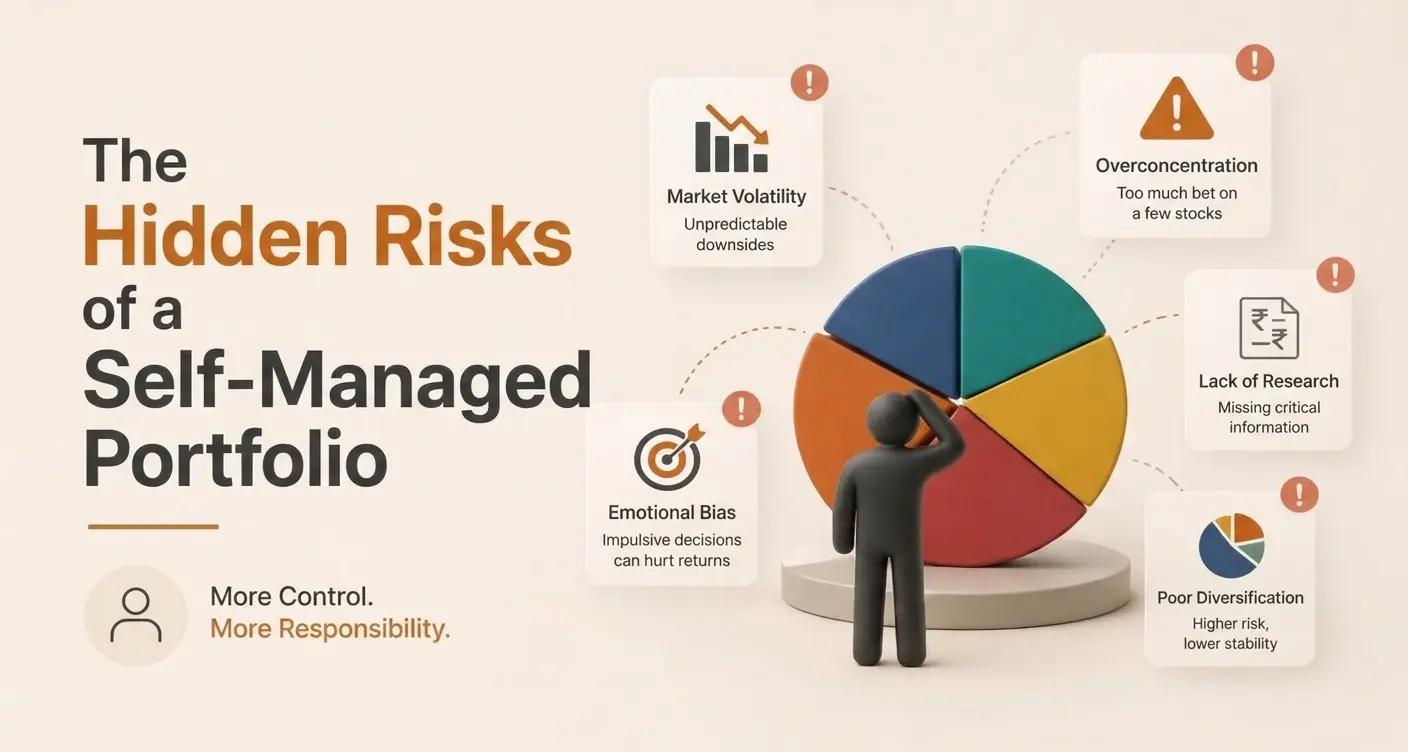
Table of Contents
Click to Expand
- The Strategy That Got You Here Won't Get You There
- The Inflection Point: When DIY Becomes a Liability
- The Illusion of a "Diversified" DIY Portfolio
- The Behavioral Tax of Self-Management
- The Tax-Efficiency Gap in DIY Portfolios
- The Vestbox Audit: The Hidden Cost of a 12% XIRR
- Delegation: The Ultimate Wealth Scaling Tool
The Strategy That Got You Here Won't Get You There
If you are reading this, there is a high probability that you are a highly successful professional, a founder, or a C-suite executive. And there is an even higher probability that you built your initial wealth by taking concentrated bets.
Maybe you picked the right direct stocks early, held onto your company's ESOPs, or identified a structural trend before the institutions did. You defied the "index fund" advice, trusted your own research, and built a self-managed portfolio worth ₹2 Crores, ₹3 Crores, or more.
You should be incredibly proud. But here is the brutal truth about wealth creation: The strategy that gets you from zero to one will almost always prevent you from going from one to ten.
If managing your investments feels like a high-stress second job, you must go for a Portfolio Reivew and analyze your portfolio for overlap to see if your DIY approach has hit its mathematical ceiling.
The Inflection Point: When DIY Becomes a Liability
Managing a ₹20 Lakh self-managed portfolio is vastly different from managing a ₹3 Crore portfolio.
At ₹20 Lakhs, a 20% drop means a ₹4 Lakh paper loss. It hurts, but it doesn't alter your lifestyle.
At ₹3 Crores, a 20% drop is a ₹60 Lakh wipeout. Suddenly, market volatility stops being an intellectual game and starts affecting your sleep, your focus at work, and your family dynamics.
This is the inflection point. When the absolute rupee risk exceeds your annual income, continuing to manage it yourself isn't a display of skill; it is an unnecessary risk to your mental health and your family's financial security.
The Illusion of a "Diversified" DIY Portfolio
Most successful self-directed investors hold 12 to 18 stocks or a handful of mutual funds. They believe this is a "concentrated but diversified" portfolio.
In institutional risk management, this is known as a "closet index with hidden bombs."
Because the Indian market is heavily skewed toward the top 50 companies, if you pick 15 quality stocks or funds, 8 of them will inevitably be large-caps (Reliance, HDFC, L&T, etc.). You are essentially holding a bloated, high-fee version of the Nifty.
The remaining 7 picks are your "alpha" bets, mid-cap or small-cap companies. The problem? If even one or two of those smaller companies face an unexpected governance issue or sector collapse, they can easily drop 40% to 50%. Because they represent a large chunk of your concentrated portfolio, they drag your entire net worth down massively.
In professional Portfolio Management Services (PMS), an institutional manager is equipped with the quantitative tools to run correlation matrices and stress tests. They systematically hedge against these localized bombs. A DIY investor rarely has the analytical infrastructure or the emotional detachment to do this.
The Behavioral Tax of Self-Management
We talk a lot about capital gains tax, but the most expensive tax in a self-managed portfolio is the Behavioral Tax.
The Sunk Cost Fallacy: You buy a stock based on a great thesis. The market proves you wrong, and the stock drops 50%. Instead of admitting defeat and redeploying that capital, you hold it for years. Why? Because selling it makes the loss "real."
The Recency Bias: Your best stock doubles, and you sell it too early to "book a profit." Your worst stock crashes, and you hold it forever because you don't want to book the loss. Over a decade, your portfolio becomes a graveyard of bad decisions tied up in dead capital.
You are paying a massive hidden tax in the form of "opportunity cost," the compounding returns you could have earned if that dead capital were managed by a professional who enforced strict discipline.
The Tax-Efficiency Gap in DIY Portfolios
When you manage your own wealth, tax planning is usually an afterthought. You sell when you need money, or when you panic, triggering whatever capital gains tax applies at that exact moment.
A professional PMS operates with tax efficiency baked into the daily mechanics. If a position is sitting at a loss, a PMS manager will strategically harvest that loss, selling it to offset the capital gains tax on a winning position elsewhere in the portfolio.
This isn't tax evasion; it is legal, mandated tax optimization. A DIY investor rarely has the time or the spreadsheet sophistication to execute this across 20 different assets.
The Vestbox Audit: The Hidden Cost of a 12% XIRR
A highly successful tech executive came to Vestbox fiercely proud of his self-managed portfolio. Over eight years, he had grown it to ₹4 Crores with an XIRR of 12%. He refused to even look at professional management because he believed no one could beat his returns.
We ran the diagnostic.
1. The Beta Illusion: Out of 15 stocks and mutual funds, 9 were Nifty heavyweights. His "alpha" was mostly just the broader market rising.
2. The Dead Zone: 4 positions were down 40% to 60%, representing nearly ₹80 Lakhs in trapped, dead capital.
3. The Stress Factor: We calculated his "Sortino Ratio" (a measure of downside risk). It was terrible. To get that 16% return, he had endured two 35% drawdowns in eight years. The psychological toll was immense.
When we showed him that a structured PMS could have delivered a smoother 14% return without the 35% heart-stopping drawdowns, and with continuous tax-loss harvesting, he finally understood: He wasn't beating the market; the market was beating him up, and he was just stubborn enough to hold on.
Delegation: The Ultimate Wealth Scaling Tool
You are likely at the top of your field. You understand that to scale a business, you have to stop doing everything yourself and hire specialized executives.
Yet, when it comes to your personal wealth, which is likely larger than many small businesses, you insist on being the CEO, the analyst, the risk manager, and the tax accountant all at once.
Transitioning from a self-managed portfolio to professional management is not an admission of defeat. It is the recognition that your time and mental bandwidth are your most valuable assets. It is the decision to delegate the operational complexity of wealth management to an institutional desk, so you can focus on what you actually do best: creating more wealth.
If you aren't ready to hand over the keys completely, start by getting a professional audit. Find out exactly how much risk you are hiding in your DIY portfolio. To see how professional structures like PMS compare to other institutional options in handling this exact transition, review our SIF vs PMS vs AIF vs Mutual Funds breakdown.
Explore our complete guide:
Disclaimer
Mutual fund investments are subject to market risks. Read all scheme-related documents carefully. Please consult a certified financial advisor before making any investment decisions.
Trust & Compliance
This article has been created following our strict Editorial Policy. We believe in complete transparency regarding how we operate; you can read our Disclosures. For legal liabilities and risk factors, please review our Disclaimer.