SIF vs Thematic Funds: Why SEBI Created the SIF Category

For the last decade, the Indian asset management industry has played a dangerous game.
It took high-risk, ultra-concentrated sector bets, wrapped them in a mutual fund wrapper, and sold them to retail investors as long-term wealth creators.
When those sectors crashed, investors lost millions. The industry shrugged and said, "It was a market cycle."
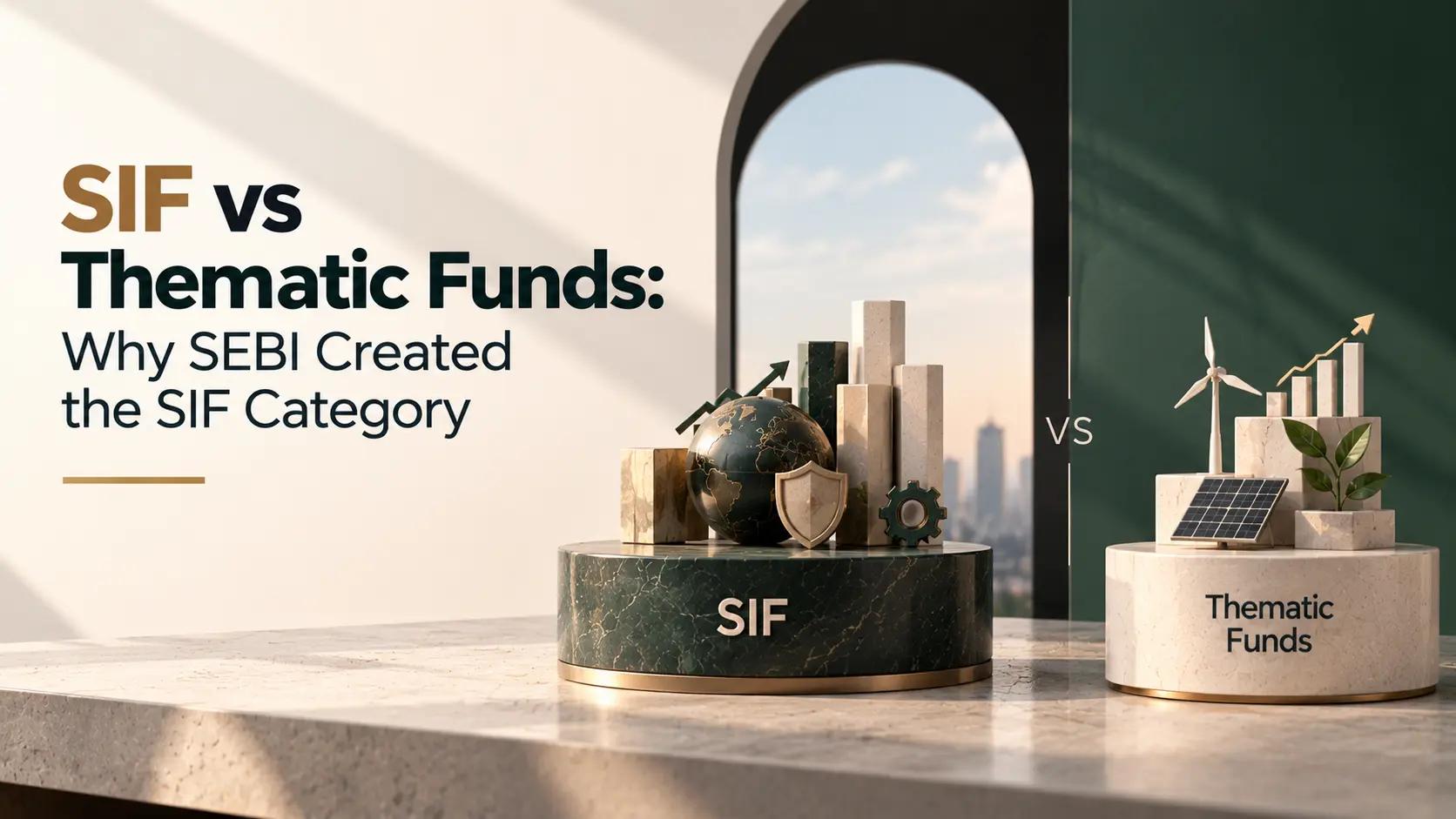
SEBI realized that forcing retail investors into unhedged, concentrated thematic bets was structurally flawed. The regulator did not just create a new product. It marked a clear boundary between toxic beta and true institutional alpha. That line is the Specialized Investment Fund (SIFs).
If you are confused about SIF vs thematic funds, this structural breakdown will change how you view wealth creation forever.
Key Takeaways
- Thematic mutual funds are highly concentrated, long-only bets that inherit the full downside of a sector crash without any hedging tools.
- SEBI created the SIF category under a circular dated February 27, 2025, to cleanly separate sophisticated derivative strategies from standard retail mutual funds.
- A Sector Rotation SIF can actively short weak sectors using derivatives, while a thematic mutual fund is legally prohibited from hedging its downside.
- SIFs require a strict Rs 10 lakh minimum investment to ensure only sophisticated investors participate in complex derivative strategies.
- The SIF framework ends the practice of selling toxic sector bets disguised as low-risk mutual funds.
Table of Contents
Click to Expand
The Thematic Mutual Fund Trap
Over the last five years, fund houses launched dozens of thematic and sectoral mutual funds. Defense funds, tech funds, pharma funds. They marketed these as "future-proof" wealth creators.
The reality is far more brutal.
A thematic mutual fund is a long-only, unhedged bet on a single sector. If the defense sector drops 30 percent, your fund drops 30 percent. The fund manager has zero tools to protect your capital. Under standard mutual fund regulations, they cannot short the sector. They cannot hold significant cash. They are legally mandated to stay fully invested in a crashing market.
Retail investors were essentially taking hedge fund-level sector risk, but with zero hedging tools and a 1.5 percent management fee. It was a structural mismatch.
The SEBI Intervention: Drawing the Line
SEBI recognized that fund houses were launching ultra-specific thematic funds under the mutual fund banner, which often misled retail investors into taking concentrated risks without realizing it.
To bring order to this space, SEBI introduced the Specialized Investment Fund framework.
A circular dated February 27, 2025, introduced this asset class, and it officially came into effect on April 1, 2025. You can verify the framework details through SEBI’s February 2025 SIF Circular.
The regulator essentially said: If you want to run complex, concentrated, derivative-heavy strategies, you cannot do it under the standard retail mutual fund wrapper. You must do it under the SIF framework, with a strict Rs 10 lakh minimum investment to keep beginners out.
The SIF Separation: True Alpha vs Toxic Beta
This is where the SIF vs thematic funds debate is settled.
A thematic mutual fund only makes money when its specific sector goes up. It is purely directional. It is toxic beta.
A Sector Rotation Long Short SIF is fundamentally different. The manager picks up to four high-potential sectors. But instead of just buying stocks and hoping they go up, they use derivatives to actively short the weak sectors.
If the broader market declines due to a global supply chain disruption, the SIF short positions surge in value, acting as an airbag. It generates returns that move independently of broader market direction.
To understand the different categories available under this framework, read our guide on Types of SIF Funds.
The Vestbox Case Study: The Sector Crash
Let us look at a real-world scenario to see why this regulatory shift matters.
The Client: A 45-year-old investor who invested Rs 30 lakh in a popular defence sector thematic mutual fund in 2023.
The Problem: The defense sector had run up massively, but when global macroeconomic sentiment shifted, the sector faced a severe 35 percent correction. Because it was a thematic mutual fund, the manager was legally forced to stay fully invested and watch the portfolio bleed. According to Vestbox data, his concentrated thematic fund suffered an estimated 34 percent drawdown.
The Solution: We intercepted the portfolio and redirected his remaining capital into a Sector Rotation Long Short SIF. The manager took long positions in strong infrastructure stocks, but actively shorted overvalued mid-cap defense stocks using derivatives.
The Math: When the defense sector faced its next 15 percent correction, the SIF short positions kicked in flawlessly. Based on Vestbox data, instead of crashing 15 percent, his SIF allocation stayed completely flat at a positive 0.5 percent. He saved his capital from a sector-specific crash because the SIF framework allowed the manager to hedge the risk legally.
To understand the broader rules governing these funds, read our guide on SIF Regulations in India.
To evaluate the top funds in this category, read our list of the Best SIF Funds in India.
Disclaimer: The above scenario is an illustrative study based on expected market behavior and estimated Vestbox data. The figures are approximate and meant strictly for educational purposes to demonstrate portfolio architecture. Actual market returns and fund performance will vary based on real-time conditions.
Frequently Asked Questions
What is the difference between a SIF and a thematic mutual fund?
The main difference is hedging capability. A thematic mutual fund is a long-only, unhedged bet on a single sector. A Sector Rotation SIF can use derivatives to actively short weak sectors, protecting your capital during a sector crash.
Why did SEBI create the SIF category?
SEBI created the SIF category to separate complex, derivative-heavy strategies from standard retail mutual funds. This prevents beginners from accidentally taking on hedge-fund-level sector risks without proper hedging tools.
Can a thematic mutual fund short the market?
No. Under standard mutual fund regulations, thematic and sectoral funds are strictly long-only. They are legally prohibited from holding short positions to protect the portfolio during a market crash.
Is a SIF safer than a thematic fund?
A SIF isn't necessarily safer, but it actively manages risk. While a thematic fund inherits the full downside of a sector crash, a SIF can use unhedged short exposure of up to 25 percent to hedge its downside, resulting in much lower drawdowns.
What is the minimum investment for a SIF vs a thematic fund?
You can start investing in a thematic mutual fund with as little as Rs 100. A Specialized Investment Fund requires a strict minimum investment of Rs 10 lakh per investor at the PAN level, ensuring only sophisticated investors participate.
Can a SIF invest in specific sectors?
Yes. A Sector Rotation Long Short SIF concentrates capital in up to four high-potential sectors, and the manager can rotate capital among them based on economic cycles.
“Want the full overview of SIFs, regulations, and benefits? Explore the complete guide: What are SIF Funds? How do SIFs work?“
Ready to explore?
SEBI-regulated long-short and hedging strategies designed to capture opportunities in all market conditions.
Disclaimer
Mutual fund investments are subject to market risks. Read all scheme-related documents carefully. Please consult a certified financial advisor before making any investment decisions.
Trust & Compliance
This article has been created following our strict Editorial Policy. We believe in complete transparency regarding how we operate; you can read our Disclosures. For legal liabilities and risk factors, please review our Disclaimer.