SIF in Market Crash: The Long-Short Hedging Advantage

The market drops 20 percent in a single month. Your mutual fund statement arrives, and you have lost a massive chunk of your wealth. What is your next move?
Most retail investors panic, sell at the bottom, and swear off the stock market forever. But institutional investors don't panic. They planned for this exact scenario before deploying their capital.
If you’re looking to protect your portfolio during a market crash, you need to understand the structural advantage of a Specialized Investment Fund (SIF).
Key Takeaways
- A standard mutual fund is mathematically trapped during a market crash because it is legally restricted to long-only positions.
- A SIF protects capital with long-short strategies, buying strong stocks while simultaneously shorting weak stocks or index futures.
- When the broader market drops, the short derivative positions in a SIF surge in value, offsetting the long portfolio’s losses.
- The primary benefit of a SIF during a crash is psychological. It prevents panic selling by mathematically containing the portfolio drawdown.
- SEBI permits SIFs to take an unhedged short exposure of up to 25 percent of their net assets, giving them institutional-grade hedging power.
Table of Contents
- The Asymmetry of Market Crashes
- The Mutual Fund Trap
- The Long-Short Hedging Mechanic
- The Vestbox Case Study: The 2024 Global Shock
- Frequently Asked Questions
The Asymmetry of Market Crashes
Most investors do not understand the brutal math of drawdowns. The stock market is highly asymmetric when it moves south.
If your portfolio drops 20 percent, you do not need a 20 percent gain to recover. You need a 25 percent gain to break even. If your portfolio drops 40 percent, you need a massive 67 percent gain.
When the market crashes, you don’t just lose money today. You are mathematically destroying your ability to compound wealth for the next five years. Protecting your capital during a crash is not just about avoiding fear. It is about ensuring your recovery curve is short enough to survive.
The Mutual Fund Trap
During a market crash, standard equity mutual funds are structurally defenseless.
Under standard mutual fund regulations, equity schemes must be long only. Fund managers cannot hold significant cash to defend against corrections. They cannot use derivatives to hedge their positions. They cannot short sell an overvalued stock.
You are paying a management fee for excellent stock selection, but the manager is fundamentally restricted to being a passenger during a market crash. When the market bleeds, your mutual fund bleeds.
To understand how this stacks up against other structures, read our guide on SIF vs PMS vs Mutual Funds.
The Long-Short Hedging Mechanic
This is where the Specialized Investment Fund completely changes the game.
A SIF protects capital by using long-short strategies. The fund manager buys high-conviction stocks while simultaneously using derivatives to short weak stocks or the broader index.
SEBI permits SIFs to take an unhedged short exposure of up to 25 percent of their net assets. SEBI introduced this under its SIF circular dated February 27, 2025.
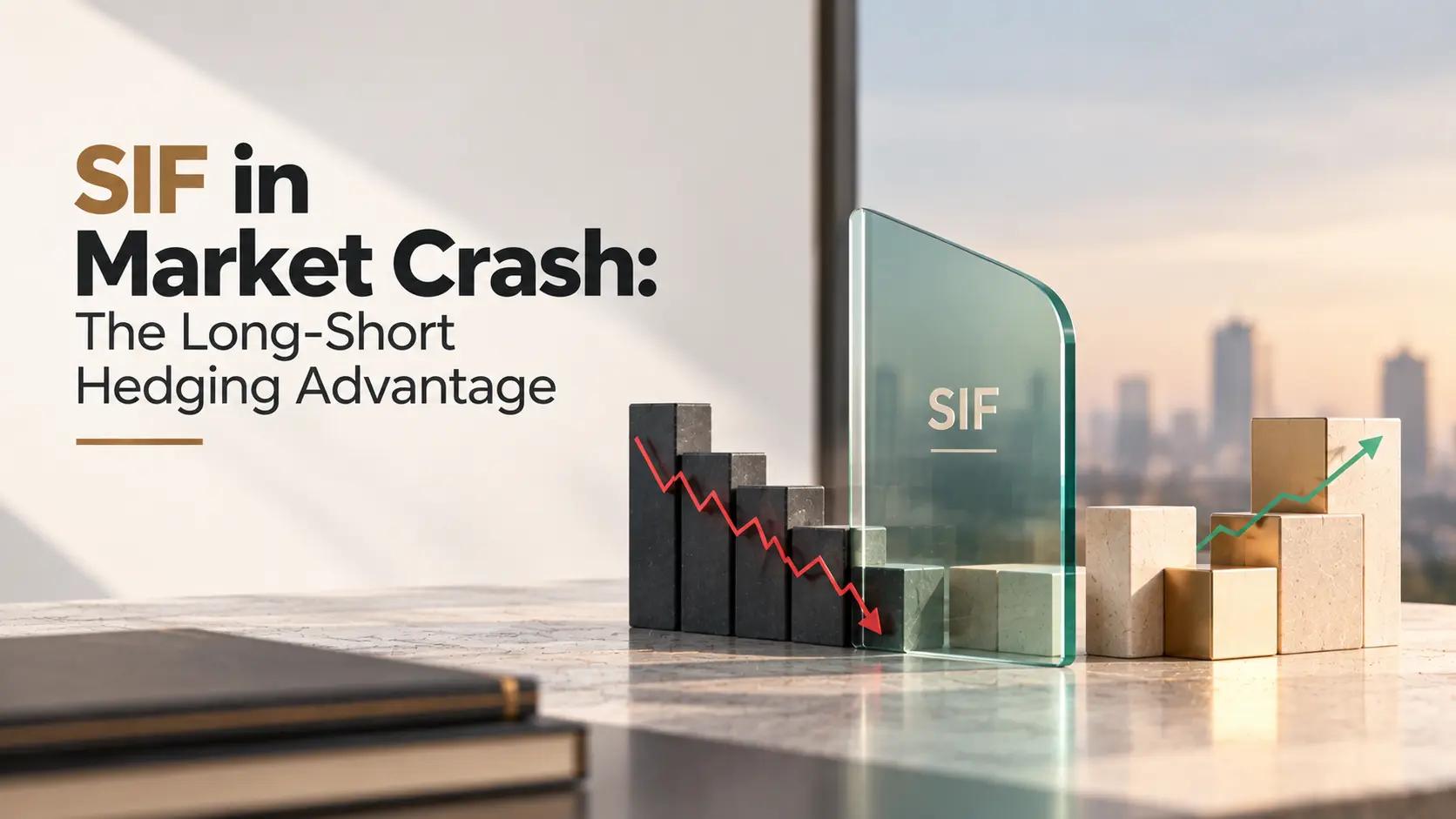
When the broader market drops, SIF long positions take a hit. But the short positions surge in value, acting as a structural shock absorber. Your portfolio stays flat, instead of crashing 20 percent.
To understand how these strategies work, read our guide on SIF Strategies: how long-short arbitrage derivatives work.
The Vestbox Case Study: The 2024 Global Shock
Let us look at a real-world scenario to see the long-short advantage in action.
The Client
A 48-year-old executive with a Rs 30 Lakh portfolio, heavily concentrated in large-cap mutual funds.
The Problem
A sudden global macro shock hit the markets, and the Nifty dropped a violent 18 percent in a single quarter.
Based on Vestbox data, his large-cap mutual fund portfolio suffered an estimated drawdown of roughly 16 percent. He lost an estimated Rs 4.8 lakh in three months. He was on the verge of panic selling at the absolute bottom.
The Vestbox Restructure
We intercepted the portfolio and redirected a portion of his capital into an Equity Long Short SIF. When the market faced its next 12 percent correction, the SIF manager aggressively shorted weak mid-cap stocks and used index put options to hedge the downside.
The Math
Based on Vestbox data, while the broader market fell 12 percent, the SIF allocation restricted the drawdown to an estimated 2 percent. His overall portfolio drawdown was cut in half.
The Real Result
Because his drawdown was mathematically contained, he did not panic. He did not sell at the bottom. His entire portfolio recovered to an all-time high when the market rebounded.
The SIF did not just save his portfolio mathematically. It saved his portfolio psychologically.
To understand how to size these hedging positions within your overall wealth, read our guide on SIF Portfolio Allocation.
Disclaimer: The above scenario is an illustrative study based on expected market behavior and estimated Vestbox data. The figures are approximate and meant strictly for educational purposes to demonstrate portfolio architecture. Actual market returns and fund performance will vary based on real-time conditions.
Frequently Asked Questions
How does a SIF protect capital during a market crash?
A SIF protects capital by using long-short hedging strategies. The fund buys high-conviction stocks while simultaneously shorting weak stocks or index futures. When the broader market drops, the short positions surge in value, offsetting the losses in the long portfolio.
Can a mutual fund hedge during a market crash?
No. Under standard mutual fund regulations, equity schemes must be long-only. They are legally prohibited from holding short positions to protect the portfolio during a market crash.
What is the long-short advantage in a SIF?
The long-short advantage lets a SIF generate returns uncorrelated with the broader market. Instead of absorbing the full downside of a market crash, the SIF uses derivatives to hedge downside risk, resulting in much lower drawdowns.
Are SIFs riskier than mutual funds during a crash?
No. SIFs generally carry lower downside risk during a crash than standard long-only mutual funds because they can actively hedge their positions with derivatives. However, they do involve complex derivative risks that standard mutual funds do not face.
How much short exposure can a SIF take?
SEBI permits SIFs to take an unhedged short exposure of up to 25 percent of their net assets using derivatives. This gives the fund manager institutional-grade hedging power during a market crash.
Should I sell my mutual funds to buy a SIF?
You should not sell your core mutual funds, as they are essential for long-term compounding. A SIF is a satellite investment designed to hedge your core portfolio. You need both in a mature architecture.
“Want the full overview of SIFs, regulations, and benefits? Explore the complete guide: What is SIF Fund? How do SIFs work? “
Ready to explore?
SEBI-regulated long-short and hedging strategies designed to capture opportunities in all market conditions.
Disclaimer
Mutual fund investments are subject to market risks. Read all scheme-related documents carefully. Please consult a certified financial advisor before making any investment decisions.
Trust & Compliance
This article has been created following our strict Editorial Policy. We believe in complete transparency regarding how we operate; you can read our Disclosures. For legal liabilities and risk factors, please review our Disclaimer.