SIF vs Arbitrage Mutual Funds: The Institutional Upgrade

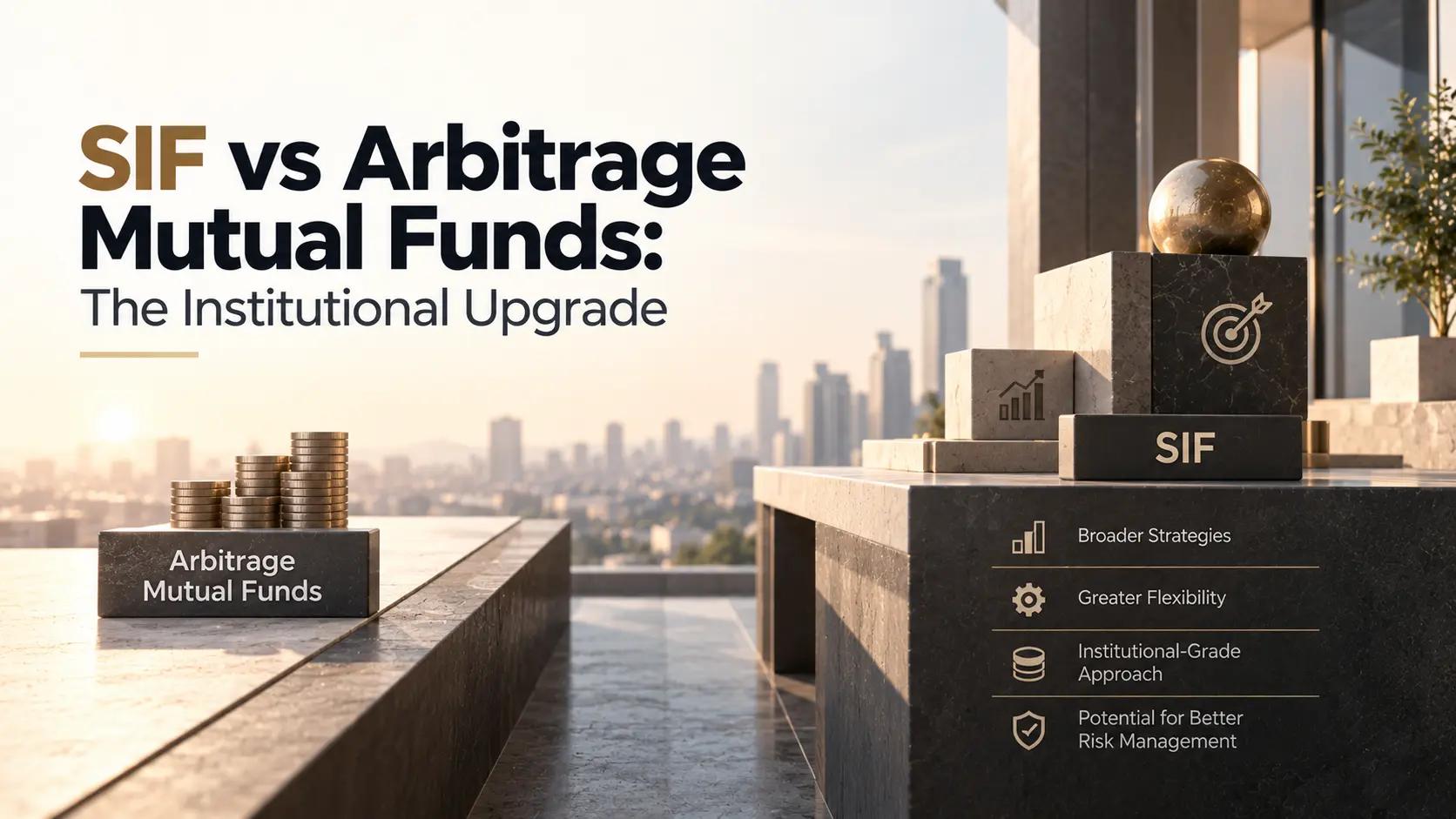
Arbitrage mutual funds are merely training wheels on India's wealth management journey. They are safe, they are simple, and for years they were the only way retail investors could access the futures market without taking directional risks.
But if you are a High Net Worth Individual deploying Rs 10 Lakhs or more, training wheels will slow you down. You need an institutional upgrade.
If you're confused between parking your capital in a standard retail arbitrage fund and upgrading to a Specialized Investment Fund (SIFs), this breakdown will save you years of compounded underperformance.
Key Takeaways
- Retail arbitrage mutual funds suffer from massive AUM bloat, causing severe slippage and lower yields for investors.
- A Specialized Investment Fund uses institutional-grade, high-frequency algorithms to execute arbitrage trades with near-zero friction.
- SIFs offer dynamic asset allocation flexibility, allowing managers to pivot across equity, debt, and commodity derivatives.
- Although both vehicles are taxed similarly given their 65% equity exposure, SIFs generate significantly better post-tax returns because their execution costs are lower.
- Arbitrage funds aim to preserve capital, whereas SIFs are designed to generate institutional alpha and hedge downside.
Table of Contents
Click to Expand
The Retail Trap: Limits of Arbitrage Mutual Funds
Arbitrage mutual funds exploit the pricing spread between the cash and futures markets. The strategy is fundamentally sound. The problem is the scale at which retail funds operate.
When an arbitrage mutual fund collects Rs 10,000 crore in Assets Under Management, the sheer size forces the fund manager to deploy massive capital into a limited number of liquid futures contracts. This sheer size creates severe market impact.
The fund's massive size creates slippage. It ends up buying at higher prices and selling at lower prices than the algorithm intended. This friction cost eats into your returns, dragging the yield down to levels barely above a standard liquid fund.
The Institutional Upgrade: SIF Execution Power
This is where the Specialized Investment Fund destroys the retail arbitrage fund.
A SIF's strict Rs 10 lakh per PAN minimum naturally restricts its AUM to serious, high-ticket investors. The fund manager is not drowning in Rs 500 SIP contributions. They are managing a concentrated, agile pool of institutional capital.
This lets the SIF use high-frequency algorithms and co-located servers housed physically inside the NSE building to execute trades. Based on Vestbox data, institutional SIF execution models capture microscopic pricing spreads that retail funds simply cannot access, resulting in an estimated yield improvement of roughly 2 percent annually over standard retail arbitrage funds.
To understand the exact mechanics of these strategies, read our guide on SIF Strategies: how long-short arbitrage derivatives work.
The Flexibility Advantage: Dynamic Asset Allocation
A retail arbitrage mutual fund is structurally boxed in. It must maintain a minimum exposure to equities and derivatives to qualify for equity taxation. If the arbitrage spread disappears, the fund manager has no other tools to generate returns. They sit on cash.
A SIF is completely unboxed. SEBI permits SIFs to take an unhedged short exposure of up to 25 percent of their net assets. SEBI introduced this asset class in its SIF circular dated February 27, 2025.
If the arbitrage spread dries up, a Hybrid Long Short SIF can dynamically shift its capital into pure debt instruments, REITs, or even commodity derivatives to hunt for yield in different markets. The manager is not restricted to one strategy.
The Tax Reality Check
Many investors wrongly assume that retail arbitrage funds are tax-free. They are not.
The taxman does not care about the clever name of your strategy. SIFs and arbitrage mutual funds attract the same tax treatment based on their underlying asset allocation.
If the fund maintains over 65 percent in domestic equities, you pay 20 percent Short-Term Capital Gains and 12.5 percent Long-Term Capital Gains above the Rs 1.25 lakh exemption limit.
If the fund holds less than 65 percent in equities, all gains are added to your income and taxed at your personal income tax slab rate.
To understand the deep math behind this, read our guide on SIF Taxation & Fee Structures in India.
A SIF doesn't win the tax battle through some loophole. It wins on arithmetic. A higher gross yield before taxes means a significantly larger absolute post-tax return.
The Vestbox Case Study: The Yield Upgrade
Let us look at a real-world scenario to see why upgrading matters.
The Client: A 52-year-old chartered accountant who had parked Rs 50 Lakhs in a top-tier retail arbitrage mutual fund for 3 years.
The Problem: He was seeking capital protection and steady yields. However, according to Vestbox data, the fund had grown so large that slippage dragged his net annualized return down to an estimated 5.8 percent. After factoring in his 30 percent tax slab rate, his post-tax return was a mere 4 percent. He was losing money to inflation.
The Solution: We intercepted the portfolio and redirected his capital into a Hybrid Long Short SIF that maintained a strict 70 percent equity tilt. The institutional algorithms captured better spreads, and the manager dynamically shifted to debt during a volatile market correction.
The Math: Based on Vestbox data, the SIF generated an estimated annualized return of 8.2 percent. Because it qualified for equity taxation, his post-tax return jumped to roughly 7.1 percent. He captured an estimated Rs 1.55 lakh more in pure profit per year simply by upgrading from a retail vehicle to an institutional one.
To evaluate the top funds in this category, read our list of the Best SIF Funds in India.
Disclaimer: The above scenario is an illustrative study based on expected market behavior and estimated vestbox data. The figures are approximate and meant strictly for educational purposes to demonstrate portfolio architecture. Actual market returns and fund performance will vary based on real-time conditions.
Frequently Asked Questions
What is the difference between a SIF and an Arbitrage Mutual Fund?
The main difference is execution scale. Retail arbitrage mutual funds suffer from massive AUM bloat and slippage. A SIF uses institutional algorithms for near-zero-friction trade execution, generating higher yields with the freedom to reallocate assets dynamically.
Are SIFs safer than arbitrage mutual funds?
SIFs are not necessarily safer, but they manage risk more dynamically. While an arbitrage fund is restricted to one strategy, a SIF can use unhedged short exposure and shift across asset classes to protect the portfolio during a market crash.
Are SIFs taxed like arbitrage funds?
Yes. Both vehicles are taxed like mutual funds based on their underlying 65 percent equity allocation. SIFs win the tax battle because their institutional execution generates a higher gross yield before taxes are applied.
Why do retail arbitrage funds have lower yields?
Retail arbitrage funds collect massive amounts of capital from small investors. When a fund manager is forced to deploy thousands of crores into a limited number of liquid futures contracts, the sheer size creates market impact and slippage, dragging the net yield down.
Can a SIF invest in commodities?
Yes. Under the SIF framework, a Hybrid Active Asset Allocator SIF can dynamically shift capital across equity, debt, REITs, InvITs, and commodity derivatives based on market opportunities.
Is a SIF better than an arbitrage fund for HNIs?
Yes. For High Net Worth Individuals with a Rs 10 lakh-plus corpus, a SIF provides better execution, higher post-tax returns, and institutional-grade flexibility that a retail arbitrage fund cannot match.
“Want the full overview of SIFs, regulations, and benefits? Explore the complete guide: What are SIF Funds? How do SIFs work? “
Ready to explore?
SEBI-regulated long-short and hedging strategies designed to capture opportunities in all market conditions.
Disclaimer
Mutual fund investments are subject to market risks. Read all scheme-related documents carefully. Please consult a certified financial advisor before making any investment decisions.
Trust & Compliance
This article has been created following our strict Editorial Policy. We believe in complete transparency regarding how we operate; you can read our Disclosures. For legal liabilities and risk factors, please review our Disclaimer.