Hybrid SIF Downside Protection Trade-off: The Real Cost

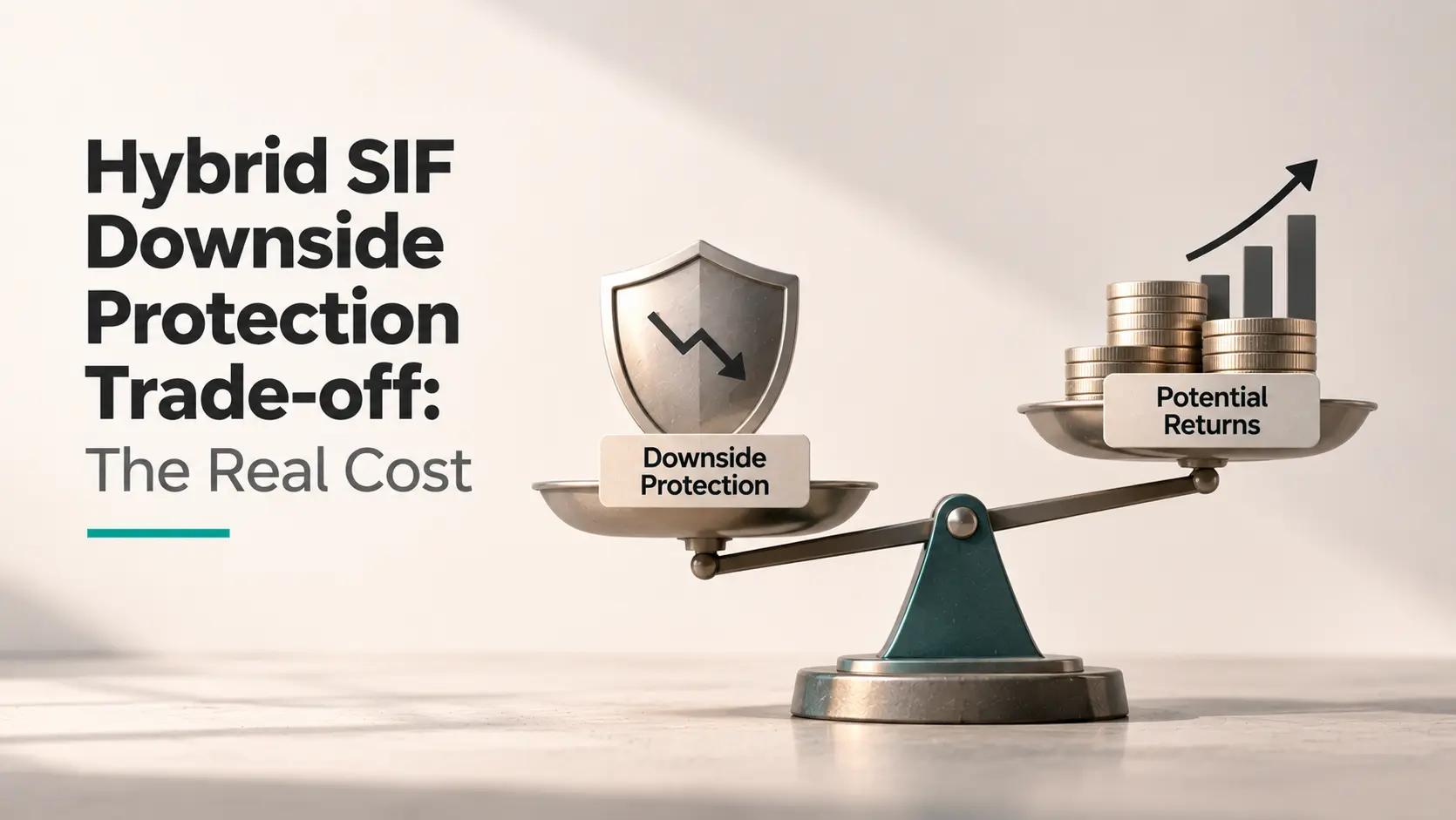
Insurance is never free.
When you buy a term plan, you pay a premium every year. If nothing happens to you, you lose that premium. But if disaster strikes, your family gets a massive payout. You accept a small, guaranteed loss to protect against a catastrophic loss.
A Hybrid Long-Short Specialized Investment Fund works on the same logic. The fund manager uses derivatives, short positions, and dynamic asset allocation to insure your portfolio against market crashes. But that insurance has a premium. And the premium is paid through sacrificed returns during bull markets.
This is the hybrid SIF downside protection trade-off. It is the single most misunderstood concept in the SIF ecosystem, and it's why most investors abandon their hedged funds at the worst possible moment.
The Core Mechanic: What You Are Actually Buying
Under the SEBI SIF framework introduced on February 27, 2025, a Hybrid Long-Short SIF must maintain at least 25 percent in equity and 25 percent in debt at all times. The manager can then take an unhedged short exposure of up to 25 percent of net assets using derivatives. You can verify the exact framework through the SEBI SIF Circular February 2025.
When the market crashes, those short positions surge in value. The fund stays flat or even generates a positive return while pure equity funds bleed 20 percent. This is the protection.
But here is what nobody tells you. When the market rallies 25 percent in a single year, those same short positions become dead weight. The fund returns 12 percent instead of 25 percent. That missing 13 percent is the premium you paid for the insurance.
The Three Market Phases and the Trade-off
To understand the trade-off, break the market into three distinct phases and see how a hybrid SIF behaves in each. To understand the broader category, read our guide on Types of SIF Funds.
Phase 1: The Bull Market (The Drag Phase)
In a structural bull run, a hybrid SIF will chronically underperform a pure equity mutual fund. This is not a flaw. This is the trade-off functioning exactly as designed. The short positions that protect you during a crash actively work against you during a rally. Derivatives bleed value through theta decay, and the unhedged short exposure loses money as stock prices rise.
If you compare a hybrid SIF to a Nifty 50 index fund during a bull market, the index fund will win every single time. An investor who doesn't understand the trade-off will see the underperformance, panic, and exit the SIF. This is the moment the trade-off does its job.
Phase 2: The Bear Market (The Protection Phase)
This is when the trade-off pays off. When the market drops 25 percent, your pure equity friends are bleeding. Your hybrid SIF, with its short positions and dynamic debt allocation, might drop only 5 percent or even stay flat.
The 20 percent you did not lose is the payout. This is the insurance claim. But here is the psychological trap. Most investors don't celebrate the 20 percent they didn't lose. They only see the 5 percent they did lose, and they panic anyway.
Phase 3: The Sideways Market (The Alpha Phase)
This is where a hybrid SIF actually justifies its existence beyond pure insurance. In a sideways, volatile market where the index goes nowhere for 18 months, a pure equity fund generates nothing. A hybrid SIF, however, can generate steady alpha through arbitrage spreads, sector rotation, and tactical long-short positioning.
The fund manager is not just hedging. They are actively manufacturing returns from market inefficiencies. This is the phase where the trade-off flips in your favor. You get the protection of the hedge plus the alpha of the strategy. To understand the exact mechanics, read our guide on SIF Strategies: how long-short arbitrage derivatives work.
The Hidden Costs Nobody Talks About
The trade-off is not just about sacrificed upside. Hidden friction costs compound the drag over time.
Derivative Slippage: Every time the fund manager rolls over a futures contract or adjusts a short position, there is slippage between the intended price and the executed price. In a high-frequency strategy, this slippage can eat 1 to 2 percent of your gross return annually.
Securities Transaction Tax (STT): Every derivative trade in India attracts STT. A hybrid SIF executing thousands of trades a year pays a significant cumulative STT bill that flows directly out of your returns.
Margin and Capital Efficiency: To maintain short positions, the fund must park a portion of its capital as margin with the exchange. This capital does not generate returns. It sits idle as collateral, creating an opportunity cost drag on the portfolio.
These costs exist regardless of market direction. They are the structural premium of running a hedged book, and they explain why a hybrid SIF will never match the gross returns of a pure equity fund even in a perfectly sideways market.
The Mathematical Reality
Let us look at the numbers to see the trade-off in action. Based on Vestbox data, during the last major market correction, a pure large-cap equity mutual fund suffered an estimated drawdown of roughly 16 percent. A well-managed hybrid long-short SIF restricted its drawdown to an estimated 3 percent over the same period.
That is a 13 percent protection advantage. That is the insurance payout.
But over the subsequent 18-month recovery rally, the pure equity fund generated an estimated 28 percent return. The hybrid SIF generated an estimated 17 percent. That is an 11 percent performance drag during the recovery.
Over the full cycle, net trade-off was roughly 2 percent in favor of the SIF. The SIF did not win because it generated higher peak returns. It won because it avoided the catastrophic drawdown that would have forced the equity investor to sell at the bottom.
To understand how to size this allocation within your overall wealth, read our guide on SIF Portfolio Allocation.
Disclaimer: The above scenario is an illustrative study based on expected market behavior and estimated Vestbox data. The figures are approximate and meant strictly for educational purposes to demonstrate portfolio architecture. Actual market returns and fund performance will vary based on real-time conditions.
When the Trade-off Makes Sense
The hybrid SIF downside protection trade-off is not for everyone. It makes sense only under specific conditions.
Accept the trade-off if you have a large existing corpus you cannot afford to lose, no 20-year time horizon to ride out multiple market crashes, and if you understand that the underperformance during bull markets is the cost of protection during bear markets.
You should reject the trade-off if you are young, building your first corpus, and have a 25-year time horizon. In that case, you do not need crash insurance. You need maximum equity exposure to compound aggressively. The drag of a hybrid SIF will only slow your wealth creation without providing meaningful benefit.
The Final Verdict
The hybrid SIF downside protection trade-off is not a bug. It is the entire point of the product.
If you want maximum returns, buy a pure equity fund and accept the full downside of every crash. If you want capital protection, buy a hybrid SIF and accept the drag of the hedge during rallies. You cannot have both. The trade-off is structural, mathematical, and unavoidable.
The investors who understand this sleep peacefully through market crashes. Those who don't understand will exit their SIF during the next bull market, chase the highest-returning equity fund, and then get annihilated when the cycle reverses.
To evaluate the top funds in this category, read our list of the Best SIF Funds in India.
Ready to explore?
SEBI-regulated long-short and hedging strategies designed to capture opportunities in all market conditions.
Disclaimer
Mutual fund investments are subject to market risks. Read all scheme-related documents carefully. Please consult a certified financial advisor before making any investment decisions.
Trust & Compliance
This article has been created following our strict Editorial Policy. We believe in complete transparency regarding how we operate; you can read our Disclosures. For legal liabilities and risk factors, please review our Disclaimer.