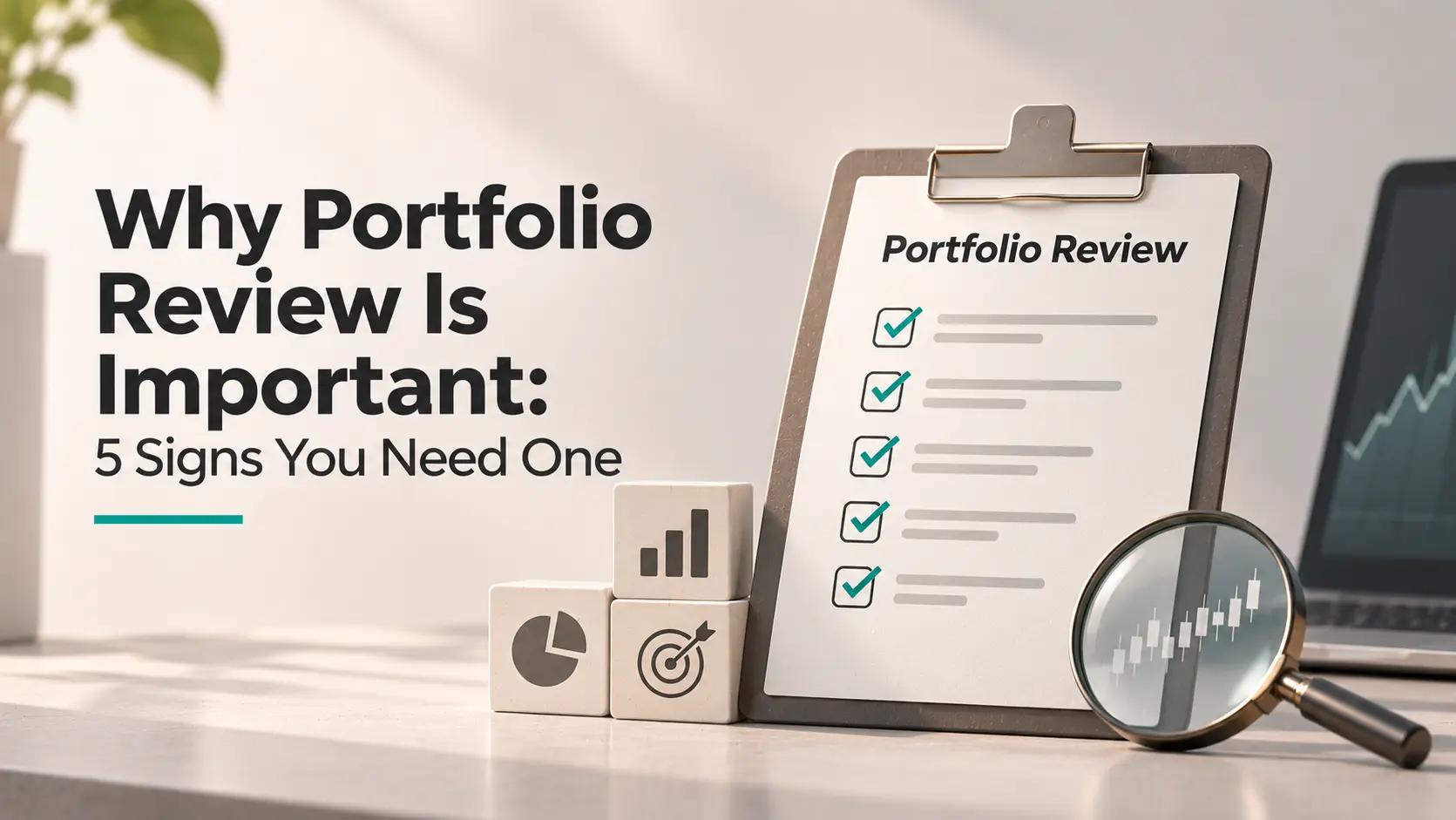
Why Portfolio Review Is Important: 5 Signs You Need One

Open your portfolio tracking app now. If the overall return number is green, you probably feel relieved. You assume the system is working, your wealth is compounding, and you can go back to your day job.
But aggregate returns are a mirage. They hide a terrifying reality.
Most Indian investors do not have a portfolio. They have a chaotic collection of financial products bought on impulse, on tips, and based on incomplete advice. Under that green aggregate number, your portfolio is likely bleeding real returns due to structural inefficiencies.
That's why a portfolio review matters. Not to check if your returns are green, but to check if your architecture is sound. If you suspect your investments are underperforming, book a professional review before you lose another quarter of compounding.
Key Takeaways
- A portfolio review matters because aggregate returns hide structural inefficiencies like overlapping holdings and tax leaks.
- If you hold multiple mutual funds, direct stocks, and ESOPs that have never been audited for overlap, get a portfolio review.
- The most common wealth leak in India is overlapping mirror holdings, where funds hold the same top 100 stocks, creating false diversification.
- Tax blind switching destroys post-tax returns because impatience triggers 20 percent STCG and 12.5 percent LTCG liabilities.
- HNIs need a portfolio review because as corpus complexity grows, DIY Excel audits lead to math errors and wrong financial decisions.
- A professional review identifies dead equity zones, executes tax-loss harvesting, and eliminates the triple cost of redundant diversification.
Table of Contents
Click to Expand
- Why We Need a Portfolio Review: The Set It and Forget It Fantasy
- Sign 1: The Overlapping Mirror
- Sign 2: The Tax Blind Switching Penalty
- Sign 3: The Direct Equity Dead Zone
- Sign 4: The Goal Asset Mismatch
- Sign 5: Ignoring the Multiple Pay
- Why a DIY Audit is Financially Dangerous
- The Vestbox Research: Stop the Bleeding
- Why HNIs Should Have a Portfolio Review
- Frequently Asked Questions
Why We Need a Portfolio Review: The Set It and Forget It Fantasy
The financial industry sold retail investors a beautiful lie. Buy assets, set it, and forget it.
For a basic passive index fund, this works. But as your wealth grows, life gets complicated. You change jobs, your tax bracket jumps, you receive company ESOPs, you dabble in direct stocks, and you buy random mutual funds recommended by different people at different times.
Set it and forget it quickly becomes set it and neglect it. Without an institutional-grade audit, your portfolio slowly mutates into a highly inefficient risk and tax liability.
That's why a portfolio review matters. It is not a luxury. It is a diagnostic necessity. You would not drive a car for 10 years without a service check. You should not run a multi-lakh portfolio for 10 years without a structural audit.
Sign 1: The Overlapping Mirror
This is the most common wealth leak in India, and it happens across your entire investment ecosystem, not just in mutual funds.
Let us say you hold a large-cap mutual fund, a flexi-cap fund, and direct shares of Reliance, HDFC Bank, and Infosys because you believe in those companies. You think you are highly diversified.
Under SEBI's mutual fund categorization rules, large-cap and flexi-cap funds must hold a large portion of their assets in the top 100 companies. Because these are the only companies large enough to absorb institutional money, every major fund must hold Reliance, HDFC, and Infosys. You can verify the exact categorization norms through the SEBI Master Direction for Mutual Funds.
The Leak: You hold HDFC Bank directly, again through Fund A, and again through Fund B. You haven't diversified. You've just concentrated your risk in 10 underlying mega caps while paying three different sets of fees. When a sector correction hits these giants, your entire portfolio tanks because your diversified assets mirror each other.
Sign 2: The Tax Blind Switching Penalty
Human beings are emotional. When a specific stock or fund underperforms for six months, the instinct is to sell it and switch to the current chart topper.
The Leak: Every time you switch an equity mutual fund or sell a direct stock before 12 months, you trigger a Short-Term Capital Gains tax of 20 percent on any profits. If you hold it longer, you pay Long-Term Capital Gains tax of 12.5 percent on gains exceeding Rs 1.25 lakh. You can verify the exact rates through the Latest Finance Act.
Most retail investors switch investments 3 to 4 times over 5 years without calculating the tax bill. By the time they calculate their actual post-tax returns, they have drastically underperformed a standard bank Fixed Deposit. You are transferring your wealth to the government simply because of impatience.
Calculate Your Long-Term and Short-Term Tax on your investment with the Free Capital Gains Calculator.
Sign 3: The Direct Equity Dead Zone
Every HNI has a Dead Zone in their Demat account. These are 5 to 10 direct stocks bought on a broker's tip or a friend's hot tip three years ago. They are currently down 40% to 60%.
The Leak: You refuse to sell them because selling means booking the loss and admitting you were wrong. This is the sunk cost fallacy.
While you hold onto these zombie stocks hoping they return to your purchase price, that locked capital misses out on the compounding power of quality assets. Worse, you cannot use those losses to offset your capital gains tax because you have not actually sold them. A professional review ruthlessly identifies these dead zones and executes tax-loss harvesting to turn those mistakes into real tax savings.
Sign 4: The Goal Asset Mismatch
This is a silent structural leak. You are saving for your daughter's college education in 3 years, but you have allocated that money to a mid-cap mutual fund or direct small-cap stocks. These assets can drop 35 percent in a single year. If the market crashes a year before you need to pay the college fees, your child's future is compromised.
Conversely, you are saving for retirement 20 years away, but 60 percent of your money is sitting in low-yield debt funds because you are scared of the stock market.
The Leak: Mismatching your time horizon with your asset volatility guarantees that you either take too much risk for short-term needs or too little risk for long-term wealth creation.
When your goals and assets are misaligned, your portfolio is effectively at risk. To understand this concept more deeply, read our guide on About Portfolio At Risk.
Sign 5: Ignoring the Multiple Pay
Look at your entire wealth landscape. You might be paying a mutual fund Expense Ratio, paying an annual fee to a financial advisor, and paying brokerage charges on your direct equity account.
The Leak: If the same underlying assets sit in all three buckets, as Sign 1 explains, you're paying three managers for the same risk. You are paying triple for diversification that doesn't actually exist.
Why a DIY Audit is Financially Dangerous
You cannot audit your own portfolio. You're emotionally attached to the stocks you picked. You suffer from confirmation bias.
Calculating exact overlap across direct stocks and 10 different mutual fund fact sheets, estimating capital gains tax liability if you consolidated those holdings, and mapping the remaining capital to your risk profile requires institutional-grade computational power. Doing it on a basic Excel sheet will lead to math errors, which can lead to wrong financial decisions.
The Vestbox Research: Stop the Bleeding
At Vestbox, when an investor comes to us for a portfolio review, we do not just look at aggregate returns. We run a structural X-ray of every single asset, including direct stocks, mutual funds, ESOPs, and fixed income.
Based on Vestbox data, in a recent audit of an estimated Rs 2.5 Crore portfolio, we discovered the client held 11 mutual funds alongside a direct stock portfolio. Our overlap engine revealed that roughly 65 percent of his total equity exposure was just a shadow replication of the Nifty 50. Worse, he had unknowingly triggered an estimated Rs 4 lakh in STCG taxes over the previous two years by blindly switching between funds with identical mandates.
We suggested consolidating the redundant funds, mapped the direct equity dead zone for immediate tax loss harvesting, and transitioned a portion of the capital into a structured, customized PMS mandate to eliminate the overlap.
Disclaimer: The above scenario is an illustrative study based on expected market behavior and estimated Vestbox data. The figures are approximate and meant strictly for educational purposes to demonstrate portfolio architecture. Actual market returns and fund performance will vary based on real-time conditions.
Why HNIs Should Have a Portfolio Review
If you are an HNI with a corpus above Rs 50 Lakhs, the stakes are dramatically higher. A 2 percent structural leak on a Rs 1 Crore portfolio is Rs 2 Lakhs that evaporates every single year. Over 10 years, that is Rs 20 Lakhs of lost compounding, not including the opportunity cost of what that capital could have earned if deployed correctly.
HNIs need a portfolio review because their wealth complexity outgrows retail tools. You have ESOPs, direct equity, multiple mutual funds, insurance policies, fixed deposits, and real estate. No single retail app can audit the overlap and tax efficiency of that entire ecosystem.
The Vestbox portfolio review is built for this exact complexity. We do not just look at your mutual funds. We audit your entire financial life.
Your portfolio isn't a museum for past financial mistakes. It is an engine meant to fund your future. If you suspect your engine is leaking, get a diagnostic before the damage becomes irreversible.
“Get Your Free Mutual Fund Portfolio Review Now and Get a Detailed Analysis, Overview, & Report of Your Portfolio.”
Frequently Asked Questions
Why is a portfolio review important?
A portfolio review matters because aggregate returns hide structural inefficiencies like overlapping holdings, tax-blind switching penalties, and goal-asset mismatches. Without a review, these leaks compound silently and destroy real returns over time.
Why do we need a portfolio review?
We need a portfolio review because most investors do not have a portfolio. They have a chaotic collection of impulse buys. A review identifies overlaps, eliminates underperformers, and ensures your asset allocation matches your risk profile and time horizon.
What are the signs you need a portfolio review?
The five signs you need a portfolio review are overlapping mirror holdings across funds and direct stocks, tax-blind switching penalties, a direct-equity dead zone of loss-making zombie stocks, goal asset mismatches, and triple-paying for redundant diversification across multiple platforms.
Why should HNIs review their portfolio?
HNIs should review their portfolio because their wealth complexity outgrows retail tools. With ESOPs, direct equity, multiple mutual funds, and real estate, a 2 percent structural leak on a Rs 1 Crore portfolio means Rs 2 Lakhs evaporating every year. A professional review stops this bleeding.
Can I audit my own portfolio?
No. You cannot audit your own portfolio because you are emotionally attached to your stock picks and prone to confirmation bias. Calculating exact overlap and tax liability across 10 different funds requires institutional-grade computational power, not a basic Excel sheet.
How often should I get a portfolio review?
Get a professional portfolio review at least once a year, or whenever a major life event occurs, like a job change, tax-bracket jump, or receiving a large ESOP payout. The Vestbox portfolio review is an ongoing process, not a one-time exercise.
What does the Vestbox portfolio review include?
The Vestbox portfolio review runs a structural X-ray of every single asset, including direct stocks, mutual funds, ESOPs, and fixed income. It identifies overlapping holdings, calculates tax liabilities, maps dead equity zones for tax loss harvesting, and restructures your allocation for optimal compounding.
Disclaimer
Mutual fund investments are subject to market risks. Read all scheme-related documents carefully. Please consult a certified financial advisor before making any investment decisions.
Trust & Compliance
This article has been created following our strict Editorial Policy. We believe in complete transparency regarding how we operate; you can read our Disclosures. For legal liabilities and risk factors, please review our Disclaimer.