How to Fund Your ESOP Exercise: Loans vs. Selling Investments

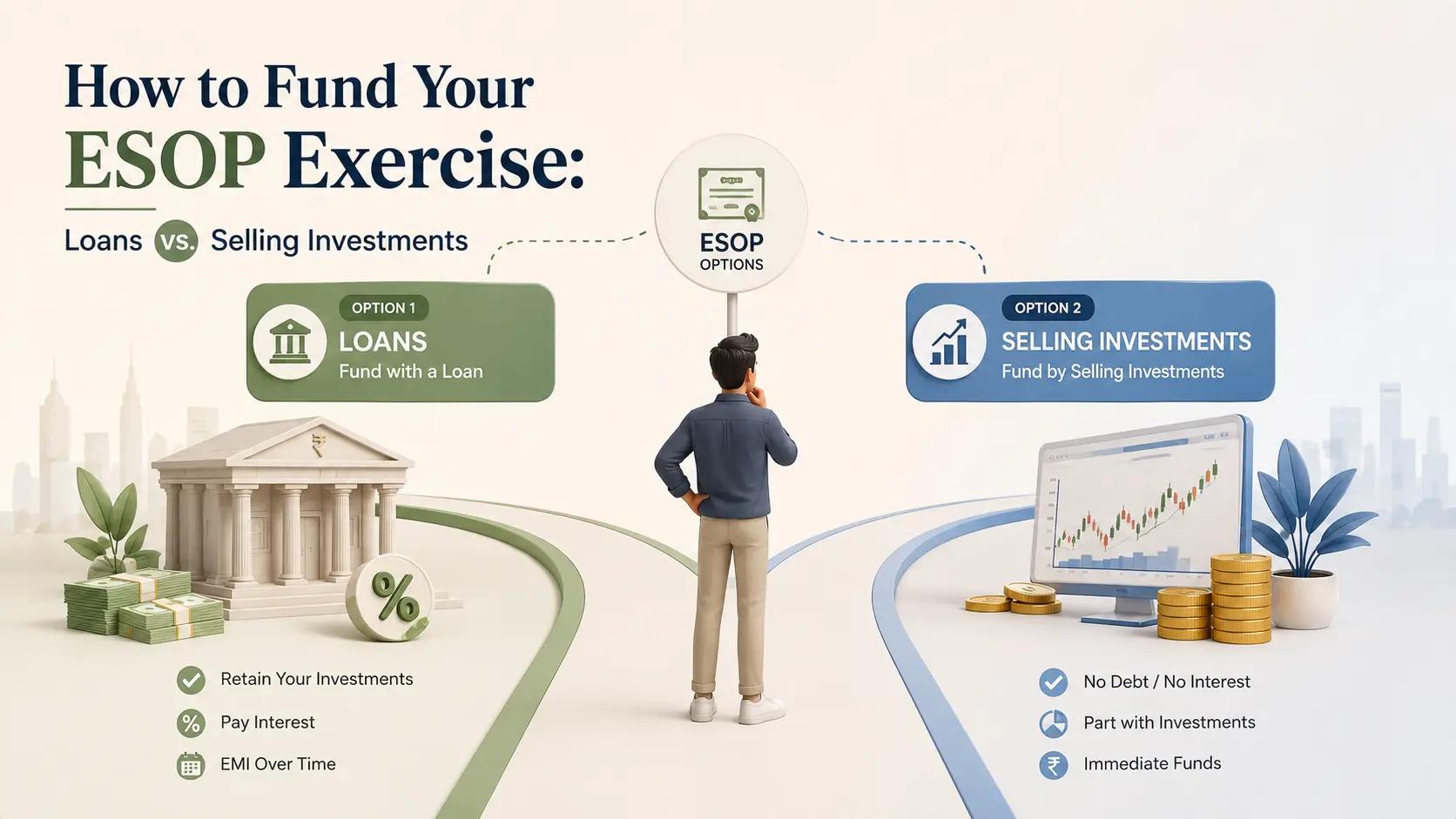
Table of Contents
Click to Expand
- Why the Tax Bill Hits So Hard
- Option 1: The Personal Loan Trap
- Option 2: The Mistake of Breaking Good Investments
- Option 3: The Structural Approach (How to Actually Do It)
- Case Study: Funding a ₹2 Crore Exercise
- What Happens After You Fund the Exercise?
- How Vestbox Helps & Why Choose Vestbox
- Conclusion / Final Thoughts
- Frequently Asked Questions
How to Fund Your ESOP Exercise: Loans vs. Selling Investments
Your startup just valued your options at ₹10 Crores. You feel rich.
Then HR sends you the exercise email. To buy those shares, you must pay a perquisite tax of ₹2.5 Crores. The deadline is Friday.
You look at your bank account. You have ₹30 Lakhs.
This is the ESOP cash flow trap. You are wealthy on paper, but illiquid in reality. Most employees panic. They make a terrible financial decision to meet the HR deadline.
Funding your ESOP exercise requires strategy. If you do it wrong, you will pay more in interest and lost compounding than you will ever make on the startup's growth.
Why the Tax Bill Hits So Hard
You do not pay tax when your ESOPs vest. You pay tax when you exercise.
The government taxes the difference between the Fair Market Value (FMV) and your exercise price as a perquisite. This amount is added to your salary and taxed at your income tax slab rate.
If you work for an eligible start-up, you can defer the actual tax payment for up to 5 years.
But even with deferral, the company is legally forced to deduct TDS at the time of exercise.
You still need massive liquidity on the day you sign the papers. Read our complete guide to ESOP Taxation in India to see exactly how this math is calculated.
Option 1: The Personal Loan Trap
This is the most common reaction. You walk into a bank and ask for an "ESOP Funding Loan."
Banks are happy to lend you the money. They take your unlisted ESOP shares as collateral.
Why this is a terrible idea: You are taking a loan at 11% to 14% interest to buy an illiquid asset that might not have an exit for 3 to 5 years. If the startup fails, you lose your shares, and you still owe the bank the principal plus years of interest. You are taking double leverage on a single, highly risky asset.
Use a loan only as a last-resort bridge for a few weeks, not as your primary funding strategy.
Option 2: The Mistake of Breaking Good Investments
The next step is looking at your existing portfolio. You see you have ₹50 Lakhs in a mutual fund. You decide to sell it to fund the exercise.
The mistake is not selling. The mistake is selling the wrong mutual funds.
Many employees break their long-term equity mutual funds to pay a short-term tax bill. You destroy years of compounding to buy an illiquid stock. Or, they break a fixed deposit, losing the guaranteed interest rate, to buy unlisted equity.
You are replacing a safe, compounding asset with a locked-in, high-risk asset. This damages your net worth even if the startup succeeds.
Option 3: The Structural Approach (How to Actually Do It)
Smart executives don't liquidate blindly. They restructure their portfolio to free up cash with minimal damage.
Step 1: Find Idle Cash
Do you have money sitting in low-yield savings accounts? Do you have a massive emergency fund earning 3.5% while inflation sits at 6%? This is dead capital. Use it first.
Step 2: Restructure Tax-Inefficient Holdings
Look at your debt mutual funds. If the interest rates have peaked and you are holding funds that are barely beating FD rates, sell them. You aren't losing compounding equity returns; you are just optimizing dead weight.
Step 3: Use a Short-Term Bridge
If you still have a gap of ₹20 Lakhs, take a small, short-term personal loan or use a sweep facility against your FD. The goal is to bridge the gap for 3 to 6 months. Once the company processes your exercise, you can use your next bonus or sell a small, mature portion of your portfolio to clear the loan immediately.
Case Study: Funding a ₹2 Crore Exercise
Rahul needs ₹2 Crores to exercise his unlisted ESOPs.
The Wrong Way: He takes a ₹2 Crore personal loan at 12% interest. He waited 3 years for the IPO. He pays ₹72 Lakhs in pure interest to the bank. When the IPO happens, the market is volatile, and he only makes a 40% profit. The bank eats his gains.
The Right Way: Rahul does a structural review. He finds ₹50 Lakhs in idle savings. He sells a debt fund yielding 7% that he no longer needs. He takes a ₹20 Lakh bridge loan for 6 months. He sells a tiny, mature equity mutual fund for ₹30 Lakhs to clear the bridge loan immediately post-exercise. He minimizes interest costs and protects his core equity wealth.
What Happens After You Fund the Exercise?
You sign the papers. You pay the TDS. The shares are allotted to your name.
You are now officially an unlisted shareholder. But your job isn't done.
You are now sitting on extreme concentration risk. 80% of your net worth is tied to a single, unlisted startup. If the IPO is delayed by another two years, your wealth is completely frozen.
You need a plan to liquidate these shares safely when the time comes. If the company allows it, you can use a secondary sale to cash out before the IPO. Read our guide on how to sell unlisted ESOPs in India to understand the secondary market process.
How Vestbox Helps & Why Choose Vestbox
Do not break your compounding investments blindly to fund an ESOP exercise.
Why choose Vestbox:
-
Find the Hidden Cash: Before you trigger a massive tax event, run a structural portfolio review. We will map out your exact liquidity. We will show you where you have idle cash or tax-inefficient investments that can be safely liquidated to fund the exercise without destroying your long-term wealth.
-
Post-Exercise Protection: Once the shares are yours, we help you manage the concentration risk. Through Portfolio Management Services in India, we build a focused, actively managed equity portfolio across different sectors. If your startup fails, your remaining wealth survives. To see how this active framework works, read our guide on how PMS works through construction and monitoring.
-
Tax Planning: If your exercise triggers a significant capital outflow, we help you stagger the exercise over multiple financial years to keep you within a lower income tax slab. Use our ESOP Tax Calculator to map out the numbers.
Don't let a liquidity crunch force you into bad debt.
Ready to fund your exercise intelligently? Explore Portfolio Management Services in India and let’s build a strategy to protect your capital.
Conclusion / Final Thoughts
Funding an ESOP exercise is a pure cash flow problem.
Taking a massive personal loan is the easiest route, but it is financially destructive.
Liquidating your best compounding assets is emotionally driven and damages your net worth.
The right approach is structural. You audit your portfolio, free up idle or inefficient capital, and use short-term debt only as a temporary bridge. Protect your downside before you bet on your startup's upside.
Frequently Asked Questions
Can I take a loan specifically to exercise ESOPs?
Yes, banks offer ESOP Funding Loans. They take your unlisted shares as collateral. However, interest rates are high (11-14%), and taking a loan to buy illiquid stock is highly risky. Use it only as a short-term bridge.
Should I break my fixed deposit to pay ESOP tax?
It depends. If you have a massive FD earning 7%, and the startup exit is highly certain in 6 months, it might make mathematical sense. But if the IPO is uncertain, you are giving up a guaranteed return for a risky one.
Can I sell my mutual funds to pay ESOP TDS?
Yes. TDS is mandatory, even if you defer the actual tax. You may need to liquidate a portion of your portfolio to generate the cash to cover your TDS deduction.
What is the cheapest way to fund an ESOP exercise?
The cheapest way is to use cash sitting in savings accounts or low-yield debt funds. The next cheapest is to stagger your exercise over multiple financial years so the tax bill doesn't hit you all at once.
Will my employer give me a loan to exercise ESOPs?
Some mature startups offer internal financing or salary advances to help employees pay the exercise price, but this is rare. Most companies expect you to arrange your own funding.
Disclaimer
Mutual fund investments are subject to market risks. Read all scheme-related documents carefully. Please consult a certified financial advisor before making any investment decisions.
Trust & Compliance
This article has been created following our strict Editorial Policy. We believe in complete transparency regarding how we operate; you can read our Disclosures. For legal liabilities and risk factors, please review our Disclaimer.
Share & Save Article
Other Posts
How to Sell Unlisted ESOPs in India: Guide to Cashing Out Early
Aug 6, 2026

Creating Wealth with ESOPs: Steps You Actually Need to Take
Aug 6, 2026
How to Check Income Tax Refund Status Online: A Complete Guide
Jul 18, 2026
Why is Income Tax Refund Delayed? A Complete Guide to Processing Times
Jul 18, 2026
