The Paradox of Legacy: Why Generational Wealth Demands Institutional Architecture

Table of Contents
Click to Expand
- The Fantasy of Infinite Capital: A Structural Reality
- The Psychological Disconnect: How Founders View Wealth
- The Three Pillars of Wealth Destruction
- The Institutional Shield: Family Governance
- Engineering a Family Constitution: The Moral Infrastructure
- The Legal Armor: Insulating Capital via Trust Frameworks
- The Vestbox Scenario: The Neutral Trustee
- Preserving the Legacy, Not Just the Capital
There is an old proverb whispered in the private banking halls of Geneva and New York: "Shirtsleeves to shirtsleeves in three generations."
The first generation makes a fortune through sheer grit and obsession. The second generation spends it on lifestyle and status, having witnessed the hardship but never feeling it. The third generation starts from scratch, wondering what happened.
This isn't just a cultural cliché; it is a statistically proven reality. A staggering percentage of ultrahigh-net-worth families fail to transmit their wealth past the third generation.
What is profoundly misunderstood is how the wealth is lost. Generational wealth rarely succumbs to a stock market crash, a black swan economic event, or a failed business investment. Instead, a lack of structural governance almost always destroys it. If your goal is to ensure your capital outlasts your lifetime, you must structure multi-generational wealth well before the generational transition.
The Fantasy of Infinite Capital: A Structural Reality
When a founder successfully navigates a liquidity event, selling a business for ₹100 Crore or taking a massive public offering, their mindset is frozen in the past.
They remember the sleepless nights, the near-bankruptcies, and the obsessive focus required to build that wealth. They view the ₹100 Crore as a sacred, finite resource that must be protected at all costs.
Typically, the second generation, the founder's children, did not build the wealth. They only see the outcome. When they look at the family's capital, they do not see the blood, sweat, and tears behind its creation. They see an abstraction.
The Psychological Disconnect: How Founders View Wealth
This creates a dangerous psychological gap. The founder operates from a mindset of scarcity. The heirs operate from a dangerous illusion of infinite capital. If this gap is not bridged by formal education and rigid structural rules, the capital will inevitably bleed out through poor decision making, frivolous litigation, or sheer negligence.
The Three Pillars of Wealth Destruction
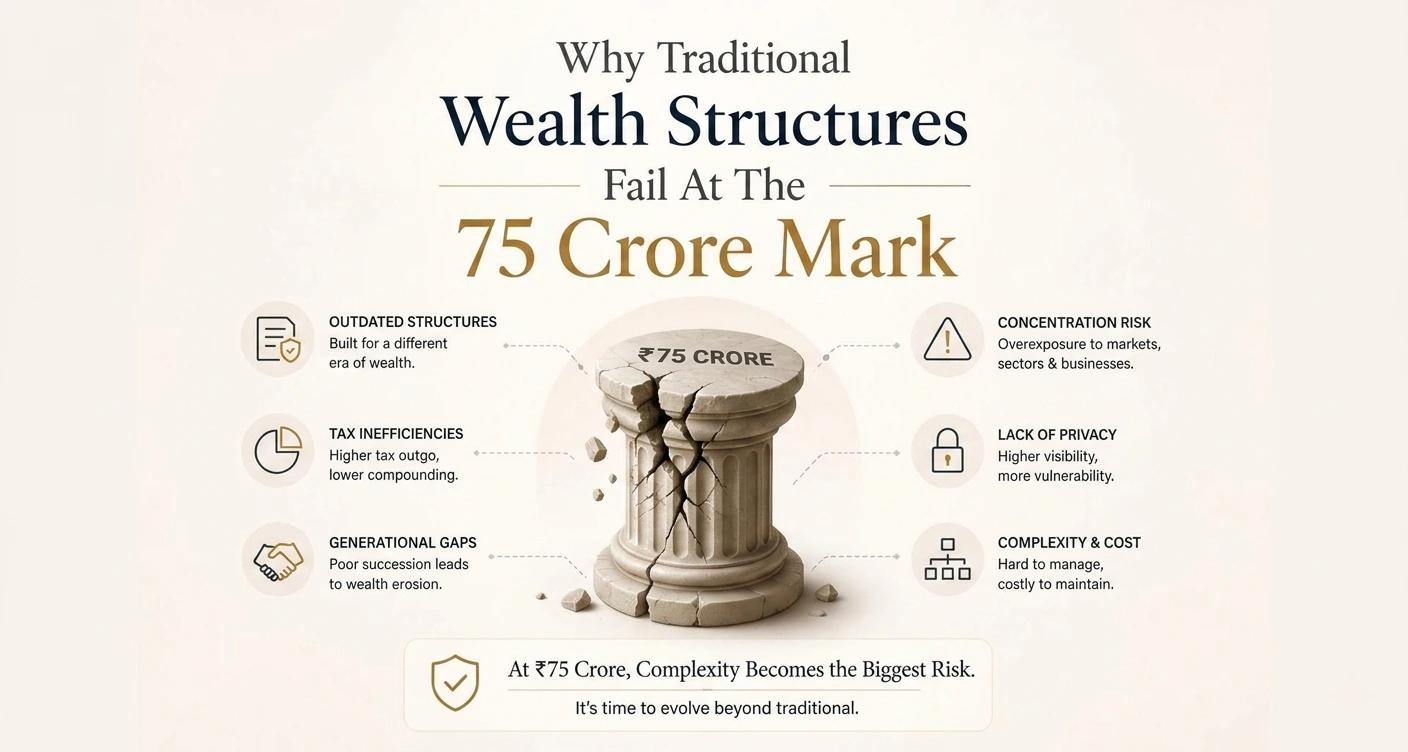
Generational wealth doesn't vanish overnight. It erodes slowly through three structural vulnerabilities.
1. The Governance Vacuum: In most wealthy families, the only person who knows how the capital is structured is the founder. The heirs know the bank balances but lack an understanding of the legal wrappers, the trust deeds, tax planning strategies, or the reasons specific assets were purchased. When the founder passes away or loses cognitive capacity, the heirs are handed the keys to a complex machine with no instruction manual.
2. The Succession Ambush: Without a pre-determined, legally binding succession framework, the death of a patriarch or matriarch often triggers a cold war among siblings. Assets get frozen in legal disputes. Courts appoint temporary receivers who drain the estate with legal fees. By the time the family agrees on a division, a massive portion of the wealth has been consumed by the legal system, simply because the founder refused to have difficult conversations while they were alive.
3. The Dilution of Purpose: Without a unified family vision, heirs begin to treat their inheritance as personal checking accounts. One child wants to fund a vanity tech startup. Another wants to buy a fleet of luxury assets. The capital is pulled in five different directions, destroying the compounding power of a consolidated, centrally managed structure.
The Institutional Shield: Family Governance
You cannot fix a human behavioral problem with a financial product. You cannot buy a mutual fund or a bond that prevents siblings from suing each other.
The only defense against the destruction of generational wealth is Family Governance. This is the exact architecture utilized by old-money dynasties. It treats the family's capital not as a pool of money, but as a corporate entity that requires a board of directors, a constitution, and strict operational mandates.
Engineering a Family Constitution: The Moral Infrastructure
A Family Constitution is not a legally binding document in the traditional sense; it is a moral and operational charter. It is an agreement signed by the current and next generations, dictating exactly how the wealth is to be treated.
It answers questions that founders usually avoid:
- At what age can a child access the income from the family trust?
- Can capital be used to fund personal businesses, or only for passive preservation?
- Who has the authority to fire the family's wealth advisor if the advisor is underperforming?
- What is the protocol for resolving a dispute without entering the public court system?
By forcing the family to align on these answers on paper, you remove the emotional friction that typically destroys families after the founder is gone.
The Legal Armor: Insulating Capital via Trust Frameworks
Alongside the moral governance of a Family Constitution, you need the legal armor of a sophisticated Trust framework, governed by the General framework of Indian Succession and Trust laws.
A properly structured Trust does not just hold assets; it legally separates legal title to the asset from the beneficiaries. This is a concept most heirs struggle to accept. They feel they "own" the money.
In reality, the Trust owns the capital. The heirs are merely beneficiaries with a right to receive distributions per the rules the founder outlined in the Trust Deed. If the Trust Deed stipulates that capital may only be distributed for education, health, or conservative growth, a beneficiary cannot legally demand a ₹10 Crore withdrawal to fund a risky venture. The structure protects the capital from the heir, and paradoxically, protects the heir from their own worst impulses.
The Vestbox Scenario: The Neutral Trustee
A first-generation industrialist approached Vestbox with a familiar structural challenge. He had built a ₹200 Crore empire. He had three children. Two were responsible; one was highly impulsive.
He was terrified that upon his death, the impulsive child would demand his one-third share in cash, dismantle the family's entire asset base, and blow it within five years. He wanted to disinherit the child, but couldn't bear the emotional toll.
We did not offer him an investment product. We suggested him an architectural solution.
We designed a centralized Family Trust, legally locking the ₹200 Crore capital inside an irrevocable structure. We then facilitated the drafting of a Family Constitution that explicitly stipulated no beneficiary could demand a lump-sum redemption of capital. They could only receive quarterly distributions strictly based on the cash flow generated by the underlying assets.
Furthermore, we positioned Vestbox not as a broker, but as an independent, conflict-free Investment Advisor with a fiduciary mandate to the Trust. When the impulsive child demanded aggressive, high-risk investments, we, bound by the governance rules set by the founder, respectfully declined.
The structure successfully neutered the heir's emotional volatility, protected the capital base, and maintained family harmony, simply because the money was governed by rules, rather than relationships.
Preserving the Legacy, Not Just the Capital
Generating wealth is an act of aggression. It requires defeating competitors, exploiting market inefficiencies, and taking outsized risks.
Preserving wealth is an act of defense. It requires bureaucratic precision, emotional detachment, and the willingness to tell your own family "No" for their own long-term good.
If you do not build a governance framework to enforce your values, the market won't destroy your wealth; your heirs will. Moving from a founder's mentality to an institutional architect is the final, and most difficult, stage of true wealth creation.
Disclaimer
Mutual fund investments are subject to market risks. Read all scheme-related documents carefully. Please consult a certified financial advisor before making any investment decisions.
Trust & Compliance
This article has been created following our strict Editorial Policy. We believe in complete transparency regarding how we operate; you can read our Disclosures. For legal liabilities and risk factors, please review our Disclaimer.