SIF vs PMS vs AIF vs Mutual Funds: The Modern HNI Breakdown

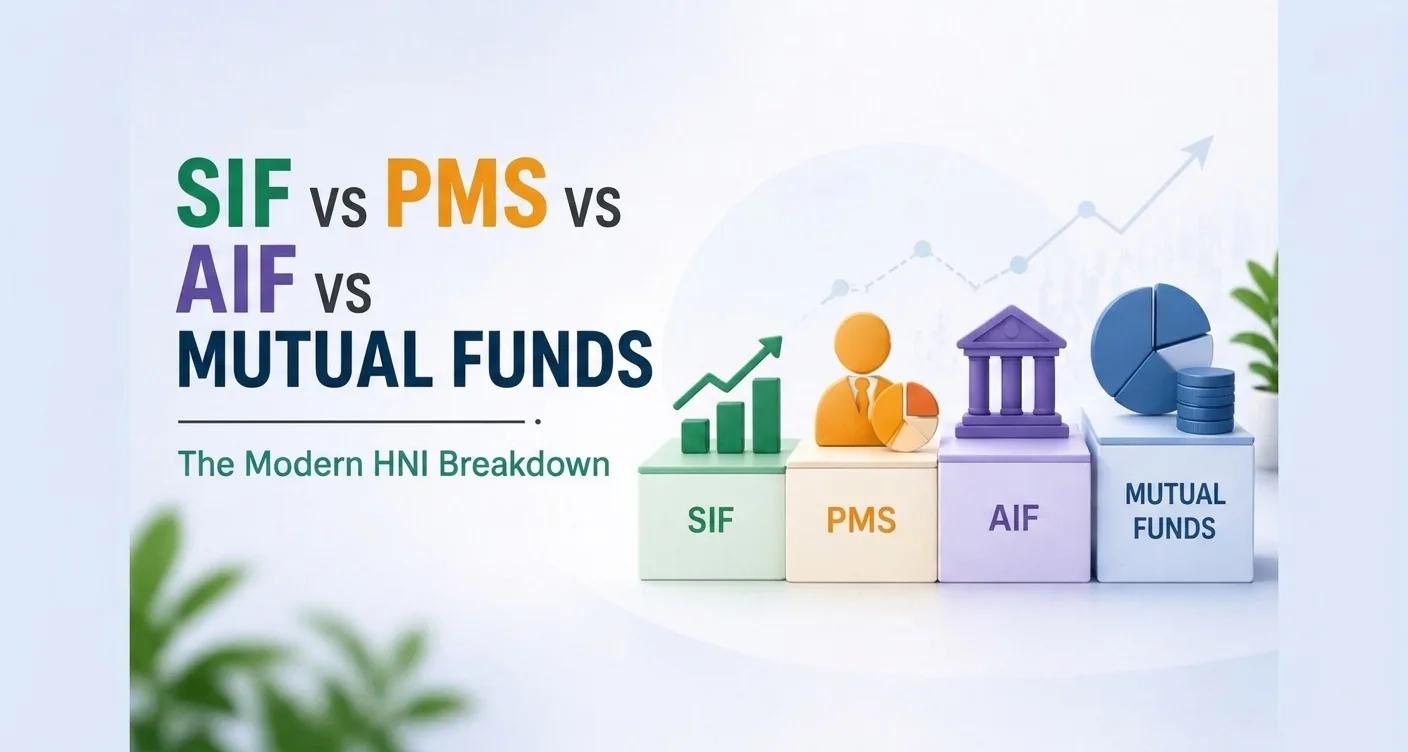
Table of Contents
Click to Expand
Let’s settle this once and for all.
If you have a ₹10 Lakh to ₹5 Crore corpus, the Indian wealth management industry wants to fragment your attention. They tell you to use Mutual Funds for safety, PMS for prestige, and AIFs for exclusivity.
It’s exhausting. It fractures your portfolio visibility. And mostly, it’s a structural mismatch between what your wealth actually requires in a hyper-connected, volatile global economy and what the industry is legally allowed to sell you.
To see the full SIF (Specialized Investment Funds) vs. mutual funds breakdown, you have to stop reading marketing brochures and start reading the legal rulebooks that govern your money. Let’s rip the cover off the four major wealth structures in India.
The Structural Boundaries of Standard Mutual Funds
Don’t misunderstand, mutual funds are arguably the greatest financial invention for wealth creation. However, for a high-net-worth investor looking to build a modern, resilient portfolio, standard mutual funds operate within strict structural boundaries.
Under SEBI categorization of mutual funds, an equity fund is defined by its mandate at birth. If it’s categorized as a "Large Cap" fund, the manager is required to hold at least 80% of your money in the top 100 stocks.
This structure is perfect for steady, long-term compounding, but it means the fund inherently inherits the market's downside. If the broader market drops 20%, your fund will closely follow. Why? Because the manager’s toolkit is intentionally limited by design.
To maintain category purity, they cannot hold significant cash to defend against corrections. They cannot use derivatives to hedge their positions, nor can they short-sell an overvalued stock. You are paying a management fee for excellent stock selection, but the manager is fundamentally restricted to being a long-only participant during a market crash.
The Myth vs. The Reality
- Myth: "My mutual fund manager will move my money to cash if they see a crash coming."
- Reality: If a Large Cap manager suddenly exits stocks to hold cash to dodge a correction, SEBI will flag them for "style drift" and penalize the AMC. Their regulatory mandate isn't to protect your downside; it is to stay fully invested in their specific category at all times.
PMS: The ₹50 Lakh Customization Tax
Portfolio Management Services (PMS) solves the flexibility problem. Managers can buy concentrated bets (10-15 stocks), short-sell, and use complicated strategies under SEBI PMS regulations.
But PMS comes with two massive hidden taxes:
- The Entry Barrier: The minimum investment is ₹50 Lakhs. This immediately locks out a massive segment of experienced investors who have built a ₹15 Lakh or ₹20 Lakh corpus but aren't quite "Ultra-HNI" yet.
- The Fee Drain: PMS fee structures are brutal. A typical PMS charges a 2% fixed management fee, plus a 20% profit-sharing fee (on gains above a hurdle rate). If the market does well, the fees eat your alpha. If the market performs poorly, you still pay the 2% fixed fee just for them holding your money.
Furthermore, PMS operates as a "black box." There is no daily NAV published. You get a monthly statement, but you never really know exactly what your manager is doing each day.
AIFs: The Illiquidity Trap
Alternative Investment Funds (Category III) are the closest thing India has to Western hedge funds. Governed by SEBI AIF Regulations 2012, they offer the most aggressive, unconstrained strategies.
The catch? Illiquidity.
Most Category III AIFs have a 3 to 5-year mandatory lock-in period. Your money is trapped. If the market crashes and you have a medical emergency or a cash-flow crisis in your business, you cannot withdraw your investment without paying substantial penalties to a secondary buyer (if you can find one).
SIF vs Direct Equity & Index Investing
You might ask, Why not just manage my own money?
Direct equity investing is great for generating alpha on a small core portfolio. But can you, as an individual, write algorithms to cover calls against your portfolio to extract additional yield? Can you execute pair trades across sectors using futures to isolate market risk?
No. The infrastructure costs, margin requirements, and screen time make it impossible for a working professional to execute this at scale.
What about Index Funds (Passive Investing)? This is the biggest trap for HNIs. If the market enters a prolonged sideways, volatile cycle, which defines modern macro environments, your wealth generates nothing literally. Index funds are a great tool, but they offer zero defense mechanisms. They only make money when the market goes up.
The Vestbox Case Study: Architecting Downside Protection
Let’s look at a real-world scenario to see how this plays out in actual rupees, not just theory.
The Client: A 48-year-old surgeon from Mumbai with a ₹2 Crore portfolio.
The Previous Setup: ₹1 Crore in PMS (concentrated mid-cap equity), ₹50 Lakhs in Large Cap Mutual Funds, ₹50 Lakhs in FDs.
The Problem: During the last severe mid-cap drawdown cycles, his PMS dropped 28%. His mutual funds dropped 18%. He lost nearly ₹37 Lakhs in a matter of months. He had zero downside protection and massive anxiety.
The Vestbox Restructure:
- Core: ₹1 Cr in Index Funds or Mutual Funds (Large Cap/Mid Cap Oriented) (For long-term India growth).
- Satellite: ₹50 Lakhs deployed into distinct SIF funds: A Long/Short SIF and a Market-Neutral Arbitrage SIF.
- Support: ₹50 Lakhs deployed into PMS funds (For flexibility and concentration)
The Result:
When the broader market faced its next major correction, his core mutual funds dropped 12%. However, his SIF allocation stayed flat (+0.5%) due to the derivative hedging.
Instead of losing ₹24 Lakhs, his total portfolio drawdown was restricted to just ₹8.4 Lakhs. He slept peacefully. And because his drawdown was mathematically smaller, he compounded his wealth much faster when the market recovered.
The Definitive Comparison Matrix
| Feature | Mutual Funds | PMS | AIF (Cat III) | SIF (Vestbox) |
|---|---|---|---|---|
| Min. Investment | ₹500 - ₹5,000 | ₹50 Lakhs | ₹1 Crore+ | ₹10 Lakhs |
| Strategy Flexibility | Long-Only (Caged) | High (But Black Box) | Unlimited | High (Hedging, Long/Short) |
| Transparency | Daily NAV, Full Disc. | Monthly Statements | Quarterly/Black Box | Daily NAV, Full Disc. |
| Liquidity | High (T+1/T+2) | Contractual | 3-5 Year Lock-in | Structured (T+2 to 30 days) |
| Fee Structure | 1-2% TER | 2% + 20% Profit | 2% + 20% Profit | Standard TER + Perf. Fee |
The Final Verdict: Should You Switch?
SIFs sit in the exact "Goldilocks zone" of modern Indian investing.
They offer the derivative flexibility and tactical freedom of AIFs and PMS. But they strip away the ₹50 Lakh entry barrier. They eliminate the 3-year illiquidity lock-ins. And they destroy the black-box lack of transparency by operating under the mutual fund framework (daily NAVs, strict SEBI trustee oversight).
If you want hyper-concentrated, illiquid, multi-year lock-in bets, use AIFs. If you want simple market-matching returns, use Index Funds. But if you want tactical, liquid, institutional-grade downside protection without paying the ₹50 Lakh PMS entry tax, a Specialized Investment Fund (SIF) is the undisputed champion.
Stop letting product structures dictate your risk. Take back control of your downside and Explore Vestbox's curated SIF investments.
Want a simpler breakdown of just SIFs? Explore the complete guide to Specialized Investment Funds (SIF).
Disclaimer
Mutual fund investments are subject to market risks. Read all scheme-related documents carefully. Please consult a certified financial advisor before making any investment decisions.
Trust & Compliance
This article has been created following our strict Editorial Policy. We believe in complete transparency regarding how we operate; you can read our Disclosures. For legal liabilities and risk factors, please review our Disclaimer.
Share & Save Article
Other Posts

How to Fund Your ESOP Exercise: Loans vs. Selling Investments
Aug 11, 2026
How to Sell Unlisted ESOPs in India: Guide to Cashing Out Early
Aug 6, 2026

Creating Wealth with ESOPs: Steps You Actually Need to Take
Aug 6, 2026
How to Check Income Tax Refund Status Online: A Complete Guide
Jul 18, 2026
