What Is an Alternative Investment Fund (AIF)? Full Form, Meaning, Benefits & Taxation

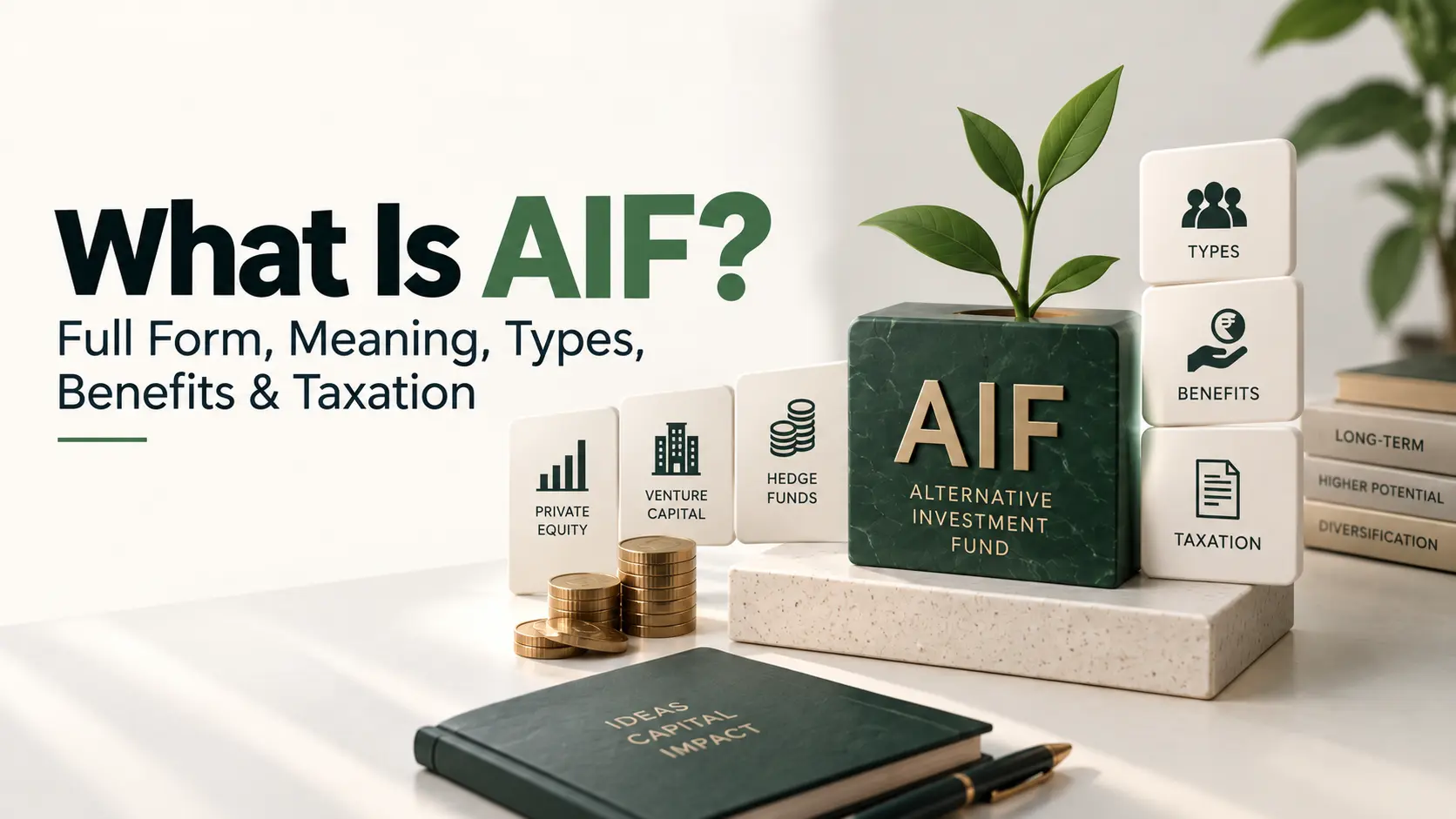
Plenty of India's best-known startups were bankrolled years before their names ever reached a stock exchange. Somebody wrote those early cheques. In most cases, it was a fund that never advertises, never cold calls, and never pings your phone with an app notification. The industry calls these Alternative Investment Funds. Committed capital in them has already sailed past ₹12 lakh crore as per SEBI's monthly AIF report, and you can verify the latest figure before publishing. The entry ticket starts at ₹1 crore. Still, the queue of investors keeps growing every single year. That combination of secrecy, size, and rising demand usually means one thing. People who can afford these funds clearly believe they are worth it. So what exactly is an AIF, what do the three categories mean, how do fees and taxes actually work, and which risks will no brochure ever point out for you? Every answer sits on this page, in plain language, with all the numbers you need.
Key Takeaways
- AIF stands for Alternative Investment Fund. AIF is a SEBI-regulated, privately pooled investment fund that collects money from investors and invests it in opportunities beyond traditional stocks and bonds.
- One rulebook governs them all: the SEBI (Alternative Investment Funds) Regulations, 2012. It sorts every fund into Category I, Category II, or Category III.
- Category I funds build, Category II funds grow, and Category III funds trade. Learn that one line and the whole map lives in your head.
- The minimum investment is ₹1 crore per investor. Accredited investors and fund employees can enter with ₹25 lakh. Large Value Funds take only accredited investors and start at ₹70 crore.
- A single scheme can hold a maximum of 1000 investors, which is why these funds stay genuinely exclusive.
- Nobody pays the full commitment on day one. The fund asks for money in instalments as it finds investments, and the whole journey typically runs 5 to 10 years.
- Fees usually sit at about 1.5 to 2 percent a year plus 15 to 20 percent of profits, and that profit share kicks in only after the fund clears a minimum return hurdle.
- Category I and II AIFs are pass-through for tax, so you are taxed almost as if you had invested directly, though listed and unlisted holdings follow different sections. Category III funds pay tax at the fund level and give you a credit.
- No AIF can promise or guarantee returns. SEBI rules ban it outright, so any fund or anyone who promises is waving a red flag.
- The real risk is not losing money fast. It is illiquidity, because your money stays locked away for years with no easy exit.
Table of Contents
Click to Expand
- What is an AIF?
- Where does AIF sit in the investing ladder?
- The three categories of AIF
- Angel funds, the startup specialists
- Who can invest in an AIF?
- How an AIF actually works
- How AIF fees work
- How AIFs are taxed
- Rules that protect your money
- Accredited investors, Large Value Funds and Co-Investment Vehicles
- The real benefits of AIFs
- The real risks, honestly stated
- How to invest in an AIF
What Is an AIF?
AIF stands for Alternative Investment Fund. AIF is a SEBI-regulated privately pooled investment fund that collects money from investors and invests it in opportunities beyond traditional stocks and bonds. AIFs can invest in private companies, startups, unlisted debt, real assets, and complex trading strategies.
SEBI defines an AIF as a fund set up in India that pools money from Indian or foreign investors under a defined investment policy. The rulebook is the SEBI (Alternative Investment Funds) Regulations, 2012, which replaced the old venture capital fund regime.
Here's a detail that saves people from bad products. The AIF definition deliberately excludes three family structures. Family trusts are not AIFs. Neither are employee welfare trusts or ESOP trusts. Regular debt funds run by mutual fund houses do not count either. So if someone offers you a product that calls itself an AIF but behaves like one of these, ask for the SEBI registration number before the conversation goes any further.
How big is this industry? More than 1,300 AIFs are registered with SEBI today; verify the current count against SEBI's registered intermediaries list before publishing. The range runs from tiny angel funds to giant private equity managers.
"Simply put, a mutual fund is a bus with fixed stops that anyone can board for the price of a ticket. An AIF is a private car with a personal chauffeur who picks the route; fewer seats, a bigger ticket, and a very different ride."
Where Does AIF Sit in the Investing Ladder?
India's regulated investment products stack up like a ladder, and every rung has its own minimum ticket. Find your rung, and you instantly know whether an AIF is even on the table.
| Product | Minimum investment | Regulated by | Built for |
|---|---|---|---|
| Mutual fund | From ₹500 through SIP | SEBI | Everyone |
| SIF | ₹10 lakh | SEBI | Serious retail investors |
| PMS | ₹50 lakh | SEBI | Affluent investors |
| AIF | ₹1 crore | SEBI | High net worth investors |
Here is what surprises most people. The regulatory umbrella stays the same across all four rows. SEBI watches the fund managing ₹1 crore per investor just as closely as it watches your ₹500 SIP. What changes is the freedom, not the oversight. A mutual fund must hold listed securities in fixed proportions. An AIF can back a five-year-old company with no revenues, lend against unlisted shares, or run long-short trades, all because its investors are presumed to understand what they bought.
PMS and AIF get confused the most, so let me settle that quickly. In PMS, your shares sit in your own demat account, and you can see every single holding. An AIF pools money into a trust, and the fund owns the assets on behalf of all investors. If the PMS ticket size suits you better, Vestbox's PMS page explains that product in detail.
The Three Categories of AIF
SEBI sorts every AIF into one of three buckets, and the bucket determines what the fund can do, how it is taxed, and how strictly it is monitored.
| Category I | Category II | Category III | |
|---|---|---|---|
| Plain description | Funds that back ventures India wants to encourage | Funds that grow established businesses | Funds that chase trading profits |
| Common types | Venture capital, angel funds, SME funds, social venture, infrastructure, special situations | Private equity, private debt, fund of funds | Hedge fund-style strategies, long-short equity |
| Minimum corpus | ₹20 crore | ₹20 crore | ₹10 crore |
| Leverage allowed | No | No | Yes, up to 2 times net assets |
| Typical life | 8 to 10 years | 5 to 8 years | Open ended or 3 to 5 years |
| Tax treatment | Pass through to investors | Pass through to investors | Taxed at fund level |
| Registration fee to SEBI | ₹5 lakh application plus ₹10 lakh registration | Same as Category I | ₹5 lakh application plus ₹15 lakh registration |
Category I exists because the government wants capital flowing into certain corners of the economy. A venture capital fund backing a biotech startup, a social venture fund financing rural healthcare, an infrastructure fund building a logistics park. All of them land here. SEBI rewards this flow with lighter compliance and faster registration.
Category II funds are the quiet giants of the industry, and they hold the largest share of AIF assets even though newspapers write about them the least. Private equity funds buy stakes in growing companies, work on them for years, and exit at a profit. Private debt funds lend to companies that banks tend to overlook. Neither type can borrow to invest, and that one restriction keeps them calmer than Category III.
Then you have Category III, the professional traders of this world. They buy and sell listed securities using complex strategies, betting on falling prices as comfortably as rising ones. Only they can borrow, up to twice their net assets. Gains get magnified. So do losses.
"If you remember one line, remember this. Cat I builds, Cat II grows, Cat III trades. Every AIF you will ever be offered fits somewhere on that line."
Angel Funds, the Startup Specialists
Angel funds earn their own section because this is the AIF a young investor meets first. An angel fund is a Category I fund that pools money to back very early startups, often at an idea stage when no bank will even look at them. The rules are tuned for small funds and individual backers.
| Angel fund rule | Number |
|---|---|
| Minimum fund corpus | ₹5 crore |
| Minimum investment per individual angel | ₹10 lakh |
| Maximum investment per angel | ₹10 crore |
| Maximum investors per scheme | 300, raised from 200 by SEBI in 2022 |
| Accredited investor | Exempt from the minimum, maximum, and investor count limits |
The math here is brutally honest, so let me say it plainly. A fund backs twenty startups while expecting most of them to fail. One or two winners are supposed to return the entire fund several times over. That is the model working as designed. When a founder whose startup was angel-funded finally lists on an exchange, the backers celebrate loudly. The quiet failures that came before that win rarely make headlines. SEBI has been steadily nudging angel funds toward accredited investors through its 2024 relaxations, so check the latest circular before you commit.
Who Can Invest in an AIF?
The entry rules look complicated in brochures and simple in one table.
| Investor type | Minimum ticket |
|---|---|
| Any investor meeting net worth norms | ₹1 crore |
| Accredited investor | ₹25 lakh |
| Employees or directors of the fund manager | ₹25 lakh |
| Accredited investor in a Large Value Fund | ₹70 crore |
| Angel investor (individual) | ₹10 lakh |
Money aside, three more conditions apply. A single scheme can accept up to 1000 investors. A Category I or II fund must raise at least ₹20 crore before launching, an angel fund needs ₹5 crore, and a Category III fund needs ₹10 crore, which is half the bar set for the other two. Every investor also completes standard KYC, exactly like opening a demat or investment account.
And here is the part that catches almost everyone by surprise. That ₹1 crore is usually not a one-time payment. It is a commitment. Section 6 shows what actually happens to your money.
How an AIF Actually Works
Most competitor pages skip this section completely. That is a mistake, because this is the difference between understanding AIFs and being surprised by them.
It starts with a commitment. You sign an agreement promising, say, ₹1 crore over the fund's life. Your bank account stays untouched on day one.
Then come the capital calls. The manager finds a company worth backing, and the fund sends investors a formal notice asking for their share of the money. Paying that notice is called a drawdown. Some years bring four calls. Some bring none at all. It depends entirely on deal flow.
Deployment follows. Over two to three years, the fund invests its full corpus across its target companies. Your statements now show the holdings and their valuations, refreshed at least quarterly by an independent valuer.
The waiting and the exits. Private companies take years to mature. The fund exits its investments one by one through a sale, an IPO, or a buyback, and every exit triggers a distribution back to you.
Finally, the wind-up. All investments are exited, the remaining capital comes back, final profits are settled, and the fund closes.
Rohit's story makes this real. He sold his logistics business and committed ₹2 crore to a Category II growth fund. The fund called only ₹50 lakh from him in year one, because good deals take time to find. By year three, his full ₹2 crore sat invested across nine companies. Year five brought the first exit, and with it his first distribution. Around year eight, the fund will fully wind up. Over those eight years, Rohit can never press a button to take his money back. Every other decision about AIFs flows from that single fact.
"Think of it like building a house. You do not hand the builder the full payment on day one. Money goes out in instalments as each stage of work gets completed, and only the final handover settles everything. An AIF works exactly that way, except the builder also earns a bonus if the house sells at a great price."
How AIF Fees Work
Two layers make up AIF fees, and understanding them can protect you from nasty surprises.
| Fee | Typical range | What it pays for |
|---|---|---|
| Management fee | 1.5% to 2% per year on invested capital | The manager's salary, research and operations |
| Carry (performance share) | 15% to 20% of profits | The manager's share of gains |
| Hurdle rate | Usually 8% | The return investors must earn before carry applies |
| Clawback | Standard clause | Makes the manager return carry if later losses reverse your gains |
Let me walk you through the math with a simple case. You put in ₹1 crore. Years later, the fund returns ₹2 crore, doubling your money, so your profit is ₹1 crore. The 8% hurdle amounts to ₹8 lakh, and that belongs to you untouched. The 15% carry applies only to the remaining ₹92 lakh, which works out to ₹13.8 lakh for the manager. Out of your original ₹1 crore profit, you keep ₹86.2 lakh. Notice what happened there. The manager earns well only because you earned well, and that alignment is the entire point of the structure.
Now compare this with a mutual fund, where the expense ratio gets charged every single year whether the fund makes money or loses it. An AIF manager who fails to clear the hurdle collects the management fee and watches the profit share walk away.
How AIFs Are Taxed
Tax treatment splits cleanly along the category line, and for many investors this becomes the deciding factor when choosing between funds.
| Category I and II | Category III | |
|---|---|---|
| Tax structure | Pass through under Section 115UB | Fund pays tax at maximum marginal rate |
| Who pays | You, as if you invested directly | The fund, before money reaches you |
| Equity gains treatment | Your own rates apply, including the 12.5% long-term rate | Flat at fund level, roughly 39% with surcharge and cess |
| Your paperwork | Reported in your ITR like direct investments | Fund issues a credit certificate so the same income is not taxed twice |
A number makes pass-through easier to see. Say a Category II fund books a ₹10 lakh long-term gain on listed shares and allocates it to your account. Under pass-through, the income is treated exactly as if you had bought and sold those shares yourself. Apply the ₹1.25 lakh annual exemption under Section 112A and your tax comes to about ₹1,09,375 at 12.5%. The fund level takes nothing extra.
One nuance matters in pass-through, and careful investors should know it before signing anything. If you sell listed shares on an exchange and pay STT, the gains fall under Section 112A and qualify for the ₹1.25 lakh annual exemption. Holdings in unlisted shares fall under Section 112 instead, where long-term gains are taxed at 12.5 percent after a 24-month holding period, and no annual exemption applies. AIFs hold plenty of unlisted companies, so ask the fund how much of its book is listed versus unlisted. Your personal tax outcome depends on the answer.
Now place the same ₹10 lakh gain inside a Category III fund. The fund itself pays roughly 39% at the maximum marginal rate, which is about ₹3.9 lakh. You receive the post-tax amount along with a certificate for the tax already paid. No double taxation occurs. You also do not get access to your personal lower rates or exemptions.
Non-resident investors work under the FEMA NDI Rules, 2019, with the fund handling the compliance, which is a genuine convenience. Treat this section as orientation and let a chartered accountant sign off on anything beyond a simple case, because AIF tax statements can stretch across jurisdictions.
"In plain words, in Category I and II, the tax follows you like a shadow and lands in your own return. In Category III, the fund pays the tax itself and hands you what remains, with a receipt proving it was paid."
Rules That Protect Your Money
The AIF label comes with a strict regulatory framework, and knowing these rules makes you a sharper investor.
| Protection | What it means in practice |
|---|---|
| No assured returns | Regulation 3 bans any fund from promising or guaranteeing returns. Always |
| Manager skin in the game | Category I and II managers must invest at least 2.5% of the corpus or ₹5 crore, whichever is lower. Category III managers put in 5% or ₹10 crore, whichever is lower |
| Maximum 1000 investors | A scheme cannot become a mass product |
| Independent valuation | Category I and II holdings are valued by an independent valuer at least quarterly, and Category III NAVs are disclosed monthly |
| Minimum tenure with consent for extension | Closed-ended Category I and II funds must run for at least 3 years. Any extension of up to 2 more years needs approval from two-thirds of investors by value |
| Limited leverage | Only Category III can borrow, capped at 2 times net assets |
| Detailed disclosure | Every fund files a Placement Memorandum covering strategy, fees, risks, and exit plans before accepting money |
| Demat and custody | AIF investments are held in demat form with SEBI-registered custodians, not in the manager's pocket |
| Regular reporting | Quarterly updates and an audited annual report reach every investor |
Pause on that second row for a moment. The manager writing his own cheque into the fund is the strongest single protection in the entire structure. When a downturn arrives, the person deciding whether to hold or exit is watching his own money sink right beside yours.
Accredited Investors, Large Value Funds and Co-Investment Vehicles
SEBI has run an accreditation framework since 2021, and it changes what sophisticated investors can access. You become an accredited investor when a SEBI-recognised agency certifies your income, net worth, and financial knowledge. The certificate stays valid for three years.
Three doors open with accreditation. The AIF minimum drops from ₹1 crore to ₹25 lakh. Angel fund investment limits disappear entirely. The newest rooms in the building are now open; the next two paragraphs walk you through them.
A Large Value Fund for Accredited Investors, or LVF, is a Category I or II fund that accepts only accredited investors, with a minimum commitment of ₹70 crore. Serving only the very large earns these funds freedom from several investment restrictions that bind normal AIFs, such as the cap on how much can sit in a single company. The logic is fair enough. Someone writing a ₹70 crore cheque can be trusted to judge concentration risk without a regulator holding their hand.
The 2024 amendments also created the Co-Investment Vehicle, better known as CIV. This one lets accredited investors put money directly into a company an AIF is backing, alongside the fund, at a far smaller ticket of ₹25 lakh. Like one specific deal but not the entire fund? This is the legitimate door.
For most readers, the practical takeaway is the ₹25 lakh door. If an AIF fits your plan but ₹1 crore does not, accreditation is the honest bridge, and the certification cost is small compared to the flexibility it buys.
The Real Benefits of AIFs
Ask anyone who has put serious money into an AIF why they did it, and you’ll get the same four answers, though rarely in the same order.
Access comes up first. Serious private companies raise money privately years before any IPO, and an AIF is the legal vehicle that lets a private investor stand in that queue. Diversification follows close behind. Private equity, private credit, and venture returns run on different clocks than the stock market, which softens the shock when public markets wobble. Then there is professional alignment. The carry structure pays the manager mainly for results, so his incentives sit on your side of the table. And finally there is scale. A large fund negotiates and diligences opportunities with resources no individual investor can match alone.
All four benefits are real, and together they explain why committed capital keeps climbing. Each has a flip side, though, and the next section states it without varnish.
The Real Risks, Honestly Stated
Any page that lists benefits without risks is selling to you, not informing you. So here is the honest ledger.
| Risk | What it actually feels like |
|---|---|
| Illiquidity | No exit button for 5 to 10 years. Emergency money does not belong in an AIF |
| Capital calls | The fund can ask for money at any point in the commitment period. You must keep funds liquid and ready |
| Blind pool risk | You commit before knowing exactly which companies the fund will buy |
| Fee drag | Management fees continue even in years when nothing exits |
| Failure risk | Startups and private credit deals can and do go to zero |
| Valuation lag | Unlisted holdings are estimates, and the NAV on your statement is an opinion, not a market price |
Before you sign anything, run this red flag checklist. Walk away immediately from any fund that promises assured or fixed returns, because SEBI forbids it and honest managers never do it. Verify the fund's registration on SEBI's list of registered AIFs. Refuse to invest based on WhatsApp screenshots or dinner table urgency. Ask what percentage the manager has personally committed. And read the fee and clawback terms in the Placement Memorandum before the cheque, never after.
"One line to remember. The AIF risk most people fear is losing money. The risk that actually bites is not being able to reach your money when life demands it."
How to Invest in an AIF
Knowing the sequence in advance makes the whole process smoother.
Check eligibility first. Confirm the ₹1 crore ticket, or pursue accreditation if the ₹25 lakh route fits better. Be certain this money can stay locked for years.
Choose the category and the manager. Match the fund's category to your goal, then judge the manager on track record across full fund cycles. One-star deal proves very little.
Read the Placement Memorandum properly. Fees, hurdle, clawback, tenure, capital call terms, and the manager's own commitment all live in there.
Complete KYC and sign the commitment. Any SEBI-registered fund will run standard KYC, and units arrive in demat form.
Stay organised afterwards. Capital calls follow their own schedule, sometimes with short notice windows, and a missed call can bring penalties or dilution.
Disclaimer
Mutual fund investments are subject to market risks. Read all scheme-related documents carefully. Please consult a certified financial advisor before making any investment decisions.
Trust & Compliance
This article has been created following our strict Editorial Policy. We believe in complete transparency regarding how we operate; you can read our Disclosures. For legal liabilities and risk factors, please review our Disclaimer.
Share & Save Article
Other Posts

What is ESOP? A Complete Guide to Employee Stock Ownership Plans
Aug 6, 2026
ESOP Taxation in India: A Complete Guide to Perquisite & Capital Gains Tax
Aug 7, 2026
ESOP vs Equity Shares vs RSU: Understanding Employee Equity
Aug 11, 2026
ESOP vs ESPP: Which Employee Equity Plan is Better?
Aug 11, 2026
