SIF vs AIF: The Costly mistake 90% of investors are doing

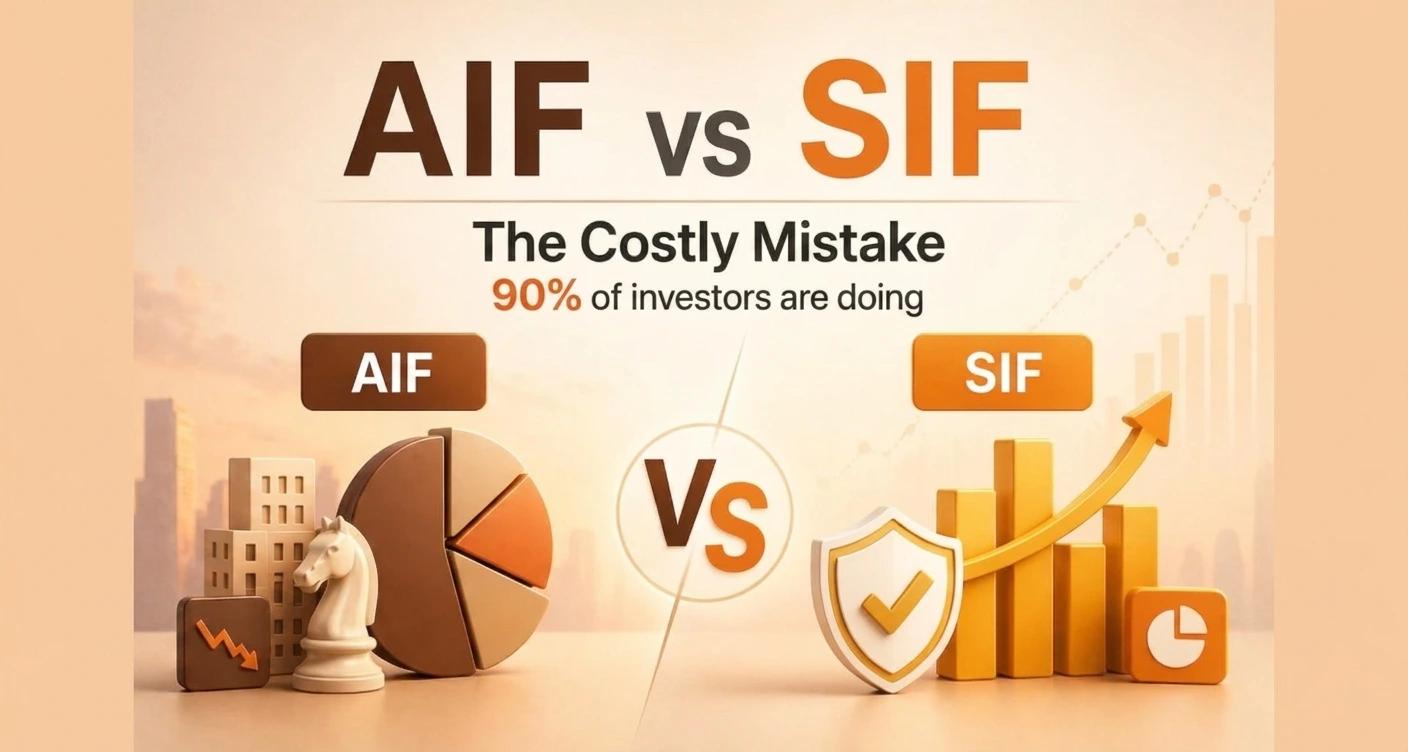
SIF vs AIF: Decoding India’s Next Wealth-Building Frontier
There is a huge wealth transition happening in India right now, and it is completely bypassing the stock market.
For years, the serious money, private equity, venture capital, distressed assets, was locked behind a rigid, ₹1 Crore paywall. But suddenly, the Indian wealth management space is buzzing with a new acronym Invest in SIF.
Naturally, high-net-worth investors are aggressively searching one specific query: Is a SIF just a cheaper AIF, generally SIF vs AIF info?
The short answer is no. The long answer is a structural shift in how SEBI wants affluent India to invest. If you are trying to decide where to park your next ten or fifty lakhs and are confused between two vehicles, it will cost you.
Let’s make things clear. Here's the unfiltered reality about SIF vs AIF, and exactly which one fits your portfolio architecture.
Table of Contents
Click to Expand
- What is Specialized Investment Fund (SIF)
- What is Alternative Investment Fund (AIF)
- Why is SEBI reshaping the rules now
- The Core Difference: Assets vs Strategies
- The Heavyweight: How AIFs Actually Work
- The New Guard: Decoding the SIF
- SIF vs AIF: The Head-to-Head Breakdown
- The Regulatory Compliance Check
- The Taxation Reality Check
- Where Does Your Capital Belong?
- Frequently Asked Questions
- The Final Conclusion
What is Specialized Investment Fund (SIF)
A Specialized Investment Fund is a newly proposed SEBI framework investment vehicle that allows affluent investors to access complex, institutional-grade strategies (like long-short equity and derivatives arbitrage) within the listed markets.
What is Alternative Investment Fund (AIF)
An Alternative Investment Fund is a privately pooled vehicle regulated by SEBI that invests your money into unlisted, high-growth assets like startups, private equity, and real estate. Explore complete guide on AIF
Why is SEBI reshaping the rules right now?
You cannot understand the SIF without understanding the crisis it was born from.
The trigger isn't theoretical. Indian retail investors lost a staggering ₹51,689 crore in F&O trading in 2023-24 alone. Investors are desperately seeking "alternative" returns but are getting destroyed using complex derivatives on their own.
SEBI’s introduction of the SIF framework is a direct surgical strike. The regulator wants to give affluent investors access to institutional-grade hedging and arbitrage strategies, but inside a regulated, fund-managed wrapper. The SIF is designed to absorb that speculative hunger and channel it into sophisticated, risk-managed investing.
The Core Difference: Buying Companies vs. Executing Strategies
Alternative Investment Fund (AIF) can be seen as a buying club. Investors club together funds to purchase actual physical assets, usually unlisted companies, real estate, startups, etc.
Essentially, you would be owning the asset.
On the contrary, Specialized Investment Funds (SIFs) is an execution machine. SIF was devised by SEBI to help high-net-worth individuals engage in complex investment strategies such as long-short equity, arbitrage, and structured derivatives without the need for purchasing unlisted companies.
It is important to recognize that while AIFs are found in the realm of unlisted assets, SIFs remain within the realm of listed securities using institutional methods.
The Heavyweight: How AIFs Actually Work
Regulated tightly under SEBI’s 2012 framework. Alternative Investment Funds are the undisputed heavyweights of private wealth.
If you invest in a Category II AIF (the most popular bucket for private equity and credit), you are handing your money to a fund manager who goes out and buys a 15% stake in a mid-sized manufacturing company, or lends money to a real estate developer at a high interest rate.
The Mechanics:
- Minimum Ticket: ₹1 Crore. No exceptions. (Extended to ₹25 Lakhs only for employees/directors of the fund).
- Lock-in: Brutally illiquid. Expect your money to be locked away for 5 to 7 years. You cannot just hit "sell" on an app.
- The Payoff: You are hunting for absolute, market-independent returns. If the unlisted company goes public or gets acquired, you make significant gains.
Real-World AIF Example:
Imagine an AIF buys a minority stake in a quick-commerce logistics startup in 2021 for ₹50 Crores. The fund holds it for four years. The startup goes public, and that stake is now worth ₹200 Crores. The AIF distributes this profit to its investors. You didn't invest in the stock market; you invested in the building of a private enterprise.
The New Guard: Decoding the SIF
When looking at SIF vs AIF, it is crucial to understand that a SIF is not a "mini-AIF." It is a completely different beast designed for the ₹10 Lakh to ₹50 Lakh investor who wants more than just mutual fund returns, but cannot afford the ₹1 Crore AIF ticket.
The Mechanics:
- Minimum Ticket: Expected to be around ₹10 Lakhs. This is the ultimate democratizer.
- What it CAN do: Run complex long-short strategies, invest in structured products, use derivatives for hedging, and allocate to InvITs/ReITs.
- What it CANNOT do: SEBI explicitly restricts SIFs from investing in unlisted companies. They cannot borrow heavily (leverage is capped strictly at 2x). They cannot do naked short selling.
Real-World SIF Example:
Instead of buying an unlisted startup, a SIF fund manager might notice that Reliance Industries is trading cheaper in the futures market than in the spot market. The SIF buys the spot, sells the future, and locks in a risk-free arbitrage spread. Or, they might buy a basket of high-dividend PSU stocks and hedge against market crashes using Nifty Put options. You are trading sophisticated strategies, not buying private companies.
SIF vs AIF: The Head-to-Head Breakdown
| Feature | AIF (Alternative Investment Fund) | SIF (Specialized Investment Fund) |
|---|---|---|
| Minimum Investment | ₹1 Crore | ₹10 Lakhs (Estimated) |
| Target Investor | UHNIs, Family Offices, Institutions | Affluent Retail, Executives |
| Underlying Assets | Unlisted equity, private credit, real estate | Listed equities, derivatives, InvITs, structured notes |
| Liquidity | Highly Illiquid (5-7 years locks) | Higher liquidity (monthly/quarterly redemption windows expected) |
| Leverage | Varies by category | Capped strictly at 2x |
| Risk Profile | High business/execution risk | Market risk, but structurally hedged |
The Regulatory Compliance Check
Under the stringent SEBI Alternative Investment Funds Regulations, 2012, AIF compliance is built like an iron cage specifically to protect users from the brutal illiquidity of private markets.
To launch an AIF, managers must pass aggressive "fit and proper" due diligence, proving deep track records in private equity or unlisted debt.
The ultimate user safety net here is the mandatory skin-in-the-game rule: SEBI forces sponsor to invest a minimum of 2.5% of the corpus or ₹5 Crores of their own money, ensuring they bleed alongside investors if a private deal fails.
Furthermore, strict quarterly SEBI filing mandates and independent valuations leave zero room for the fund manager to hide toxic, illiquid assets on their books.
Conversely, the proposed SEBI framework for SIFs shifts the compliance focus toward shielding investors from market volatility and excessive leverage.
Because SIFs execute complex derivative strategies within the listed ecosystem, SEBI has instituted a hard-coded safety ceiling: a strict 2x leverage cap.
The Taxation Reality Check
When evaluating the SIF vs AIF frameworks, this is where the structural difference hits the investor's pocket.
AIFs enjoy "pass-through" status. The fund itself pays zero tax.
If the AIF invests in an unlisted company and you sell your units after 3 years, you pay a flat 20% Long-Term Capital Gains (LTCG) with the benefit of indexation.
SIFs, because they deal heavily with listed securities and derivatives, will likely attract standard mutual fund tax rates.
Where Does Your Capital Belong?
Looking at internal Vestbox data, we see a distinct behavioral split among serious investors.
Those allocating to AIFs treat it as a replacement for direct real estate or business ownership.
Those looking at SIFs are usually frustrated equity investors.
Choose an AIF if:
- You have ₹1 Crore in truly idle capital.
- You already have a heavily diversified listed portfolio and need unlisted exposure.
- You have the temperament to wait 7 years for a payout.
Wait for a SIF (or allocate to early ones) if:
- You have ₹10-50 Lakhs to deploy.
- You want institutional-grade derivative strategies without managing it yourself.
- You require some degree of liquidity to exit if your life circumstances change.
Frequently Asked Questions: AIF vs SIF
Is a SIF safer than an AIF?
Yes, structurally. SIFs operate in the listed, heavily regulated market with strict leverage caps (maximum 2x). AIFs carry the brutal execution risk of funding unlisted, early-stage businesses.
Can I invest ₹10 Lakhs in an AIF?
Legally, no. The ₹1 Crore minimum mandate by SEBI for AIFs is non-negotiable for external investors.
Will SIFs replace Mutual Funds?
No. Mutual funds are vanilla, long-only products meant for steady, benchmark-linked wealth creation.
Which has better taxation: AIF or SIF?
AIFs generally have the upper hand due to "pass-through" status.
Can I invest in both AIF and SIF at the same time?
Yes. Sophisticated investors use AIFs as a long-term wealth engine, while allocating a smaller portion to SIFs.
The Final Conclusion
Ultimately, understanding the SIF vs AIF difference comes down to this:
The introduction of SIFs is not a threat to AIFs; it is a much-needed expansion of the Indian wealth matrix. AIFs will remain the gold standard for accessing the unlisted, wealth-creating engine of India. SIFs will become the ultimate tool for affluent investors to squeeze alpha out of the listed markets using institutional tactics. Understand the boundary. Don't force the fit. If you want to own the company, write the ₹1 Crore cheque for an AIF. If you want to outsmart the market with advanced, regulated strategies, the SIF is your upcoming playground.
Explore more with us: What is SIF? Specialized Investment Fund Meaning, Strategies, Benefits, & Rules.
Disclaimer
Mutual fund investments are subject to market risks. Read all scheme-related documents carefully. Please consult a certified financial advisor before making any investment decisions.
Trust & Compliance
This article has been created following our strict Editorial Policy. We believe in complete transparency regarding how we operate; you can read our Disclosures. For legal liabilities and risk factors, please review our Disclaimer.
Share & Save Article
Other Posts

How to Fund Your ESOP Exercise: Loans vs. Selling Investments
Aug 11, 2026

How to Sell Unlisted ESOPs in India: Guide to Cashing Out Early
Aug 6, 2026

Creating Wealth with ESOPs: Steps You Actually Need to Take
Aug 6, 2026
How to Check Income Tax Refund Status Online: A Complete Guide
Jul 18, 2026
