SIF Taxation & Fee Structures in India: The Complete Guide

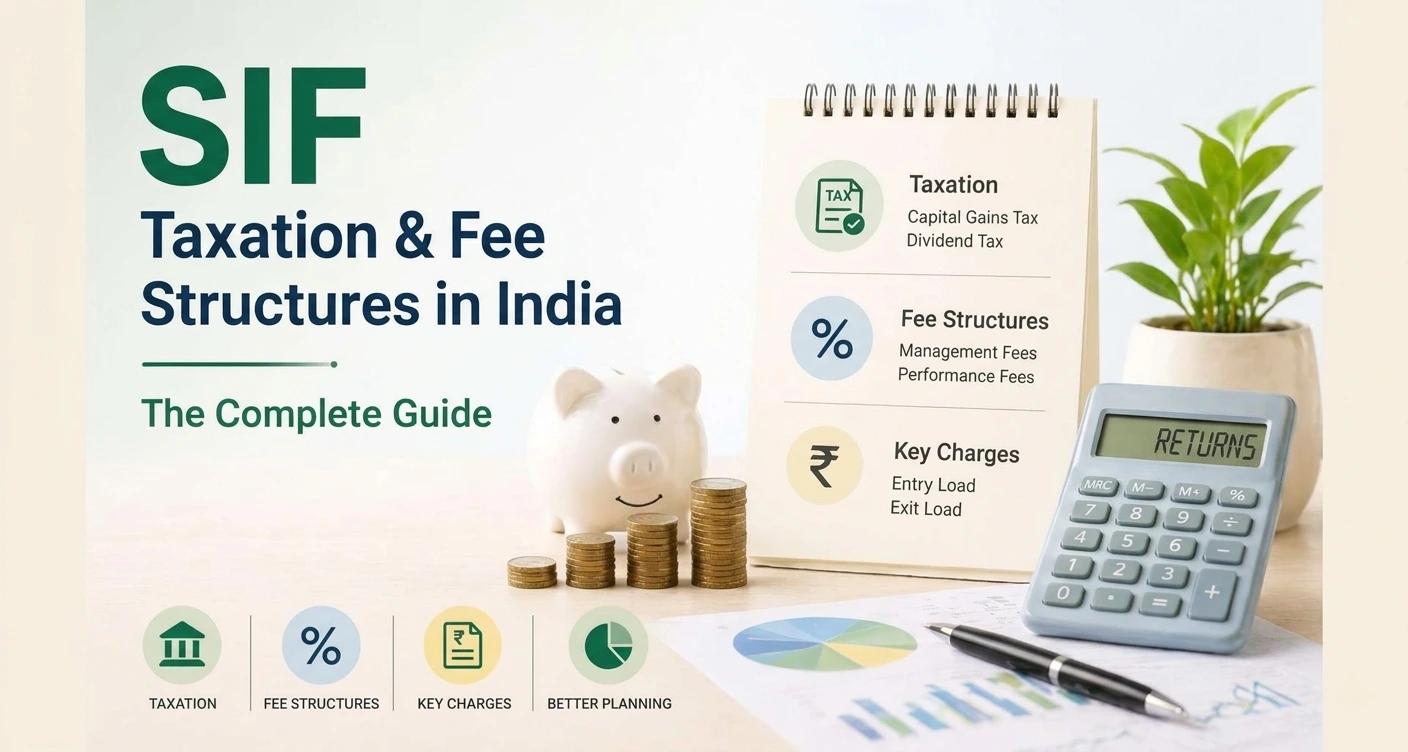
Table of Contents
Click to Expand
- The Silent Assassins of Wealth
- The Performance Fee Reality Check: Why You Should Want to Pay It
- Management Fees vs. Total Expense Ratio (TER)
- Uncovering the "Hidden" Friction Costs
- SIF Taxation: The Critical 65% Equity Rule
- The "Slab-Rate" Trap in Derivative Funds
- SIF vs PMS vs AIF: The Post-Tax Bloodbath
The Silent Assassins of Wealth
Taxes and fees do not care about your market genius.
You can spend months researching the perfect fund manager, predict a macroeconomic shift, and generate a brilliant 15% return on your capital. But if you don't understand the fee structure and tax matrix of your product, the government and the AMC will quietly siphon off half your profits.
Before you start your SIF investment journey, you must memorize this page. Most investors ignore this stuff until tax season, and by then, it’s too late to fix.
The Performance Fee Reality Check
When retail investors see a "Performance Fee" on an SIF factsheet, they panic. They are conditioned to believe that a 1.5% flat mutual fund fee is "cheap," and a 10-20% performance fee is a "rip-off."
Let’s flip that narrative.
The Mutual Fund Scam: You invest ₹50 Lakhs in a standard large-cap fund. The market crashes 20%. You lose ₹10 Lakhs. Did the AMC reduce your fees because it failed to protect your money? No. They still deducted their 1.5% management fee from your remaining balance. You paid them to lose your money.
The SIF Alignment: A SIF charges a base management fee and performance fee (usually 10-20% of the profits generated above a specific hurdle rate, such as the T-Bill rate). If the SIF doesn't make you money, or if it loses money, the manager gets zero performance fee.
You aren't paying extra; you are buying absolute alignment of interest. The manager only eats if you eat.
Management Fees vs. Total Expense Ratio (TER)
Under SEBI guidelines on mutual fund expense ratios, SIFs are capped at a certain TER limit based on their AUM (Assets Under Management). But TER only tells half the story.
In standard mutual funds, turnover is relatively low. In SIFs—especially Arbitrage or DeltaNeutral strategies—the fund manager might execute thousands of derivative trades a day.
This creates a gap between the "Gross Return" (what the strategy makes before costs) and the "Net Return" (what hits your dashboard). Always look at the Net TER, and ask your distributor for the historical gross-to-net slippage of the specific SIF strategy.
Uncovering the "Hidden" Friction Costs
In the derivative world, the advertised brokerage is irrelevant. The real costs are hidden in the microseconds of execution:
- Slippage: The difference between the price the algorithm wants to buy at and the price at which it actually fills. In a volatile market, a millisecond of delay can cost basis points.
- Bid-Ask Spread: If a futures contract has a buyer at ₹100 and a seller at ₹100.10, the fund effectively loses ₹0.10 the second it enters the trade.
Institutional SIFs use co-located servers (computers sitting physically inside the NSE building) to minimize this. Retail-friendly SIFs that use standard broker APIs will have higher friction costs, directly reducing your absolute returns.
SIF Taxation: The Critical 65% Equity Rule
This is the most important section of this blog. SIF taxation is not a fixed category dictated by SEBI. It is entirely dictated by the underlying assets the fund holds daily.
Rule 1: Equity-Oriented SIF (Domestic Equity > 65%). If the fund maintains an average of more than 65% of its net assets in Indian equity and equity-related instruments, it gets highly favorable taxation under Income Tax Act Section 112A:
- Short-Term Capital Gains (STCG): If you sell before 12 months, you pay 20% tax on the profits.
- Long-Term Capital Gains (LTCG): If you sell after 12 months, you pay 12.5% tax on profits exceeding ₹1.25 Lakhs in a financial year.
Rule 2: The "Slab-Rate" Trap (Domestic Equity < 65%). If the fund uses heavy arbitrage, holds too much debt, or uses complex derivatives that SEBI doesn't classify as "equity instruments" for tax purposes, the tax structure flips to debt-fund rules.
Your returns are added to your total income and taxed at your personal income tax slab rate.
The "Slab-Rate" Trap in Derivative Funds
This is where sophisticated HNIs lose thousands of crores.
A classic "Market-Neutral" or "Arbitrage" SIF might aim for a steady 9% return. An investor in the highest tax bracket looks at that 9%, mentally calculates the 12.5% LTCG tax, and thinks they are making a great post-tax return.
But because many arbitrage strategies hold a massive chunk of their capital in cash or cashequivalent derivatives (which do not count toward the 65% equity rule), the fund fails the equity taxation test.
Suddenly, that 9% return is taxed at 30% (plus surcharge). You are left with a post-tax return of roughly 6.2%. You would have been better off putting the money in a simple Bank FD rather than dealing with complexity.
Vestbox Data Case Study: We recently intercepted a client who was about to move ₹30 Lakhs into a multi-asset arbitrage SIF because it advertised "9% stable returns." Upon auditing the factsheet, we realized its equity exposure hovered around 45%. We stopped the transaction. Had he invested, his post-tax return would have been crushed by the 30% slab rate. We redirected him to an equity-oriented long/short SIF that maintained a 75% equity tilt, securing the 12.5% LTCG rate.
SIF vs PMS vs AIF: The Post-Tax Bloodbath
Why does SIF win the tax game?
- PMS Taxation: PMS is taxed like equity investments. But because portfolios are customized, you cannot aggregate your holdings across different stocks to optimize the ₹1.25 Lakh LTCG exemption. Every stock is taxed individually. If you have 20 stocks in PMS, you likely lose out on thousands in LTCG exemptions. SIFs, being a pooled structure, aggregate perfectly.
- AIF Taxation: Category III AIFs often suffer from "double taxation." The trust might pay tax on certain derivative gains at the fund level, and then distribute the remaining to you, where you are taxed again as business income or capital gains. It is a structural nightmare.
SIFs benefit from the clean, pass-through, pooled mutual fund taxation structure. No double taxation. Perfect aggregation of exemptions.
The Final Word
Fees are the cost of entry. Taxes are the cost of exit. A brilliant strategy wrapped in a high-fee, high-tax structure is a net loser's game.
Before you write the cheque for an SIF, demand three documents: The Scheme Information Document (SID), the latest factsheet showing exact derivative exposure, and a clear written confirmation from the AMC stating whether the fund qualifies for Equity Taxation (Section 112A) or Debt Taxation (Slab Rate).
If they hesitate to provide those, walk away.
Don't let the taxman be your unofficial business partner. Structure your defense before you deploy your capital.
Learn what SIFs are and how they work before looking at taxes. Explore the complete guide to Specialized Investment Funds (SIF).
Disclaimer
Mutual fund investments are subject to market risks. Read all scheme-related documents carefully. Please consult a certified financial advisor before making any investment decisions.
Trust & Compliance
This article has been created following our strict Editorial Policy. We believe in complete transparency regarding how we operate; you can read our Disclosures. For legal liabilities and risk factors, please review our Disclaimer.
Share & Save Article
Other Posts
What is Portfolio at Risk? A Complete Guide to Meaning, Formula, Calculation, & Benefits.
Jun 5, 2026

What is SIP & How Does It Actually Work?
May 27, 2026

What is an AMC in Mutual Funds? Understanding Asset Management Companies
May 27, 2026

How PMS Works: A Complete Guide to Construction, Monitoring, and Reporting
May 27, 2026
