Decoding SIF Strategies: How Long-Short, Arbitrage & Derivatives Work

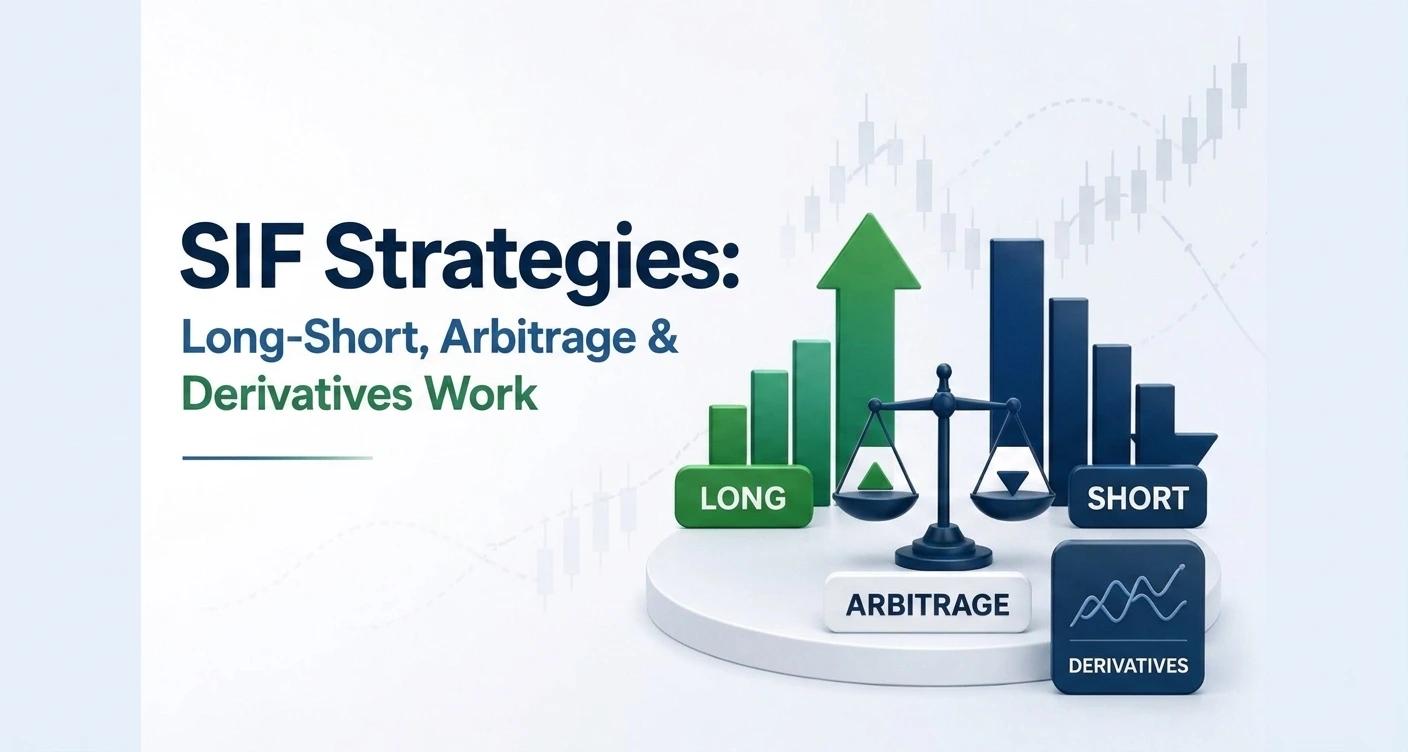
Table of Contents
Click to Expand
The "Alpha" Illusion
Stop using the word "Alpha" if you mean "high returns."
Buying a small-cap stock right before a rally and making 30% isn't alpha; that is just taking more risk (beta) and getting lucky. True alpha is generating returns that have absolute zero correlation to the Nifty 50. It is making money when the market is flat. It is protecting capital when the market is bleeding.
To Invest in SIF strategies first step is to understand how elite fund managers manufacture returns using pure mathematics, not market momentum.
Let’s tear down the three primary engines that power Specialized Investment Funds.
Long/Short Equity: The Offensive Shield
This is the most common, intuitive architecture in the SIF space. It is designed for investors who want to participate in the upside of the Indian growth story but refuse to accept the full downside of a crash.
The Mechanics:
The fund manager identifies a high-conviction theme—say, the transition to electric vehicles in India. They go "Long" (buy) top-tier battery manufacturers. But they don't stop there. To mathematically neutralize sector risk, they simultaneously go "Short" (sell) legacy auto companies that are losing market share.
If the broader auto sector declines due to a global supply chain disruption, your long positions take a hit. But your short positions surge in value, acting as an airbag. You are hedged.
The Vestbox Reality:
During a recent period of sharp decline in the IT sector due to global banking fears, standard IT mutual funds fell sharply. However, Vestbox data shows that SIFs running paired long/short IT strategies restricted their drawdowns to a fraction of the index.
They shorted fundamentally weak IT service providers, offsetting the damage to their strong core holdings.
The Regulatory Wall:
Why doesn't your standard mutual fund do this? Under SEBI Mutual Fund Regulations 1996, standard equity schemes are strictly mandated to be "long-only." They are legally prohibited from holding short positions or writing derivatives for hedging.
Market-Neutral Arbitrage: Extracting the Spread
Arbitrage is the closest thing to a mathematical free lunch in finance. It does not care if the Nifty goes up, down, or sideways. It cares only about pricing inefficiencies between two linked markets.
The Mechanics:
In the Indian stock market, the "Futures" price of a stock is almost always slightly higher than its "Cash" (regular) market price. This difference is called the "contango."
An arbitrage SIF will buy Reliance in the cash market at ₹2,500 and simultaneously sell its futures contract at ₹2,520. When the contract expires, the cash and futures prices must perfectly merge. The fund pockets that ₹20 risk-free.
Multiply this across thousands of crores of capital and dozens of stocks, and it generates a steady, FD-like return.
The Retail Trap:
If this is so easy, why don't retail investors do it? Because of friction. Brokerage charges, STT (Securities Transaction Tax), and slippage (the difference between expected price and actual execution price) eat up that ₹20 profit for a retail trader.
SIFs operate at the institutional scale. Vestbox algorithmic execution models show that by negotiating near-zero brokerage and using high-frequency servers to eliminate slippage, an institutional arbitrage SIF can capture these microscopic spreads and compound them into a reliable 8-9% annualized return, completely insulated from market crashes.
Delta-Neutral Strategies: Getting Paid for Volatility
This is the most advanced and aggressive method in SIF. It is not for beginners. Delta-neutral funds don't bet on stock prices; they bet on human psychology (fear).
The Mechanics:
In options trading, "Delta" measures how fast an option's price will move compared to the underlying stock. A delta-neutral manager buys and sells a complex web of call and put options so their net exposure to market direction is exactly zero.
Why do this? Because when people panic, options get insanely expensive. The SIF acts as the "insurance company." They construct strategies (like Iron Condors) that allow them to collect a massive upfront premium.
As long as the market stays within a predictable wide range, the options expire worthless, and the SIF keeps the premium as pure profit.
The Brutal Reality:
Delta-neutral is psychologically brutal to manage. If a sudden "Black Swan" event occurs (such as a surprise geopolitical conflict), the market gaps down violently.
The insurance the SIF sold suddenly becomes a massive liability. The manager must aggressively buy back options at a loss to reset their delta to zero. It requires supercomputers and split-second execution to survive sudden market gaps.
High-Conviction vs. Diversified SIFs
How a fund manager applies these strategies depends on their philosophy:
- High-Conviction SIFs: The manager runs a highly concentrated portfolio of 15-20 stocks. The long/short hedges are aggressive. The potential for massive alpha is high, but the stock-picking risk is elevated.
- Diversified SIFs: The manager runs a broader portfolio of 60-80 stocks. They use derivatives to manage the overall beta (market exposure). The returns are smoother and more predictable.
The True Role of Derivatives in SIF Portfolios
Retail investors use derivatives to gamble on direction. Institutional SIF managers use derivatives as surgical tools to transfer risk from your portfolio to someone else's.
They don't buy options hoping the market crashes so they get rich. They buy options to ensure that if the market crashes, their equity capital remains intact.
A standard mutual fund manager is essentially driving a car with no brakes, hoping the road stays smooth forever. A SIF manager installs aerospace-grade braking systems to navigate tight turns at high speeds.
If you are still trusting your wealth to a vehicle without brakes, it’s time to upgrade your architecture.
Want the full overview of SIFs, regulations, and benefits? Explore the complete guide to Specialized Investment Funds (SIF).
Disclaimer
Mutual fund investments are subject to market risks. Read all scheme-related documents carefully. Please consult a certified financial advisor before making any investment decisions.
Trust & Compliance
This article has been created following our strict Editorial Policy. We believe in complete transparency regarding how we operate; you can read our Disclosures. For legal liabilities and risk factors, please review our Disclaimer.
Share & Save Article
Other Posts
What is Portfolio at Risk? A Complete Guide to Meaning, Formula, Calculation, & Benefits.
Jun 5, 2026

What is SIP & How Does It Actually Work?
May 27, 2026

What is an AMC in Mutual Funds? Understanding Asset Management Companies
May 27, 2026

How PMS Works: A Complete Guide to Construction, Monitoring, and Reporting
May 27, 2026
