SIF Portfolio Allocation: How Much Should HNIs Actually Invest?

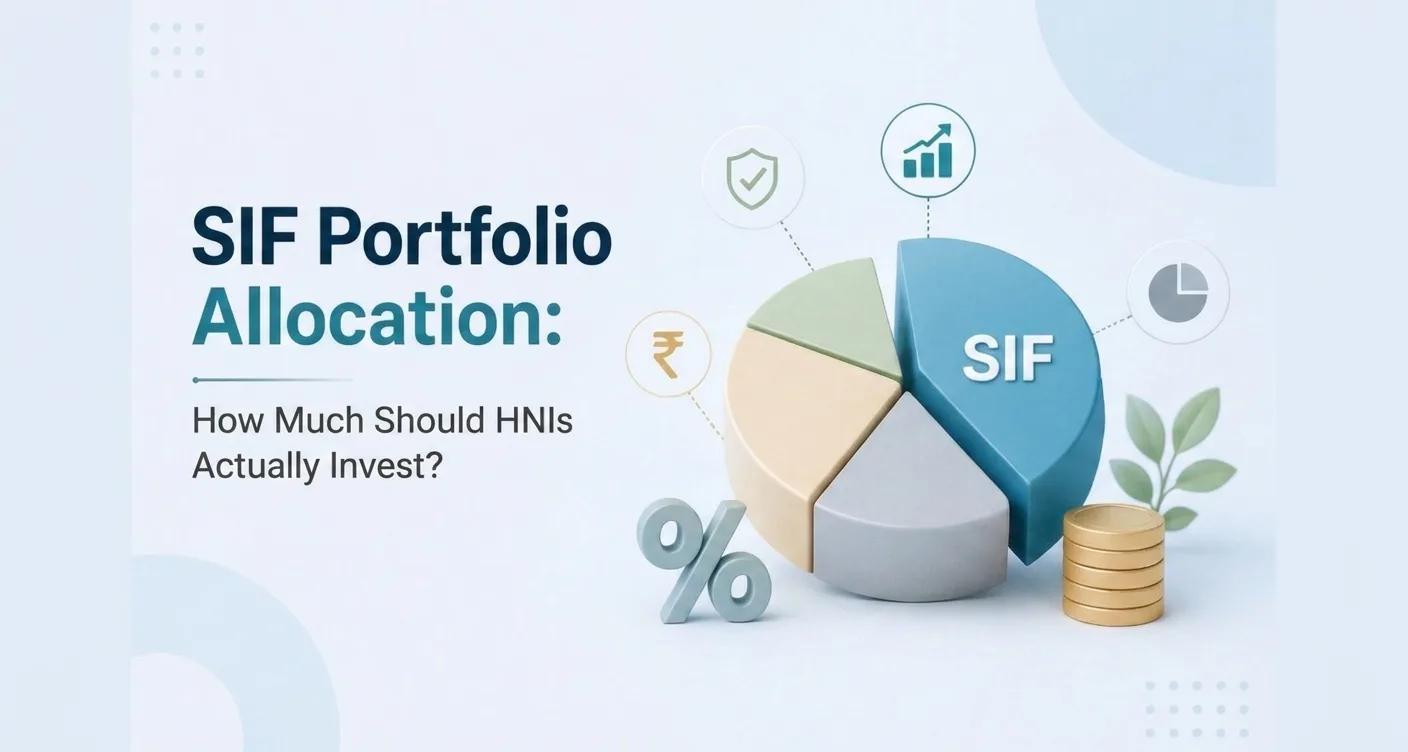
Table of Contents
Click to Expand
- The HNI Self-Assessment: Should You Even Look at SIFs?
- The Core-Satellite Architecture: The Only Way to Build Wealth
- How Much Allocation Should You Give to SIFs? (The Math)
- Can SIFs Replace Your Core Portfolio?
- Combining SIFs with Mutual Funds & Direct Equity
- The Vestbox Case Study: The "Shock Absorber" Effect
Not everyone deserves a seat at this table.
The ₹10 Lakh SEBI-mandated entry point is a financial barrier, but not the only one. Having the money does not mean you have the right psychological profile or portfolio maturity to deploy complex derivative strategies.
If you want to upgrade to HNI-level SIF investing, you must first pass a brutal self-assessment.
Putting specialized funds into an unbalanced portfolio is like putting Formula 1 tires on a family sedan; it won't make you faster; it will make you crash.
The HNI Self-Assessment: Should You Even Look at SIFs?
Under SEBI Investment Advisers regulations, advisors are mandated to ensure "suitability" before recommending complex products. Here is the exact suitability checklist you should apply to yourself. If you fail even one of these, do not invest in a SIF yet.
- Do you have a separate emergency fund and zero high-interest debt? If a medical emergency forces you to break a SIF during a derivative lock-in period, you will lose money.
- Do you already have a core mutual fund/stock portfolio of at least ₹20-30 Lakhs? SIFs are the dessert, not the main course. You cannot build a foundation out of complex derivatives.
- Do you understand basic options mechanics? You don't need a math degree, but if you don't understand the difference between buying a put option and writing a covered call, you will panic when you see the monthly SIF factsheet.
If you answered yes to all three, you are ready to understand allocation.
The Core-Satellite Architecture: The Only Way to Build Wealth
Modern wealth management does not rely on picking one "perfect" fund. It relies on architecture.
According to leading industry metrics like the CRISIL HNI wealth report, wealthy individuals who survive multiple market cycles don't concentrate their bets; they compartmentalize them using the Core-Satellite model:
- The Core (70%-80%): This is your boring, stable wealth engine. Index funds, large-cap mutual funds, sovereign gold bonds, and fixed income. Its job is to capture India's long-term economic growth with minimal stress.
- The Satellite (20%-30%): This is your alpha generator. Small-cap funds, direct equity, and Specialized Investment Funds. Its job is to generate absolute returns, provide downside hedging, and boost the overall portfolio's risk-adjusted returns.
How Much Allocation Should You Give to SIFs? (The Math)
Vestbox data strictly recommends capping your SIF allocation at 10%-20% of your total liquid net worth.
Why not more? Because of "Tail Risk." Even with perfect hedging, SIFs operate in the derivative market. If a black swan event occurs (e.g., the stock exchange shuts down for a week or extreme, sudden regulatory changes to margin requirements), even the best mathematical model can suffer temporary liquidity squeezes.
If you put 80% of your net worth into a SIF and a rare liquidity squeeze happens, you lose sleep. If you put 15% of your net worth into an SIF, a liquidity squeeze is just a minor blip on your radar. You want your SIF allocation to be large enough to impact your returns, but small enough that it never impacts your heartbeat.
Can SIFs Replace Your Core Portfolio?
No. Absolutely not.
This is the second most common mistake HNIs make (the first is ignoring taxation). An investor sees a SIF deliver a flat 12% during a market crash while their mutual funds drop 15%. They think: "SIFs are better! I should put all my money in SIFs!" Here is why that is financial suicide:
Opportunity Cost.
SIFs cap their upside to protect their downside. If the Indian market enters a structural bull run and the Nifty delivers 20% CAGR over three years, a heavily hedged SIF might only deliver 11-13%. By putting 100% of your money in SIFs, you are willingly choosing to underperform a raging bull market.
You need your Core mutual funds to capture that 20% bull market. You need your Satellite SIFs to ensure you don't give back 40% of those gains in the subsequent crash.
Combining SIFs with Mutual Funds & Direct Equity
How do these assets actually interact in a real portfolio? They must have different, non-overlapping purposes.
- Direct Equity (10-15%): For bets that you really believe in and that could make you a lot of money. You accept 100% volatility for 300% potential upside.
- Core Mutual Funds (50-60%): For compounding wealth steadily. You accept normal market volatility.
- SIF Allocation (15-20%): For mathematical defense. You use Long/Short SIFs to hedge your overall equity exposure and Arbitrage SIFs to park cash efficiently rather than in low-yield savings accounts.
The Vestbox Case Study: The "Shock Absorber" Effect
Let’s look at how this architecture plays out under extreme stress.
The Client:
A 40-year-old tech executive. Total liquid corpus: ₹1 Crore.
The Setup:
- Core MFs: ₹70 Lakhs
- Direct Equity: ₹15 Lakhs
- SIF (Long/Short Strategy): ₹15 Lakhs
The Event:
A sudden global macro shock hits. The market drops 18% in a violent, V-shaped crash.
The Math:
- His Core Mutual Funds dropped roughly 16% (Loss: ₹11.2 Lakhs)
- His Direct Equity drops 22% (Loss: ₹3.3 Lakhs)
- His SIF drops 2% due to the derivative hedging kicking in flawlessly (Loss: ₹30,000)
Total Portfolio Loss without SIF: ₹14.5 Lakhs (A 14.5% drawdown. Painful. Panic-inducing.)
Total Portfolio Loss with SIF: ₹14.8 Lakhs (Wait, the loss is slightly higher? Yes, because the SIF has a slight hedging drag in normal times. But look at the psychology.)
The Real Result: Because the client had a SIF acting as a structural shock absorber, he didn't panic. He didn't call his advisor screaming to sell everything. He understood that his downside was mathematically contained.
Because he didn't panic-sell his Core MFs at the bottom, his entire portfolio recovered to an all-time high when the market rebounded 25% over the next eight months.
The SIF didn't save his portfolio mathematically; it saved his portfolio psychologically. And in investing, psychology is everything.
The Final Word
Stop looking for a single "super fund" to solve all your problems. Wealth is not built by picking the best product; it is built by assembling the best architecture.
Allocate your core. Protect your downside. Let the compounding do the heavy lifting.
You don't build a skyscraper out of shock absorbers. You build the skyscraper out of steel and install shock absorbers in the foundation to keep it standing during an earthquake.
New to this asset class? Explore the complete guide to Specialized Investment Funds (SIF).
Disclaimer
Mutual fund investments are subject to market risks. Read all scheme-related documents carefully. Please consult a certified financial advisor before making any investment decisions.
Trust & Compliance
This article has been created following our strict Editorial Policy. We believe in complete transparency regarding how we operate; you can read our Disclosures. For legal liabilities and risk factors, please review our Disclaimer.
Share & Save Article
Other Posts
What is Portfolio at Risk? A Complete Guide to Meaning, Formula, Calculation, & Benefits.
Jun 5, 2026

What is SIP & How Does It Actually Work?
May 27, 2026

What is an AMC in Mutual Funds? Understanding Asset Management Companies
May 27, 2026

How PMS Works: A Complete Guide to Construction, Monitoring, and Reporting
May 27, 2026
