Large Cap vs Mid Cap vs Small Cap Mutual Funds: The Allocation Playbook

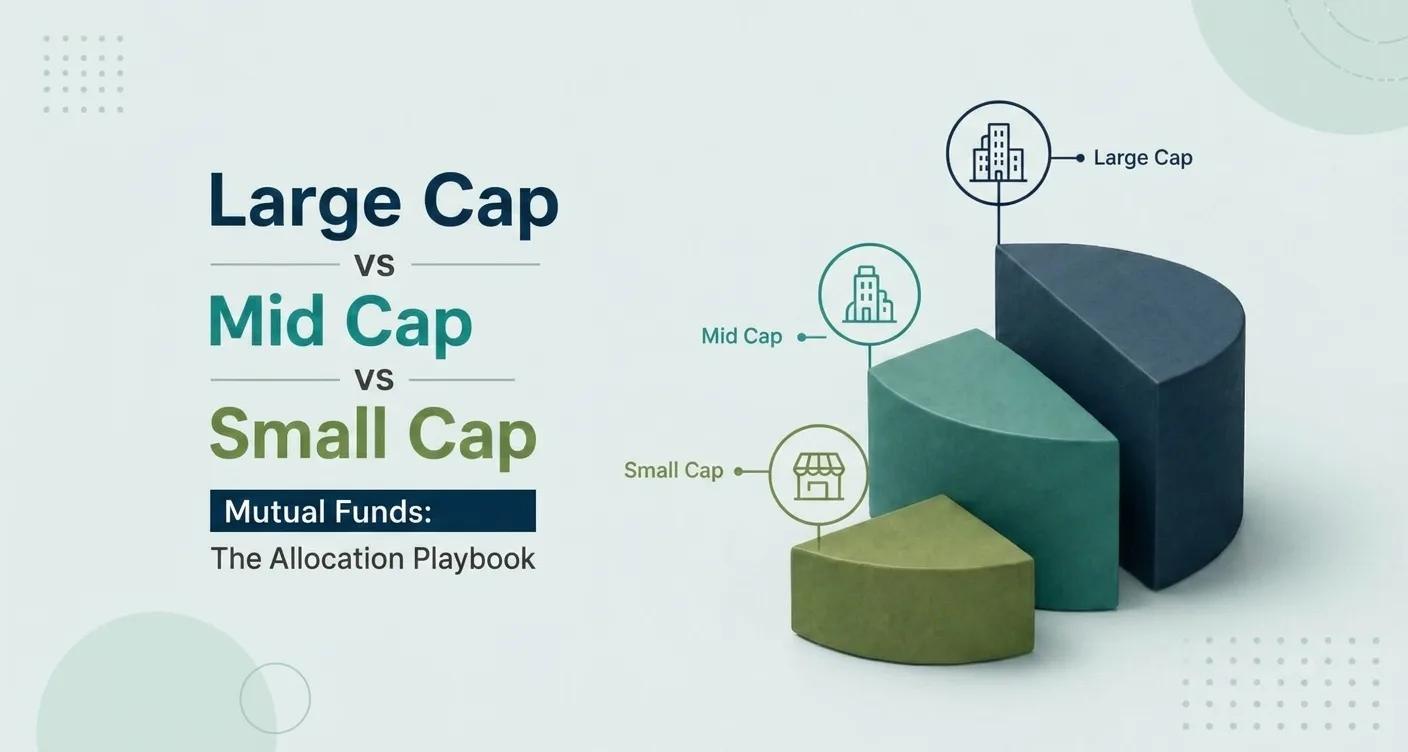
Table of Contents
Click to Expand
Let’s destroy the most dangerous habit in retail investing: Picking a mutual fund based solely on last year’s return chart.
You look at a spreadsheet, see a Small Cap fund that returned 45%, and compare it to a Large Cap fund that returned 12%. Your brain immediately calculates: "The Small Cap fund is better."
It’s not. It’s just taking a completely different class of risk. Treating all equity mutual funds as a single asset class is like treating a Formula 1 car and an armored truck as the same because they both have engines.
If you are ready to move past basic categories and analyze actual funds based on these risk profiles, you can compare top-rated equity mutual funds directly on the Vestbox platform. But first, to understand the basics of mutual fund types, you have to look beyond returns and examine the underlying architecture.
Let’s rip apart the equity spectrum.
Large Cap: The Unshakeable Bedrock
Large-cap funds are the heavyweights of the Indian economy. Under SEBI categorization of mutual funds, these funds are legally mandated to invest at least 80% of their money in the top 100 companies by market capitalization.
Think Reliance, HDFC Bank, TCS, Infosys.
The Mechanics: These are mature, monopolistic, or duopolistic businesses. They have predictable cash flows, massive moats, and survive economic downturns without breaking a sweat.
The Reality: Large-cap funds will not make you rich quickly. In a raging bull market, they will feel incredibly boring. They are the armored trucks of your portfolio, slow, steady, and built to survive crashes.
Mid Cap: The Optimal Growth Engine
Mid-cap funds operate in the 101st to 250th company bracket. This is the "Goldilocks" zone of the Indian stock market.
These are companies that are beyond the startup stage. They have market share, proven business models, and access to capital, but still have enormous room to scale in India’s tier-2 and tier-3 cities.
The Mechanics: They offer a brilliant balance. They are significantly less volatile than small caps, but offer much higher growth potential than large caps.
The Vestbox Data Reality: When we audit multi-year rolling returns, consistently profitable mid-cap portfolios often deliver the best risk-adjusted returns. They capture enough of the upside to accelerate compounding aggressively, but don't fall off a cliff during market corrections.
Small Cap: The Asymmetric Rocket Fuel
Small-cap funds invest in companies ranked 251st and below.
Let’s be brutally clear: Investing in small caps is not traditional investing. It is a publicly traded venture capital firm. You are betting on unproven management teams, niche regional businesses, and highly illiquid stocks.
The Mechanics: Because these companies are small, even a tiny amount of institutional buying can send the stock price soaring 3x or 5x. Conversely, a minor negative rumor can cause a 40% crash in a single week because there are no buyers to absorb the selling pressure.
Flexi-Cap: The Manager’s Playground
Flexi-cap funds have no SEBI mandate restrictions. The manager can allocate 100% to large-cap stocks, 100% to small-cap stocks, or any combination thereof.
Retail investors love them because they feel safe. “The manager will just move to safety if a crash happens!”
Wrong. Giving a fund manager total freedom is actually much riskier for the investor. You aren't buying a strategy; you are making an absolute, blind bet on the manager's personal psychology and market-timing ability. If they get the macro cycle wrong, a flexi-cap fund can devastate your portfolio because there is no legal mandate requiring it to hold a specific safety net.
The Vestbox Stress Test: Surviving a 30% Market Crash
Theory is cheap. Let’s look at how these buckets actually behave when the market breaks.
Imagine a severe global macro shock hits the Indian markets. The Nifty drops 30%. Here is what happens to a ₹50 Lakh portfolio allocated two different ways:
The Rookie Portfolio (100% Small/Mid Cap): Your portfolio drops 40-45%. You are down ₹22 Lakhs. The psychological pain is so intense that you convince yourself, "the economy is broken." You panic-sell at the bottom, locking in permanent, life-altering losses.
The Vestbox-Structured Portfolio Suggestion (Core & Satellite):
- Core (60% - Large Cap): Drops roughly 25%. (Loss: ₹7.5 Lakhs)
- Satellite (30% - Mid Cap): Drops roughly 35%. (Loss: ₹5.25 Lakhs)
- High-Risk (10% - Small Cap): Drops 45%. (Loss: ₹2.25 Lakhs)
Total Loss: ₹15 Lakhs (A 30% drawdown, matching the market).
Look at the psychology. Because your core large-cap holding didn't collapse 50%, you didn't panic. You stayed invested. And when the market rebounded 50% over the next two years, your Mid and Small caps surged 80-100%, pulling your entire portfolio to new all-time highs.
The asset allocation didn't just save you money; it saved you from your own emotions.
The Psychological Tax of Small Caps
Many investors claim they have a "high risk appetite" until they actually experience a small-cap crash.
There is a concept we call the "Psychological Tax." If a small-cap fund drops 40%, and you lose sleep, fight with your spouse, and check the app 20 times a day, you are paying a tax that isn't reflected on your factsheet.
If a fund's volatility forces you to sell early, the theoretical high return of small caps is irrelevant.
You must self-assess: Can I watch my ₹20 Lakhs drop to ₹12 Lakhs over 8 months without logging into my brokerage account? If the answer is no, your actual risk capacity is low, regardless of what you tell your financial advisor. Stick to Large and Mid-caps.
The Institutional Allocation Rule
How much should you put where? Stop guessing and use the Vestbox framework guide:
- Wealth Preservation Phase (Market Cap heavily weighted): If you are closer to your financial goal (e.g., 5-7 years away), your portfolio should be 70% Large Cap, 20% Mid Cap, 10% Flexi Cap. Capital preservation is paramount.
- Wealth Acceleration Phase (Time is your weapon): If you are 25-35 years old with a 10+ year horizon, your portfolio should be 40% Large Cap, 35% Mid Cap, 25% Small Cap. You have the time to endure the 40% crashes to capture the 100% surges.
The Overlap Warning: Do not hold more than 6-7 equity mutual funds total. If you hold two large-cap funds, two mid-cap funds, and two small-cap funds, you aren't diversifying; you are just buying the same underlying stocks twice.
Build the architecture. Match the allocation to your timeline. Let the compounding do the heavy lifting.
Disclaimer
Mutual fund investments are subject to market risks. Read all scheme-related documents carefully. Please consult a certified financial advisor before making any investment decisions.
Trust & Compliance
This article has been created following our strict Editorial Policy. We believe in complete transparency regarding how we operate; you can read our Disclosures. For legal liabilities and risk factors, please review our Disclaimer.
Share & Save Article
Other Posts
What is Portfolio at Risk? A Complete Guide to Meaning, Formula, Calculation, & Benefits.
Jun 5, 2026

What is SIP & How Does It Actually Work?
May 27, 2026

What is an AMC in Mutual Funds? Understanding Asset Management Companies
May 27, 2026

How PMS Works: A Complete Guide to Construction, Monitoring, and Reporting
May 27, 2026
